
A South Asian in the Southwest
Episode 6 | 24m 45sVideo has Closed Captions
A federal immigration file shows how early border laws shaped the Muslim experience in the U.S.
A federal immigration file opened in 1928 shows how early border laws shaped the Muslim experience in the United States.
From
Problems playing video? | Closed Captioning Feedback
Problems playing video? | Closed Captioning Feedback
A South Asian in the Southwest
Episode 6 | 24m 45sVideo has Closed Captions
A federal immigration file opened in 1928 shows how early border laws shaped the Muslim experience in the United States.
From
Problems playing video? | Closed Captioning Feedback
Where to Watch American Muslims: A History Revealed
American Muslims: A History Revealed is available to stream on pbs.org and the PBS app.
Providing Support for PBS.org
Learn Moreabout PBS online sponsorship[western banjo music] [Asma Khalid] It's a story of South Asian Muslims in 1920s America found in a federal immigration file.
Cold words with real consequences.
[immigration official] It is the unanimous decision of the board that the alien Mir Dad be excluded from admission into the United States as an alien, ineligible to citizenship.
Technically, they were modern undocumented immigrants in the United States.
[Zareena Greweal] There are to this day racial anxieties around the browning of America or the blackening of America.
That was there at that time, too.
[Khalid] As laws kept people out, communities joined together.
Your grandma was Mexican?
-[Shamim Khan] Yes.
-Your grandpa was South Asian.
-Mm-hmm.
[Grewal] And they forged a way forward in our country without having to try to aspire to whiteness.
There was more than one way to become American.
[Khalid] I'm one of three journalists following a trail.
[Aymann Ismail] There was one of the founding fathers imagining -Muslim Americans.
-Absolutely.
[Khalid] Each of us examining a defining moment in American history.
-Strong words.
-Very powerful words.
-He wanted this mosque here... -Yes.
-...in the U.S.?
-They were all so proud of it.
[Khalid] Tracing a legacy that's coming back into view.
There's never been an America without Muslims.
[Zain Abdullah] This is not a foreign story.
It's a part of the American story.
[Khalid] Sacramento, California.
A city shaped by farming, migration and mixing.
It's home to Shamim Khan.
Oh, that was your parents marriage, yes.
Yes.
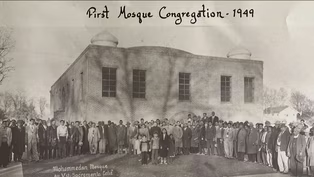
And this is the first mosque congregation in 1949.
[Khalid] Her grandfather was a Muslim man from South Asia who came to the United States over a hundred years ago.
His name was Mir Dad.
And his story takes us back to a wave of migration most people don't know about, and to the families that formed in its wake.
Your grandma was Mexican?
-[Khan] Yes.
-Your grandpa was South Asian.
-Mm-hmm.
[Khalid] What was their blended family like?
[Khan] The men in that group learned how to speak Spanish.
-So your grandpa spoke Spanish?
-Yes.
They learned it from the farms and at home.
So Spanish was the dominant language.
The food was generally a blended food.
My grandmother started making rotis.
They were very light.
We say they're the best ever.
The rice is from my dad's side of the family from Pakistan.
The beans are grandmother's beans with the Crisco oil instead of lard.
The samosas are just a treat.
After the 1960s, the new slur of folks, they introduced samosas to us.
-Ah... -Okay.
Bismillah.
[Khalid] The "new folk" Shamim mentions came after U.S.
immigration laws changed in 1965, a shift that opened the door to a new wave of South Asian arrivals.
[Vivek Bald] Until recently, the idea was that the story of South Asians in the United States didn't start until 1965, that it was predominantly Indians as opposed to Pakistanis and Bangladeshis.
But what we see when we look back farther into the late 19th century, we find a continuous and unbroken stream of migration from the parts of South Asia that were predominantly Muslim.
This starts with peddlers who settled in New Orleans and then it continues with ship jumpers.
[Khalid] Ship jumpers were sailors who slipped away from their ships in foreign ports.
Among them was a young Mir Dad.
He arrived in the United States in 1917, seven years after leaving the Punjab, then a part of British controlled India.
How did your grandpa come to the United States?
Why did he come to the U.S.?
[Khalid] There were like six or seven brothers.
They were farmers.
There wasn't a lot of money and so he told his mom one day that he has to leave.
When we look at British control in South Asia, they're not developing a local economy.
They're taking cotton making products overseas, shipping it back into India.
So there's a real pressure for South Asians when they get the opportunity to leave, to get out under this imperial control.
They try to look for that opportunity.
[Khalid] That opportunity is described by Mir Dad in a series of interviews with immigration officials.
They are preserved in his so-called alien file, the government's record on him as a non-citizen.
[immigration official] When did you leave India?
[Mir Dad] I left my home in Burhan, Punjab, India, in 1910.
I worked as a seaman out of Bombay, shipping all over the world.
[Bald] By the early 20th century, the British were employing tens of thousands of colonial laborers to do the, the most difficult, dirtiest, most industrial labor that was required for steamships.
For example, shoveling coal into the furnaces deep below the belly of the steamship.
The largest number of Indian workers on British steamships were Muslim men like Mir Dad.
[immigration official] When and where did you first enter the United States?
[Mir Dad] March 15th, 1917 at Philadelphia, Pennsylvania.
I don't remember the name of the ship.
It was a small freight boat and I worked on it as a fireman.
[immigration official] Do you remember anyone else who entered with you at that time?
[Mir Dad] There were about 60 East Indians on the boat, and 16 of us left the ship at Philadelphia.
So where did he go once he first landed in Philadelphia?
They were just walking down the street, and they needed workers for the ammunition factory because of the war.
And so they said, do you want to work for us?
And they took him immediately to the factory, he never went back to the ship.
[laughing] [Khalid] And this was what year and where?
[Khan] 1917.
[immigration official] At the time of your entry, were you inspected and duly admitted by a United States immigration officer?
[Mir Dad] No.
The captain gave us permission to visit town.
[Hardeep Dhillon] From his A-file, we know that they didn't enter through a port of entry which was legally required at that time.
And so technically they were modern undocumented immigrants in the United States.
Help me understand how he eventually makes his way all the way west.
Kismet, I guess.
There is a person that from India, and he says California has a lot of jobs in farming.
I know some folks in Fresno, they're doing grapes and so on, and they made it all the way to Fresno.
They hired a lot of Indian workers.
[Grewal] Many of these South Asian migrants, they were themselves farmers, and so many of them went westward to California and to other, and also to the Midwest, and other parts of the country, in order to have a piece of land and work, work the land, which is something that, that was a skill set that they already brought with them.
When Mir Dad is coming into California, he's coming into a South Asian community that has been there for just about a generation.
Most of these Punjabi individuals are sick.
About 10 to 12% are Muslim.
So he's coming into an established community that's relatively prosperous, doing well in their agricultural work, small business owners.
[Khalid] In this community, Mir Dad found work first as a day laborer and farmer.
It can't have been easy.
The early 1900s saw growing hostility towards Hindus, as all South Asians of any faith were called back then.
But that didn't stop Mir Dad.
Before long, he'd begun his own business.
[immigration official] What is your occupation?
[Mir Dad] I am a dealer in fertilizer in Covina, California.
[immigration official] What is your monthly income?
[Mir Dad] Sometimes I make a thousnd dollars, sometimes a hundred, sometimes nothing.
[immigration official] How much did you make last month?
[Mir Dad] $500.
[Khalid] Mir Dad's work took him across the southwest from California to Arizona, and once into Mexico, before events took a dramatic turn.
[Dhillon] Mir Dad's file is very complicated, in part because he didn't enter through a traditional port of entry.
But the other thing that's very interesting about it is he's able to move across the border.
In 1928, something interesting happens with him where immigration officials detain him.
[Khalid] Mir Dad's A-file describes how he crossed into Mexico, as he had done before.
But this time, on his return, he was stopped, detained, and brought before immigration inspectors.
[immigration official] April 20th, 1928.
It is the unanimous decision of the board that the alien Mir Dad be excluded from admission into the United States as an alien, ineligible to citizenship as a native of a country, province or dependency situated on the continent of Asia within the zone prescribed in section 3 of the Immigration Act of 1917, the natives of which are excluded from the United States.
[Khalid] Mir Dad's exclusion reflects changing attitudes towards immigrants in the early 1900s.
[Hussein Rashid] As non-European immigration is increasing there's more anxiety about what this country will look like.
[Grewal] There are to this day, racial anxieties around the browning of America or the blackening of America.
That was there at that time too.
[Khalid] By the 1920s, the door was closing.
The shift had begun decades earlier with the 1875 Page Act, the first federal law aimed at restricting Chinese immigration.
In 1917, lawmakers imposed a literacy test and created the Asiatic Barred Zone, cutting off immigration from most of Asia, including Muslim majority regions.
Even people already living here were not secure.
In 1923, the Supreme Court ruled that a South Asian immigrant would not be considered white and therefore could not become a U.S.
citizen.
Soon after, dozens of South Asians who had already been naturalized had their citizenship revoked.
[Dhillon] In that way South Asians become perhaps the first community to be uniformly denaturalized in the United States.
And this impacted a series of South Asian communities, particularly on the West Coast, where they'd come to do agricultural work, and they were stripped of their land because they weren't citizens, so they couldn't own land.
[Grewal] Basically, you're ripping the promise of citizenship away from those who had been granted it.
So they're living with that kind of chronic fear and anxiety that, what are we building and how permanent is it?
It is incredibly precarious.
[Khalid] As immigration restrictions increased, more people began trying to enter the United States across the southern border.
In 1924, Congress created the Border Patrol, and not long after, Mir Dad was taken into custody.
His detention must have been especially painful given why he was there.
Four years earlier, he had met 19 year old Susanah Lopez, originally from Sinaloa, Mexico.
In October, 1924, they married, joining a growing number of cross-cultural couples in the American Southwest.
[Khan] They were a great team throughout their whole lives and she was his partner.
They had a very good relationship and seven children.
[Dhillon] A lot of South Asian men married non-South Asian women at the time in the United States.
In part, there were really no South Asian women -in the United States.
-I was going to say, were there any women?
-No, not... Well, there were a handful.
It's more common for South Asians to marry Mexican than it was for them to marry someone who was black or white?
It was actually very difficult for South Asian men to marry white women.
There were a series of anti-miscegenation laws on the book.
Asian men were not allowed to marry white women.
Technically, at the time, Mexican and Mexican-American women were considered white.
But law officials on the ground, they didn't care so much about people of color marrying other people of color.
They cared mostly about policing the, the white color line.
And a lot of these South Asian men met their partners through the farming networks they were in, or the larger labor networks that they were in.
[Khan] I remember grandpa saying that when he came to, like California and Arizona, this area, all of a sudden they saw people that looked like them.
You know, they didn't stand out.
It was just they felt more comfortable.
[Bald] The kind of iconic idea of how immigrants come to and settle in the United States is a particular kind of story that centers around the ethnic enclave.
Often first men come from a particular part of the world.
They congregate in a particular neighborhood, a Little India, a Little Italy.
They eventually bring wives and children and have children, and then eventually, as they become more prosperous, move out to the suburbs, where often the assimilation is assimilation into white suburbs.
These earlier stories are very different.
South Asian immigrants were assimilating into other communities of color.
So we actually have this long history and community of Punjabi Muslims and Mexican Catholics.
[Grewal] There were many South Asian men who aligned themselves with other racial minorities, and they forged a way forward in our country without having to try to aspire to whiteness.
There was more than one way to become American.
[Khalid] Back at the border, Mir Dad was given the right to appeal.
He claimed he had crossed into Mexico to check the train times for Susanah, his wife, who was traveling south to visit her mother.
[Mir Dad's lawyer] We believe our client when he states that he was directed to the depot on the Mexican side of the line to secure information regarding the departure of the Mexican train.
He is above the average intelligence of his race, and had he known that his entry into Mexico would place him in the position he now is, he certainly would have familiarized himself with the unusual circumstances existing between Nogales, Arizona, and Nogales, Sonora, to have avoided this difficulty.
Mir Dad is symbolic of an early history of both family separation and mixed status families.
When he's crossing the border because of his legal status, his wife's legal status becomes precarious.
But his children technically have the right to entry.
But as these families are moving back and forth, what happens when a father is detained, as in the case of Mir Dad.
What happens if he's deported?
Will they go with him or will they stay?
[Khalid] Mir Dad's A-file reveals how his community rallied to support him, not just his fellow South Asians.
[testimonial 1] "We have known Mir Dad for the past two years.
He has been in our employ and we have found him thoroughly reliable.
If he is in any serious trouble, and there is any way in which we can assist you and him, we'll be very glad to do so."
[testimonial 2] "This man carried an account here from November 1922 to September 1925.
From time to time he passed through here, either on business or on visits to friends in the Imperial Valley.
At such times he usually stopped in and said hello.
He impressed me as being quiet and mild in every way."
[testimonial 3] "I have always found the said Mir Dad, to be a man of very high character, and he has always had a good reputation in this community."
[Khalid] Mir Dad finally drew on the fact that he was still a British subject.
He telegrammed British consular officers.
One of them forwarded the details of his case to the congressman for Texas's 16th district.
The congressman then intervened with immigration authorities on Mir Dad's behalf.
[typewriter clicking] [Khan] They finally let him go because of hardship, but when they came back trucks had been abandoned and payments or whatever else.
So he lost that business.
When you look at it, it's like, oh, your heart just goes out.
Like, how many times did he had to, you know, start over and prove himself and didn't give up?
This is the house that's still in Arizona.
It's used as an office now.
But I love this one because... -This is 1959.
Yeah... because he's in front.
-Hmmm!
-So this is precious because we don't get a, you know, full picture of him.
-And this is when he owned the farm.
-Yes.
-He owned the farm.
So he went from laborer to farm owner.
-That's huge, yes, yes.
-That's quite the American success story.
- Yes.
Yes.
[Khan] So this is my grandfather with one of the winning cows.
Just very comfortable... holding his cow.
-Yes.
[Khan] And the cow is comfortable just having a hug from grandpa.
-He looks like quite the farmer.
-Yeah.
[Khan] He used to take us to the, um, cow auction... -Yeah.
-...when we were kids.
It was a social thing, going to the auction for him too.
-Yeah.
Mm-hmm.
-We knew all the auctioneers and we knew all the cashiers.
We got to meet them all.
[Khalid] It was in this later phase of his life that Mir Dad was able to pursue a dream he had been denied ever since he'd arrived in the United States 30 years earlier.
After the Second World War, the government eased immigration and naturalization restrictions for South Asians, and Mir Dad soon applied for citizenship.
After three years, his application was approved.
Four decades after leaving what had become Pakistan, Mir Dad was finally a U.S.
citizen.
For your grandpa, was Islam a big part of his life when he came?
Just help me understand, like, what traditions he wanted to keep when he came here.
He was more of a person that, um... just had his beliefs.
He didn't talk in a preachy way, but he would just behave in that way and have his food, but not be critical of others.
It was more of an inward self.
When he heard that there was a mosque that was being built, he was completely in favor and donated money to the initial building of the mosque.
[Khalid] So this has got to be one of the oldest mosques in America.
[Khan] West coast, we think it's the oldest.
[Khalid] Your grandfather was living in Arizona... -[Khan] Yes.
-...but still donated to this mosque because he wanted this mosque to exist here on the West Coast?
He wanted this marker here... -Yes.
-...in the U.S.?
They were all so proud of it, that that there would be a mosque built as a mosque.
[Khalid] The mosque attracted Muslims from across the West Coast, including personalities like Muhammad Ali.
But for members of the Pakistani-American community like Mir Dad, it remained a very personal project.
[Khan] His daughter was married here.
He walked her down the aisle downstairs.
-[Khalid] Oh, wow.
-[Khalid] This is the Imam who is doing the Nikkah for them.
It was the first formal wedding that was done there.
Notice my mom was wearing an American... -The white wedding dress.
-Yes, with my dad.
And all of these are Pakistani men in their suits and tux and grandpa's right there.
-In the back with the mustache.
-Yes.
This is my grandmother.
There'd always be a picture of the congregation at every year Eid event.
[Grewal] I think when we look at these early migrant communities, oftentimes people will be surprised that their children may not be Muslim or their grandchildren are not Muslim.
And so they see them in some ways as like failing to propagate the faith somehow.
Rather than looking at the children as the test, we look at institution building.
So whether it be mosques or restaurants, ethnic institutions, newspapers.
They produced all these really important institutions that were absolutely critical to the continuity of Islam in this country.
So Shamim has been sharing a lot with me.
I'm just curious what you make of what his story means for us all as Americans.
If they ask me, you know, "What are you," they're going to get a history lesson.
You know, especially after 9-11 and different people being attacked because they thought they were Muslim.
So it was really important to educate people as to, you know, what Islam is all about.
When he left that boat, you think that this was a... -He-- -...a move forever, he thought?
I don't think that was his initial thoughts.
But days go by and you're thinking I'm going to get this job, that job.
You find this woman that you're attracted to and you start this family, and now they're in school, now they're doing this.
And then you go, this is my life.
This is now your home.
[Khalid] Mir Dad lived such a long life, and a vast majority of it here in the Southwest.
It's our history.
It's our history here as Muslims in America.
I didn't know it existed.
I heard that, you know, my family knows it existed.
I still want my children to know that this is here.
Want them to know that, you know, we were here as Muslims for so many decades.
[Bald] There's a generation of South Asians and Muslim Americans who have grown up in the shadow of 9-11, who have been told from a very young age, you're not from here.
You're newcomers, you're outsiders, you don't belong.
And I think for that generation in particular, knowing that South Asian Muslims and Muslims more broadly have been a part of the United States for generations, have been here just as long as many other European immigrant communities.
And understanding that, that these earlier histories are histories in which stories of Muslims were connected with the stories of other communities of color, it's a significant aspect of the past that resonates with the present, that gives a sense of a different kind of future.
[announcer] For educational resources, visit "The American Muslims: A History Revealed" collection at PBS LearningMedia.
A South Asian in the Southwest Preview
Video has Closed Captions
Preview: Ep6 | 30s | A federal immigration file shows how early border laws shaped the Muslim experience in the U.S. (30s)
Providing Support for PBS.org
Learn Moreabout PBS online sponsorship















Support for PBS provided by: