
Amid Falling Walls
Season 6 Episode 3 | 42m 48sVideo has Closed Captions
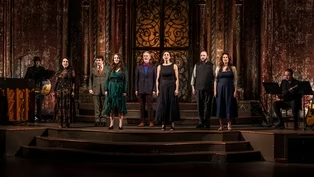
A performance of songs written in concentration camps and ghettos during the Holocaust.
Actors perform a collection of Yiddish songs written in concentration camps and ghettos during the Holocaust. In collaboration with National Yiddish Theatre Folksbiene. Credit Correction: Jewish Partisan Educational Foundation; A Partisan’s Memoir, Second Story Press; www.jewishpartisans.org. Original casting for NYTF's production of Amid Falling Walls by Jamibeth Margolis, CSA.
Problems playing video? | Closed Captioning Feedback
Problems playing video? | Closed Captioning Feedback
House Seats is a local public television program presented by WLIW PBS
Amid Falling Walls
Season 6 Episode 3 | 42m 48sVideo has Closed Captions
Actors perform a collection of Yiddish songs written in concentration camps and ghettos during the Holocaust. In collaboration with National Yiddish Theatre Folksbiene. Credit Correction: Jewish Partisan Educational Foundation; A Partisan’s Memoir, Second Story Press; www.jewishpartisans.org. Original casting for NYTF's production of Amid Falling Walls by Jamibeth Margolis, CSA.
Problems playing video? | Closed Captioning Feedback
Where to Watch House Seats
House Seats is available to stream on pbs.org and the PBS app.
Providing Support for PBS.org
Learn Moreabout PBS online sponsorship(lively music) (upbeat music) - [Crew Member] (indistinct) the stage, right?
- [Crew Member] Places, everyone.
(pensive music) (tense music) (nostalgic music) (lively music) (ensemble singing in Yiddish) (singing in Yiddish) (singing in Yiddish) (singing in Yiddish) (ensemble singing in Yiddish) (ensemble continues singing in Yiddish) - "Amid Falling Walls" is this remarkable collection of songs that were written and performed in ghettos, concentration camps, in clandestine theaters and cabarets that really paint an overview of what the experience was like of living through the Holocaust.
- During these times of unspeakable atrocities going on, people needed a normalcy and this creativity was kind of a refuge.
Their ability to write and to sing took their minds off the immediacy, and I think inspired others.
- Young Jews resisted the Nazis in so many different ways throughout World War II, but most significantly through poetry and through song.
It might seem odd to imagine young people resisting an entire tyrannical structure.
It might be easier to contemplate the idea of a young person writing a poem or putting together a few bars of music that reflect the horrors of their life.
- Shmerke Kaczerginski was a songwriter and a song collector, political activist.
He collected a large number of songs, some by himself, many by others, and post-war, started to publish these in what would become the largest collection of ghetto and camp songs in Yiddish.
- There was a lot of interest in recording the Yiddish proverbs, the Yiddish sayings that developed in the ghettos.
There was this realization that if we don't do this right now, we're never gonna be able to do it, because the survivors, once they leave the DP camps, they're gonna forget.
They're not gonna wanna talk about it.
This is the moment to get all of this information.
- The main purpose of collecting these songs and publishing these songs would've been documentation, some proof that what happened actually did happen.
It was widespread among the survivors that people would not believe afterwards what happened to them, that sometimes this is the only evidence we have of an event.
- It's so critically important to tell this story and to tell it in an authentic way.
We're not fictionalizing it.
We're not even imagining what these people went through.
We are simply telling their own words to today's audiences in a hope that somehow telling that story helps us to avoid making the same global mistakes that led to that tragedy.
("Motele Fun Varshever Geto") (singing in Yiddish) (singing in Yiddish) (singing in Yiddish) (singing in Yiddish) (singing in Yiddish) (singing in Yiddish) (ambient music) (singing in Yiddish) (singing in Yiddish) (singing in Yiddish) (singing in Yiddish) (ambient music) (singing in Yiddish) (singing in Yiddish) (singing in Yiddish) (singing in Yiddish) (singing in Yiddish) (singing in Yiddish) - "A Yiddish Kind" by Khane Kheytin speaks about having to hide your identity to survive.
This was a very sadly common occurrence during this period where women who were in the ghetto who had young children, had to send them away.
Hopefully they will survive.
Often they were taken in by a gentile family, sometimes even hidden in a church, and they were converted.
And she's instructing that child to forget who you are, because if you give it away, you're doomed.
- It was very, very difficult, because a Jewish child had to have the sensory awareness, had to be conscious of not giving away the truth.
And how much could you expect that of a child?
- "A Yiddish Kind," "A Yiddish Child" is written by a young teenager, a poet named Khane Kheytin, who was an adolescent and living in the Shavli Ghetto and who turned towards poetry and songwriting as her form of resistance.
And it is a conversation between a mother and child.
("A Yiddish Kind") (singing in Yiddish) (singing in Yiddish) (singing in Yiddish) (singing in Yiddish) (singing in Yiddish) (singing in Yiddish) (singing in Yiddish) (somber music) (singing in Yiddish) (singing in Yiddish) (singing in Yiddish) (singing in Yiddish) (somber music) - Most Jews were confined in Nazi ghettos.
Communication was very difficult.
News was very hard to come by.
They were not allowed to have newspapers.
Being caught with a radio resulted in a death sentence.
One of the best ways that people compensated for that fear, that isolation, that lack of communication, that ongoing dread, was to create new channels of communication.
And one of those channels of communication was the song.
- These artists and creators of "Amid Falling Walls," of the material of this project, people like Hirsh Glik and Shmerke Kaczerginski and Kasriel Broydo, they were simple people trying to live.
And when we hear numbers like six million, it can seem daunting to try to imagine a person.
But these songwriters and poets were individual people that give us window into that lost world.
- The reason that most of these songs were in Yiddish is that Yiddish was the first language of most of the singers and songwriters.
Many of these people were activists in Yiddish culture.
Kaczerginski certainly was one, Sutzkever another, of these partisan poets was, and all of their mentors were.
They speak sometimes of two parallel universes in Poland at the time, which was the Jewish world, which was Yiddish speaking, and the rest of it, which was Polish speaking.
Kaczerginski was not even fluent in Polish, which would've been the majority language in the city that he grew up in.
("Lomir Shvaygn") (poet speaking in Yiddish) (speaking in Yiddish) (speaking in Yiddish) (somber music) (singing in Yiddish) (singing in Yiddish) (singing in Yiddish) - This project, "Amid Falling Walls," is near and dear to my heart, as it's been an opportunity to work with my father, Zalmen Mlotek, who spent a lifetime collecting and presenting this material.
- I grew up in a home where Yiddish was spoken, where every discovery of a new Yiddish song was an event.
For me to work on it now with my son, who wrote the libretto of this piece, is quite moving for me, and I hope an inspiration for other people.
- I tease my father that I learned Yiddish Holocaust songs before I knew English nursery rhymes.
And that's because these songs were part of our family's milieu.
My grandmother compiled the first English translation of Yiddish Holocaust songs.
And as a rabbi who seeks to impart spiritual resiliency to folks, I can't think of a more prime example than looking at the songs that young Jews created during humanity's darkest Hour and being reminded of what hope and resistance and resilience looked like in the words of a 14-year-old girl or a 22-year-old poet.
("Es Vet Zikh Fun Tsvaygl Tseblien A Boym") (singing in Yiddish) (singing in Yiddish) (singing in Yiddish) (singing in Yiddish) (singing in Yiddish) (singing in Yiddish) (singing in Yiddish) (singing in Yiddish) (singing in Yiddish) (singing in Yiddish) (ambient music) (singing in Yiddish) (singing in Yiddish) (singing in Yiddish) (singing in Yiddish) (singing in Yiddish) (pensive music) - Vilna's Ghetto Youth Club was formed along with a number of other cultural entities in the ghetto as some way of restoring a sense of normal existence to people who were living in a kind of a hot house environment where things changed so rapidly.
Kaczerginski lead line for his anthem for the youth club was, "Our song is full of sorrow."
He led with that because there was no way to avoid it, but the song turns rather optimistic and the rhythm of the song, again, is full of energy.
And it was probably sung with a great deal of vigor and did certainly infuse the youth with a sense of hope.
- We thought that it would be important to hear people who have a connection to this material.
Not actors who are learning it.
We brought together a group of young people to sing this anthem that was sung in the (indistinct) era.
("Yugnt Hymn") (choir continues singing in Yiddish) (choir continues singing in Yiddish) (choir continues singing in Yiddish) (choir continues singing in Yiddish) (choir continues singing in Yiddish) (choir continues singing in Yiddish) - Young Jewish women have played a critical role in the underground, in the resistance movement in Poland.
They had all kinds of roles in the underground ranging from setting up underground schools, underground secret printing presses, libraries, soup kitchens, all the way through to there were young Jewish women who shot Gestapo men in the head, who blew up Nazi supply trains, who flung Molotov cocktails during ghetto uprisings.
They were the ones smuggling the weapons into the ghetto for the ghetto uprising.
- Not only were women crucial to the resistance in the ghetto, but they were the only people, to a large degree, who could get away with it.
Men could not hide their Jewishness because they would be stripped and a circumcision would be found.
And if that were the case, then the Nazis would say, (pops mouth) and that would be it.
My mother, Vladka Meed, because she didn't look Jewish, she didn't sound Jewish, which was even harder than looking, she knew how to get around the city and how to use her looks to kinda disarm other people.
She could go places and do things that very few other people could do.
- The Warsaw Ghetto Uprising was an uprising conducted by the youth.
These were planned for when the Nazis were coming into the ghetto, to take Jews to their deaths.
And when they entered the ghettos, the Jews said, "We're not going.
We are gonna fight back."
- There was no hope of actually surviving.
There was no hope of beating the Germans back.
It was a determination that, "We're gonna die fighting back, but we're not going to let them humiliate us anymore."
- But these women, time and time again, risk their lives in the fight for liberty, justice and dignity.
It's important for us to remember that and to, I think, even for myself, you know, attempt to be inspired by that and emulate that and try to carry that out in my world.
("Yid Du Partizaner") (singing in Yiddish) (dramatic music) (singing in Yiddish) (ensemble singing in Yiddish) (somber music) (singing in Yiddish) (singing in Yiddish) (singing in Yiddish) (ensemble singing in Yiddish) - Mordekhe Gebirtig was known as the folk troubadour of Yiddish Poland, and he wrote about the people in Cracow.
He wrote about his own experiences as a father, as a laborer.
During the war, he was put into the ghetto with his wife and his daughters, and he continued to write of his experiences in the Cracow ghetto.
A notebook that he consigned his thoughts to.
His poems and songs to survive the war.
He did not, nor did his wife, nor did his daughters, but somebody preserved that book.
- One of Gebirtig's songs is in "Amid Falling Walls."
It's called "Minutn Fun Bitokhn", "Moments of Faith," "Moments of Hope."
The words of "Minutn Fun Bitokhn", "Moments of Hope," are so piercing, because they imagine the Jews speaking directly towards their oppressors.
And so they say, "There once was a Haman, his end awaits you too," speaking to the Nazi henchman, but also speaking to the Jewish people in different verses when he says (speaks Yiddish) "Have patience, have faith.
This is our oldest spiritual weaponry that we have.
These songs.
Don't give up."
So the song fluctuates between addressing their oppressors and the people.
("Minutn Fun Bitokhn") (singing in Yiddish) (singing in Yiddish) (singing in Yiddish) (singing in Yiddish) (singing in Yiddish) (ensemble singing in Yiddish) (dramatic music) (singing in Yiddish) (singing in Yiddish) (ensemble singing in Yiddish) (tense music) (singing in Yiddish) (singing in Yiddish) (ensemble singing in Yiddish) (ensemble continues singing in Yiddish) (ensemble continues singing in Yiddish) - "The Partisan Hymn" was the creation of Hirsh Glik, a young poet from Vilna.
- Glik was inspired by the Warsaw Ghetto Uprising, which was the largest organized attack against the Nazis during World War II and was transpired on Passover Eve.
Glik was inspired by those events to write his own anthem.
When Glik brought it to Shmerke Kaczerginski, Kaczerginski was so moved, he later would call it the second Hatikvah of the Jewish people, referring to the national anthem of Israel.
- This song, "The Partisan Hymn," was taken from a popular Russian folk tune, so it was already in the consciousness of the people.
And then this 22-year-old poet wrote these inspiring words of hope.
Eventually it spread through all over Europe, all over Russia, and then after the war, it was really codified as the defining spirit that allowed survivors to survive 'cause they had this vision of never giving up.
- And of course it remains the canonic piece that's performed with audience standing up at the end of most Holocaust commemoration ceremonies.
(crowd chattering) - We've brought together several generations of survivors, second generation, third generation, in some cases, fourth generation, to sing "The Partisan Hymn" because of the importance of that song, because how that song became the anthem in those years and a symbol of hope in all the years, in the 70 or so years since then, has been sung as a testament to that resilience that here you have actual proof of how survivors actually survive when you have several generations together.
("The Partisan Hymn") (ensemble singing in Yiddish) (choir singing in Yiddish) (ensemble singing in Yiddish) (choir singing in Yiddish) (ensemble singing in Yiddish) (choir singing in Yiddish) (ensemble singing in Yiddish) (choir singing in Yiddish) (ensemble singing in Yiddish) (choir singing in Yiddish) (ensemble singing in Yiddish) (choir singing in Yiddish) - The work left behind by this group of artists and creators is critically important, not only to our history, but understanding who we are.
These were highly, highly intelligent and creative people and there was a real effort to completely erase their existence and every trace of their existence, and that we have held onto this, gives them humanity.
- We're familiar with the idea of physical resistance and armed resistance, but what does spiritual resistance and musical resistance look like?
We have that idea thanks to Shmerke Kaczerginski.
He shined a spotlight to countless young writers and poets, many of whom did not survive the war, but whose poetry and whose music and whose songs live on despite their perishing.
- With the years going by, we lose survivors all the time.
We are blessed to have their memories and their thoughts documented.
When we sing a song in 2026 and give it the context, it opens up a whole world for people who had no concept of what the Holocaust is.
- And I think the Jewish people are inheritors of a legacy of hope.
It's amid falling walls.
It's amid a lot of suffering, but at our core, we sing.
("Mir Lebn Eybik") (ensemble continues singing in Yiddish) (ensemble continues singing in Yiddish) (ensemble continues singing in Yiddish) (ensemble continues singing in Yiddish) ("Mir Lebn Eybik") (ambient music) (ambient music continues) (ambient music continues) (ambient music continues) (ambient music continues)
Video has Closed Captions
Preview: S6 Ep3 | 1m | A performance of songs written in concentration camps and ghettos during the Holocaust. (1m)
Providing Support for PBS.org
Learn Moreabout PBS online sponsorship New Episode
- Arts and Music

Innovative musicians from every genre perform live in the longest-running music series.

- Arts and Music
The Best of the Joy of Painting with Bob Ross
A pop icon, Bob Ross offers soothing words of wisdom as he paints captivating landscapes.






 New Episode
 New Episode
 New Episode
Support for PBS provided by:
House Seats is a local public television program presented by WLIW PBS