
Athletes of God
4/3/2026 | 1h 25m 14sVideo has Closed Captions
Dancers reflect on both the exhilaration and the physical and emotional toll of life on the road.
“Athletes of God” takes viewers on a world tour with the dance company. Traveling across Europe, the dancers reflect on both the exhilaration and the physical and emotional toll of life on the road. As the first American dance company to tour China post-pandemic, their journey echoes Graham’s belief in movement as a universal language.
Problems playing video? | Closed Captioning Feedback
Problems playing video? | Closed Captioning Feedback
Athletes of God
4/3/2026 | 1h 25m 14sVideo has Closed Captions
“Athletes of God” takes viewers on a world tour with the dance company. Traveling across Europe, the dancers reflect on both the exhilaration and the physical and emotional toll of life on the road. As the first American dance company to tour China post-pandemic, their journey echoes Graham’s belief in movement as a universal language.
Problems playing video? | Closed Captioning Feedback
How to Watch Martha Graham Dance Company: We Are Our Time
Martha Graham Dance Company: We Are Our Time is available to stream on pbs.org and the free PBS App, available on iPhone, Apple TV, Android TV, Android smartphones, Amazon Fire TV, Amazon Fire Tablet, Roku, Samsung Smart TV, and Vizio.
Providing Support for PBS.org
Learn Moreabout PBS online sponsorship[classical music] Dancing appears glamorous, easy, delightful.
But the path to the paradise of that achievement is not easier than any other.
It takes about 10 years to make a mature dancer.
The body is shaped, disciplined, honored and, in time, trusted.
The movement becomes clean, precise, eloquent, truthful.
Movement never lies.
One becomes, in some area, an athlete of God.
[soft music] Oh my gosh.
We're back on tour.
We're back.
[laughs] Here we are.
I feel like Graham has taught me a way of living, a way of being.
And what the hell just happened to me for the past 10 years?
Because I think when you're in it, you don't realize how amazing that one person made all of this happen, Martha.
It's so powerful to be a part of something larger than just you, that means something to so many other people, and to align yourself with other people along the way who are similar, like, minded and-- sorry.
Who will be your friends for life.
It's so cool.
Like, truly.
That's cool.
Sorry.
[sobs] [laughs] Sorry.
[sniffles] We love to cry.
[lively percussion music] Today, in this time for us who dance, the great urge is to make living theater for living people now.
[cheering] Dance is an art, the primary art of expression because the body is the primary means of communication.
It may be beautiful or it may be unbeautiful, because it is an arrow pointing to life at an instant.
It acts as a mirror.
[applause] [cheering] What is that?
It's hard to explain to someone, to our life, because they see the Instagram photos and we're at the Great Wall of China and then the Eiffel Tower.
And it's wonderful.
The trusty sneaker.
Yeah!
Yay!
Oh my god.
This is so cute.
Amazing.
The upsides of touring, leaving the country, which is something I had not done before-- I joined Graham.
To lean back.
Understanding culture in a different way.
I love dance so much because it takes you any and everywhere, and you never know where you're going to go.
That's a mall.
I know mall when I see one.
I've danced with so many amazing artists like Mariah Carey, Her, Bad Bunny.
Is that the principal of the Martha Graham Company?
I have so many other things I want to do.
I didn't see myself joining the Graham Company in my 20s.
Cheers!
Cheers.
Cheers for that.
There are also just some wonderful, like, bonding moments that we all have as a group.
Memories are being made and special laughs and fun times that stay with you.
You always remember, oh, we had a great time.
Touring can be really beautiful and it can also be eye-opening sometimes in not the best way.
Where do we-- l would never follow you anywhere.
Your direction skills-- I was just-- I feel disrespected.
It's, like, if it's a long tour, you really have to get used to being around the same people for a long period of time every day.
With the Martha Graham Company and a lot of companies, you have to wait a certain amount of years to get your own room.
So you have roommates and, of course, you love your roommate.
But you're tired and you just washed a bunch of hairspray out of your hair, and you're icing body parts after a show, and you still have to eat at midnight in a hotel room with a roommate next to you.
This is So Young and James and Antonio.
And-- We only get one key?
Yeah.
Wait-- Are you?
All going to be quiet.
We're right next to you.
I live alone in New York City, so you know, what it's like when you get to go home and just, like, relax and just do nothing.
I'm going to wait.
I kind of want my space.
Yeah, I'm going to wait.
Realistically, maybe it's gotten to a point where the dancers-- you do need a little break from one another.
Talk and talk, talk.
I'm sorry.
[laughs] Let's make peace, kids.
You definitely get sick of everyone after a while.
It's just the realness of it.
Sometimes, you know, after the second week of a tour, you might see people cracking a bit.
Definitely pluses and minuses.
What's that over there?
[flamenco music] Hey!
Hey!
But mostly pluses.
[applause] [flamenco music] [castanets clicking] When I joined the company, I was 21.
I just graduated.
I was like a hungry puppy who just wanted to know everything and be involved in everything.
I was a sponge.
I was soaking up so many things, so much information.
Hey!
I have some inspiration for Cave now.
Yes!
So we go through-- [non-english speech] that should be beautiful.
The Graham Company is turning 100.
I think people don't even know that it's the oldest company in America, but Martha's work is timeless.
I mean, I'm a young person who found Martha Graham and fell in love with it.
She's so inspired by so many different stories, different artists, different cultures.
The use of collaboration.
When you see her work, you really get a sense of 20th century artistic genius.
These new choreographers come in and give us their vision.
This was the first time I was in charge of making sure that Cave specifically, was stage-ready, and to keep the integrity of Martha's work, but also what these new choreographers come in and give us.
Cave, choreographed by Hofesh Shechter.
Epic piece.
It's special because it is a party on stage.
It's a rave.
And it's very raw in the beginning, and we're smooth and slow, and then gradually in it's a build up.
It is so [bleep] damn hard to get through that piece.
It's exhausting.
[deep rumbling] [music playing] [music playing] [fast-paced music] [music playing] [dynamic music] It's challenging movement.
It's all improv.
I just let the beat take over.
[music playing] By the end, there's so much catharsis you really give everything that you have to portray this really good time on stage.
Yeah!
[music playing] [cheering, applause] [soft music] We went to Europe on the Queen Mary, which was a mistake, actually, because we went wild on the boat, stayed up all night dancing and carrying on.
And we walked into the theater the next day, rehearsing.
We were a mess.
And Martha said, we're going to start with the jumps.
Now, nobody starts a dance class with jumps.
But she was mad at us because we had so much fun on the boat.
The company was used as like, this political pawn during the Cold War to go to different places around the globe to send a message.
The State Department sponsored several tours of the Graham Company overseas, and we really saw them as not political diplomacy, but being sent around the world to reach audiences everywhere with the universality of art.
And there's this amazing jazz musical called The Real Ambassadors that Dave Brubeck wrote, and it talks about artists like Martha Graham serving as ambassadors, and Louis Armstrong sang it on the album.
(SINGING) And just to stop internal mayhem We dispatch Martha Graham That's what we call cultural exchange That's what we call cultural exchange [classical music] My company and I did a State Department tour to the Orient in 1954.
Before we left, people kept saying to me, but how will they understand your dances?
Will you be upset if the audience does not understand?
I said, I'm not interested in whether they understand or not.
I'm only interested if they feel it.
I've tried to reveal the quickening of people's sensitivity, the opening of doors that have not been opened before.
It was coming in the wake of some of the very bad press we were getting abroad from segregation issues in the south.
[traditional music] We were the first integrated company in America.
So Martha claiming that she was apolitical is really-- actions speak louder than words.
I could not do a single step if I did not believe in brotherhood.
But I am not a propagandist.
I don't need to make dances that say they are about brotherhood.
All my dances are-- In the 30s, she was clearly influenced by the rise of fascism, what was happening in Europe.
[soft music] Her company was filled with young Jewish women.
And in 1936, Martha famously turned down the Nazis' invitation to dance at the Olympic Games in Berlin.
I must decline your invitation.
I would find it impossible to dance in Germany at the present time.
So many artists whom I respect and admire have been persecuted, have been deprived of the right to work for ridiculous and unsatisfactory reasons, that I should consider it impossible to identify myself by accepting your invitation with the regime that has made such things possible.
In addition, some of my concert group would not be welcomed in Germany or willing to go.
This refusal is directed only against the practices of the authorities and does not reflect on German artists, for many of whom I have the greatest affection and respect.
Sincerely yours, Martha Graham.
[eerie music] Spectre is the abstract way of personifying war, how it makes you feel death, grief, that pain.
When I throw the skirt and then fall back into it, it almost looks like a pool of blood.
And then take the skirt on the set.
And I lay back flat, and it literally looks like I'm in a coffin, symbolizing the aftermath, like a battle has just happened.
[dramatic music] [music playing] [music playing] Martha's dance was mostly about women, and their psyche was the subject, and their independence was the subject.
And when she was doing a Greek myth, it was told from the woman's point of view.
Some people have talked about the male characters being one-dimensional.
For example, Errand Into the Maze, the duet with the Minotaur and Ariadne, he's portraying fear and aggression.
You could consider that a one dimensional aspect, but how thrilling to have to find the animal in you to bring to that role, because you are half human, half bull.
The monster I created, that's my fear.
So you have to fight.
Literally I'm fighting with my fear.
I love.
[laughs] This is totally me.
I think it's the hardest role that Martha Graham has for their men.
You're supposed to give that impression of being a minotaur.
So you have a piece of wood between your shoulders, and you're not able to use your arms because you're stuck over here.
The steps are hard.
You're carrying your lady above your shoulders, on your back.
You are kind of freaking out the whole time.
A lot of time I risk to be injured.
And I did get injured.
Hey, husband, my ankle is not doing really much better, so I'm going to PT right now.
I hope you have a great awakening in New York City, and I'll talk to you soon.
I love you.
Have a great day.
The most stressful thing about it is that we're performing in Italy next Saturday, where all my family is coming.
My family hasn't seen me dancing in so many years.
Crossing my fingers.
Maybe I just need a few days of rest.
My injuries have been so many.
I've had a couple of small ones.
Was it a couple?
Maybe a little more.
Start at the bottom and work your way up.
Got a heel spur.
[non-english speech] Shattered my sesamoid, torn.
Multiple ligaments in my right foot.
Tendonitis.
Fractured my foot.
[non-english speech] Fifth metatarsal, sliced it right down the middle.
The dancer's fracture.
Recently, I sprained my big toe.
It's not great.
You need your big toe.
Sprained my foot.
I was out of dance for two weeks.
Displacement of the kneecap due to tightness in my quad, pulling it out of whack.
[non-english speech] Strained my meniscus.
Meniscus surgery.
Pulled my hamstrings a couple times.
Take a long time to recover.
Pulled my abductor.
[non-english speech] Sciatica going down the leg.
Two cortisone shots for that.
[non-english speech] Crack my tailbone.
Broke-- My arms.
Elbows.
Ankles, both legs.
Dislocated my knee.
Eight times with full reconstructive labrum surgery.
Clicky right now.
Whiplash a decent amount of times.
Back spasms.
Neck spasms, where a disk has shifted.
Causing my spine to curve the wrong way.
[non-english speech] A herniated disk.
L5-S1 lower back.
Base of my spine.
I was out for an entire year with that one.
Can you tell me when I'm on four?
It's a seven.
OK, I heard you.
I'm not pushing further.
Growing up in the dance world, you're just trained to feel guilty about you not being enough.
You're not putting your foot, oh my gosh, you're injured, you can't dance, you can't jump So what are you going to do now?
We all deal with that.
You feel guilty for not being able to dance that night.
You feel guilty for not being able to fill your spot on stage.
Then your ego gets in to your brain saying, oh my gosh, I'm not going to dance.
Somebody else will dance my role tonight.
The body is our instrument.
If your ankle is broken, you won't be able to do what you love and that affects your mental health.
Hi, husband.
My calf muscles are released and the pain is almost gone, and I am really happy about it and excited for the next show.
So I don't want you to worry.
Everything is fine.
Bye.
I love you.
[calm music] Mama!
Mama.
Amor.
[non-english speech] I know Alessio since a long, long, long time.
About 15 years.
Alessio is my family.
And I feel that's what I like the most on tour, when we are actually all together.
It's my favorite moments because we just-- we're just bonding.
That shows up on stage.
She's like, this is my dancer.
This is it.
I gotta warm up a little bit.
A little good luck.
Last stop.
Couldn't be more excited that it's Italy last stop.
[chuckles] This tour has been a long one.
We haven't been on in a really long time.
Long three weeks.
Long three days.
I lost all my luggage at the airport and I have been very sad.
I'm definitely ready to sleep in my own bed and wash the clothes.
I feel like my body is just kind of, like-- you know when it's like holding together-- By dear life.
[laughs] By the strings.
And then at the end is, like, praise God, I'm done.
And then it's just like-- Bitch!
[laughter] We're done!
We're done!
[exhales] I literally moved half of Italy to come see the show, and my mom hasn't seen me dancing since 2018.
And I do the first duet.
You got to break the ice for the whole show, and that's a huge responsibility.
So it's a lot of emotion to handle, but we have to bring it on, so we will.
[dramatic music] [music playing] [music playing] [music playing] [music playing] [cheering, applause] Thank you.
Thank you.
Oh my god.
Oh my god.
I need a Band Aid or something.
Beautiful job.
Mama!
I need to dry first.
Oh, yeah.
That was like last time.
Yeah.
Woo.
I'll do the mascara later, whatever.
Who cares.
All right.
Let's go.
OK, here we go.
Number Two.
OK.
[soft piano music] [music playing] [music playing] [music playing] [music playing] [cheering, applause] Congrats.
Good job.
Good job.
Mwah.
Love you.
Good work.
[chattering] Good job.
Congratulations.
Let's go home!
Ciao!
We did that over a month of touring.
An amazing show.
[sighs] We did it.
Ciao!
Ciao!
[non-english speech] All right.
[calm music] We gotta change.
A dancer, more than any other human being dies two deaths.
The first, the physical, when the powerfully trained body will no longer respond as you would wish.
Without dancing, I wished to die.
She danced until she couldn't dance anymore.
But she was 77.
Martha always said that she choreographed in order to have something to dance.
So for her to have to stop performing and stop dancing, I think everything just crumbled.
She's talked about it.
Watching your body not being able to do what it once did is-- it's not fun.
And if you're Martha Graham-- When your own limitations physically and the amount of time that you've been working at this level and inventing new things, it gets harder to re-imagine, where do you go from here?
I stayed home, ate very little, drank too much, and brooded.
Finally, my system just gave in.
I was in the hospital for a long time, much of it in a coma.
Then one morning, I felt something welling up within me.
I knew that I would bloom again.
She'd come into the studio and walk to her chair, and she'd sit down and she'd just stay in the chair the whole time.
[inspiring music] But she would verbalize for the dancers what she wanted.
She found a way to work, and the dancers found a way to work with her.
She came on tour and she was with us all the time.
She came every night to the theater, to every rehearsal.
She would sit in the wings-- and I think usually it's stage right downstage.
Second wing, stage right.
And she'd have a gel because sometimes the light's coming in and she would watch the performances.
Up until very late in her life, she would come out and do the curtain call.
The final curtain call.
The master is there with you, giving you their beauty and energy.
Just being there also elevates you.
Hello.
[chattering] [curious music] All right, Leslie, this is the day.
Yeah, this is the day today.
Opening night.
Wait, is that you?
Oh my god!
[laughs] Are you feeling this energy?
I'm feeling it, I'm feeling it.
I'm going to bring it.
I'm going to do that ritual.
OK.
She's opening tonight.
Wow.
Scary Mary.
So much drama.
Life in the big cities wakes and teases the brain.
Therefore, must its art be more thoughtful, more intellectual.
Life today is nervous, sharp and zigzag and often stops in mid-air.
That is what I aim for in my dances.
I do not want to run away from the struggle that is found in the present day of machines, but I want to understand it and express it artistically.
[chuckles] [non-english speech] It's not outside.
OK.
My mom was here December when she was born in February, and my mom left when she was four weeks old, right before the pandemic.
Everything shut down.
So she only saw her like this little.
Not even-- barely opening her eyes yet.
And now she's just like this.
A really big kid now, right, Frankie?
Yeah, right.
All right.
Are you going to give Lala her a big hug?
Yeah.
How big?
This!
This big.
We're going to pack.
I stole that from an H&M a long time ago.
I love Madonna.
And I found this on tour.
It says "I wouldn't have turned out the way I was if I didn't have all those old fashioned values to rebel against."
[laughs] And I appreciate that.
And this is Ying and I from a dance festival in Holland.
My grandparents.
Martin Luther King.
This is the Forbidden City.
And I got this on our first trip to China.
And then we're going back there.
I am shocked that we're going right now.
We haven't traveled to China in so long.
And a lot has gone on in the world since then.
Obviously, big deal pandemic.
So there's just a lot of questions and concerns about what we're actually getting into.
[soft piano music] China just opened the borders for us to be able to perform.
There's just more trepidation and quite a bit of stress.
There has been some stories about what quarantine looked like in China.
What would happen if someone got COVID, would they have to stay in quarantine alone?
People tell me, oh, I really don't want to go there.
You're going to get COVID and the country will lock you up.
That was the claim.
I would tell people it is going to be safe.
You won't be as scared as you think you will be.
Try to go up into it.
Yes!
There you go.
There you go.
That works.
Obviously, the company would never put us in danger, but there's a validity in feeling worried about taking a big trip.
We're gonna go see a real panda.
Because-- I take pride in Chinese culture.
Sometimes I can feel hurt a little bit.
At one point, China was-- it was great.
Everybody, oh, you're coming from China?
Is there any opportunity for me to go there?
And now people want to stay as far as they can from you.
I mean, I take my kids there.
If it's not safe, why are you taking her with me?
People say, you're really upset.
Of course I'm upset.
I'm been going through this kind of aggression towards this topic, this subject, for long enough.
I'm not really excited to go back, but it's hard to get excited.
So I really just hope-- but once you go there, you'll see.
People are really excited about it.
There's open arms, very excited about our coming.
People keep messaging me, like, oh, we bought tickets already.
Gonna see you guys there, like-- yeah.
So that's going to make everything better.
I want to go now.
You want to go now?
Yeah.
OK, then you have to call a taxi.
Do you know how to call Uber?
No, you do.
[motor whirring] [car horns honking] [emotional music] [crying] [non-english speech] So good to see you.
Oh my god.
[laughs] It's so good to see you [frankie yelling] [calm traditional music] I feel that the essence of dance is the expression of man, the landscape of his soul.
I hope that every dance I do reveals something of myself, or some wonderful thing a human can be.
Martha was confronting themes that we're still talking about today.
She was very much about human rights and the empowerment of the human.
Appalachian Spring, for example, she hired the sculptor Isamu Noguchi to create the set for that ballet, just a few months after he had been released from World War II internment camp.
Martha and Noguchi were both interested in stripping something down to its absolute essences.
The collaboration between Martha and Noguchi is just amazing.
I mean, you look at the lines of the barn and the fence and just very simple things that are strategically placed.
It just gives you this atmosphere, so you're transformed into that.
I mean, you're going up and you're standing on the rock and just looking to the side.
It's a really abstract form, but it just gives you a real sense of place and time and relationships, and love.
[inspiring music] Yes!
Beautiful.
Yes!
[non-english speech] We are now arriving at-- OK.
That's me!
Going through it.
And up!
Yay!
[soft traditional music] --help you to make your dreams come true.
OK.
Yeah, yeah.
I love that.
I want all the goodness coming my way.
Are you guys happy?
[cheering] Guys, welcome to China!
[cheering] [non-english speech] Good morning.
Woo!
[non-english speech] My mom still feels a little sad because she missed a big chunk of Frankie's life.
It's very important chunk of life.
Yay!
Yay!
[non-english speech] She felt missing out-- just see her little take her first step and say her first word.
And starting to build a bond from the very beginning again with a three-year-old is hard.
Frankie doesn't really speak much Chinese.
Nothing I can do.
[non-english speech] I can't really force anything.
[non-english speech] When I decided I really want to come to America, and I told my mom, and then I got married, she thought I was crazy.
Ah!
Woo!
[laughs] It's magic.
[non-english speech] OK.
One more?
Yeah, a big one!
OK, big one.
Whoa!
[non-english speech] [soft music] So we'll stand by for house and curtain.
[exhales] Thank you.
[dramatic piano music] [music playing] [music playing] [music playing] [cheering, applause] I'm a Chinese woman.
Martha, she's an American legend.
[non-english speech] But still, I feel very strong bond with her.
I want to tell people more about Graham.
I feel I have a responsibility to her legacy.
I'm asked so often at 96 whether I believe in life after death.
[emotional music] I do believe in the sanctity of life, the continuity of life and of energy.
I know the anonymity of death has no appeal for me.
It is the now that I must face and want to face.
We all knew Martha was quite ill during our Asian Tour in 1990.
They sent for me to come to Martha's apartment.
They sent for Yuriko as well from Japan.
And at that point, we knew that we were not going to have her much longer.
And I came down to the apartment.
It's the first time I'm going to Martha's apartment.
And she said, come on, sit next to me.
I said, well, Martha, I'm leaving.
I have guests coming.
I have to back, but I'll see you in the next couple of weeks.
And she says, oh no, you're not going to see me again.
I says, no, no, we reconstructed The Rite of Spring and we have the Spanish ballet to finish.
She said, no, no, you're not going to see me again.
She said, it's over.
I'm done.
And I went, oh, no, it's not, Martha.
Come on.
You can-- you've been chugging along for so long, you can keep going.
But she said, no, I'm really done.
I mean, she was right.
She knew.
She said, give me a kiss before you go.
So I leaned in to give her a kiss on the cheek, and she turned so she could get it on her lips.
And she's like, oh, I got you, I got you, I got you.
She never came back to the studio.
I was with her the night she died.
In a way, she was released.
I mean, she was not happy at the end.
She'd done what she wanted to do.
We had lost this catalyst, this very powerful woman and creator who we loved.
Martha didn't have a lot of friends.
She was more or less a person that isolated herself.
I know this sounds silly, and if you don't want to use it, don't use it, but we had a kind of girlfriend relationship.
I'd lie down next to her on the bed, and we'd go through Vogue Magazine and we'd say, oh, I like that.
Oh, you'd look good in that.
Oh, I hate that color.
Blah blah, blah.
Oh, those shoes are awful.
And da, da, da.
That kind of thing.
And I miss that.
I miss that very much.
[dramatic piano music] It wasn't a great sadness to lose Martha, because I could recognize at that point in myself and in the generations of dancers that she had influenced, that we were all-- [sighs] sorry.
We were all taking her forward.
She was just an indelible part of who we all are, how we move into the future, what we create all based on her revolution, her investment in us, and everything we learned from being part of her world, but also from her expectations of us and who she was and how she moved in the world.
[music playing] [music playing] Finally, the theater is empty, and I walk past the only light left in any theater when everything is closed and everyone is gone.
It is a single, glaring light bulb resting on top of a long, bare black metal pole placed on mid-stage.
It is called the ghost light, a symbol of all of the lives and legends that are still in this theater and that, in some form, go on.
[jazz music] I for sure will cry about that.
Yeah.
I'll be crying.
Let it out, let it out.
Yeah.
I love this hand thing that we're doing.
Yeah, we're all just, like, anxiously.
Because it's about to get real.
It's about to get very real.
[chattering] I hope everyone had a good break.
Keep breathing.
Keep taking care of each other.
But I can see you don't need any kind of a pep talk or warm up.
So Sam and Amadi, we are, of course, delighted to have you here.
Have a great rehearsal.
Thank you.
Remind those guys when you need a five.
Yeah.
We'll try to remind ourselves.
Yes.
So we aren't just-- [laughs] it's already hard.
OK, go for it.
All right.
OK.
Let's prioritize musicality and sharpness and arrival today.
And then once we have the structure, we know where the borders are, then we color in, then we embellish, then we luxuriate in certain moments, then we characterize, then we add drama to it, then we add all these layers.
But let's get this other thing first.
OK.
We start standing.
Sam and Amadi burst on the scene in their own choreography, and it's remarkable stuff.
That's how I first discovered them.
Bring the hands out.
The wrists are just rolling through.
Yeah, and this is happening simultaneously.
And we go.
I think we're just the second or third commission.
But to have the Graham Company perform their work, I think that's a big next step for them as creative artists.
Yeah.
Good.
You'll see these hands a lot.
These kind of, like-- yeah.
We love Martha and her hand position.
So this one's going to be ours as we continue, bunch, yeah?
I feel if Graham actually still living this day, she would've loved to work with the newer artist.
[humming] Great.
A little bit faster, a little bit-- Because since 1926 until 1990, she's still creating.
So she's growing.
Boom.
Good.
Good!
So if she's here, she's going to be totally up for the new, I believe.
Music.
[classical music] Yeah.
[clapping] A couple more times.
We won't get it perfectly before we move on.
But this is just so we start to get a sense of the music.
Seven, eight.
Nice!
[music playing] These images are from a televised version of this piece.
Right.
And it's called Cortege of Eagles.
And we're in a lot of respects paying homage to Martha Graham.
And in this particular piece, she plays Hecuba in a retelling of the story of Troy's fall.
[dramatic piano music] And the Charon is the ferryman of death, so he is responsible for taking souls from the real world to Hades, the underworld.
He's orchestrating a lot of the violence and mischief that occurs throughout the piece.
A reminder to the audience, this is coming.
This is going to happen.
Yeah.
It will all end badly.
Exactly.
There were a lot of things that we love about Martha's work in general, especially because she is a narrative storyteller.
We love narrative storytelling.
And we also have an affinity for mythology, and when modernizing or contemporizing American myths of the modern day.
We are asking essentially in the same way that the Charon is the harbinger of demise for the Trojan empire, the fall of the Trojan empire, who is the contemporary ferryman for the fall of the American empire, that we are living through right now, is our general guiding principle and question.
[percussion music] Amadi and I have known each other since we were six years old, and then it evolved from there.
Five, six, seven, and 8.
Boom.
[humming] We had our first African dance class together when we were in fifth grade, and we often say that the rhythms of African and hip hop inform the way we energetically confront contemporary dance and theater.
And that means that the type of rhythm in the body that allows for more arrival and stop.
We need to find the endpoint of things a little more clearly.
Yes, exactly.
And the difference between a, pa!
Impact and-- yeah?
[intriguing music] You have these two choreographers that are high powered energy, hyper masculine men, which is, like-- it's great.
It's just, like, you got to hit stuff hard.
And I'm, like, hold up now.
Wait a minute now.
Because I try to find a little bit more of a delicate way of hitting certain styles, but for them, they were, like, no, you have to crush that flower and step on it.
Everybody has different propensities, some that we're going to want to encourage and some that we will ask people to shed or notice even.
Now, just tighten up the edge of it a little bit more so it's not like-- you know what I mean?
Boom, boom, boom, boom, boom, boom.
It's soft, but-- better.
This one is perfect now.
Lloyd just has a longer history with the Graham work, and it's maybe deeper in his body.
You do this little retraction where you do this and you linger with it a little bit.
Just to know.
Boom, boom, boom, boom, boom, boom, boom.
And sometimes that will be incredibly helpful for our work, and sometimes it'll make certain things harder.
Better, better, better.
This is something to key into.
I just wish we had more time to work with them in general.
But we only have three hours in a day.
The thing that's going to help us is the acceleration out of the shape.
The speed of the switch into the next bit.
Better, better.
Three hours is not enough time to allow things to emerge.
Here.
Yeah.
Yep.
Boom!
I'm keeping my bodyweight here as opposed to here.
And allowing things to emerge is a big part of a creative process.
Their movement vocabulary is hard.
We certainly were not masters of their steps.
[humming] We really had to learn a lot in a very short period of time to try and adopt their style and their way of moving.
[chattering] [somber music] Oh, my.
Yeah, yeah, yeah.
Yeah.
Went the wrong direction?
Apparently, Richard has an old injury.
His thumb to come out of his joint, so it's kind of bent backwards twice in about a half an hour.
I'm so sorry, Richard.
It's OK.
He left us today, and he's going to tape it up.
Give him two days, and hopefully he'll be back.
So it's an old injury.
Happens.
If you are dealing with anything, always feel free to tell us if you need to stop doing stuff.
It's more important that we feel available for performance than doing it balls to the walls every time in rehearsal.
So when we say run things full out, we ask that you all do it full out.
And if you have a boundary, then we will respect it immediately.
Immediately.
You don't have to push past something, though.
No.
Do what we're telling you to do.
Yes.
What I'm feeling is that the speed is not allowing for clarity of movement, which in turn causes weird things like that to happen because it's, like, oh, I have to go to this and do this.
And then it's just, like-- If you, as a professional dancer, are telling me I need to be slower to figure out where this hand goes here, respect always to figure that out.
Yes?
So that we can get it to the place where Amadi and I are asking for it with this attack energy that absolutely is dangerous, which is also why it's exciting to watch.
[whirring] [chattering] I was expecting going to be hard and it was very, very hard.
I don't think I've ever moved that fast in my life.
[humming] They're really giving and very energetic.
So as much as you're pushing to achieve this, they are there with you along that ride.
[humming] James so clearly has an innate charisma, and I have believed from the beginning that that will show up on stage.
He's just a great performer.
[exhales] Time to clean out my locker.
I will no longer be dancing with the Martha Graham company.
Oh my gosh.
I'm going to be in a musical.
It's called Kiss of the Spider Woman, and the main actress of the movie is going to be Jennifer Lopez.
I definitely cried about it, and I prayed about it as well.
I just had to come to a conclusion that this is what I'm meant to be doing.
It was kind of a long time coming.
He had other opportunities.
He was not coming into rehearsal as often as he should have and making excuses, and this sort of thing.
The Graham technique is kind of a calling.
There's a certain type of dancer who really gets it and really wants to dive in.
Just like that, I'm out.
So when he finally left so quickly, we didn't try to pursue the fact that he was breaking his contract.
We just thought, it's not going to work.
Of course you don't want to ever leave home.
Graham is home for me.
This is my next step.
I need to fulfill my other dreams.
Later.
From the bottom of my heart, from us, thank you.
You really brought your fullest self to this process.
And the buy-in is felt and it's so appreciated.
Really, truly each one of you has incredible moments.
There are things to do, but for real, there are moments of transcendence for everybody.
So kudos.
Thank you.
Three breaths.
[inhaling, exhaling] [clapping] Yes.
All right.
[intriguing music] [music playing] In times of extreme violence, not even the most powerful or innocent may escape.
[dramatic music] [music playing] [music playing] [music playing] [music playing] [music playing] [applause, cheering] [inspiring music] We're extremely proud.
So excited.
Yeah.
We didn't grow up as Graham technique kids.
It's not in our bodies as a technique, but who Martha Graham is for the dance world and for art in our time, she means a lot.
And it's a unique thing in America.
It's a unique thing in dance that a company's 100 years old, and we're thrilled to be a part of it.
You dare apologize to me.
She's getting better and better, man.
She's sick.
Thank you.
That's slippery.
Big time.
I was, like-- I'm sorry about these arms.
Thank you.
Thank you.
Awesome.
Good job.
Good job.
Good morning, everyone.
This wonderful member of the Martha Graham family, Peter London, danced many of the most famous roles in the Graham repertoire, worked very closely with Martha Graham herself.
He has a wealth of information and only 90 minutes to give it to you today.
And I'm going to let him take it from here.
Thank you.
Thank you very much, Janet.
Mwah.
Go for it.
Sit up high.
Think of yourself walking forward on three counts.
And one.
[piano music] And two.
And three.
And four.
Jump pelvis.
Remember, you have to fly up in the air.
You're flying through the air on a split leap.
Now you're landing out of that split leap.
Lift, lift.
Find the stillness.
Go inside.
Draw inside into that sweet, sacred place of your soul.
That was Martha's directive.
It is in this stillness that you dance.
So you're actually moving in stillness, not moving in movement.
More risk, more risk on the fall.
[jazz music] I don't think Martha has been really recognized for all she's done, including her incredible accomplishments as a woman in the 20th century.
Let your heart fall.
Don't bother about the leg.
Your heart is falling in love.
Fall in love, not the leg.
Fall in love, fall in love.
Ingenious, revolutionary.
The founder of a completely new way of moving.
[soft piano music] And press the thighs backwards.
Pull your hipbones back.
Press the thighs back.
Release, one foot.
3/4 point beats.
Good.
Now, pushing down.
I've been here for 19 seasons and I've enjoyed every minute.
It's always a discussion.
Being a dancer is how long are you going to do it.
Lift the heart up to the gods.
Think that you'll give yourself to the gods.
Give yourself.
Keep that tailbone front.
I'm here at this moment, giving all I have.
And I have a lot to say.
We'll see what the universe says to do next.
It is first, second, and third position of your back and head.
So turn that back until there's nothing left to turn.
That's Martha Graham herself, OK?
That's her directive.
Turn until there's nothing left to turn.
You have to give it all, and you have to be there.
And you have to do it again and do it again, over and over and over and over again.
So I was, like, OK, I've done it.
I've done it well, and I've done it for many years, and I wanted to go and explore the world.
I actually did leave the company to take on a new adventure with Twyla Tharp.
I'm joining her for this season.
Yeah.
[humming] Yeah!
Graham will always be my home.
But right now, I need to step out of my comfort zone.
There was a large group of us that joined around the same time.
Now it's really our job for a lot of senior dancers to teach and coach and share the knowledge that you've gained over 10 years for me.
Be poetic, OK?
Do Martha's work.
Graham said the artist will never be satisfied.
So if you're never satisfied, you want to keep going and trying to embracing new inspirations, new ideas.
I don't see myself dancing as a professional Graham dancer in the company much longer.
I don't feel sadness.
I just feel very excited for next chapter.
Dance is so much a part of our life.
That's what it is.
It's a part of our life, not our full life.
Or at least that's how I feel.
It walks beside me.
But eventually we'll part paths and the artist stays walking with me.
Good to have you here.
What will I miss about being a Graham dancer?
Many things.
I was going to say, I'll miss you.
Oh my god.
[laughs] OK, let's finish.
I actually miss being exhausted.
That feeling of giving it all.
You're alive and you get everything out of yourself.
Even if it's sweat, even if it's pain, I just give it all to you.
I love the earth.
I love the sun.
[soft music] And everything between it.
Those were Martha's words.
And be still.
Hi there.
So how are you?
Good.
How are you doing?
Good.
You?
Well, I won't take a lot of your time.
I don't think it's any big secret, but I wanted to officially offer you a contract for next year.
I'm going to cry.
Me too.
Are you kidding me?
Welcoming a new artist-- mine and every generation.
[sobs] Sorry.
Beginnings are so moving and speak to everything that's gone before us in this legacy or in dance in general, you just feel the unvarnished energy of youth and hope.
And it got to me.
Ooh.
OK.
What's next?
[calm piano music] Often I am asked what I think will be the future of dance.
I always answer, if I knew, I would want to do it first.
But you never really know.
My only passion is to work, to be born to the instant, the now, to become part of that one constant in life, our only constant, change.
[music playing] [music playing]
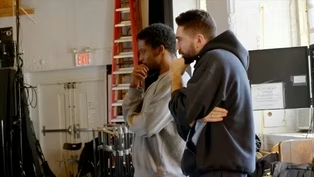
Baye & Asa in Rehearsal for CORTEGE 2025
Video has Closed Captions
Choreographers Sam and Amadi reveal the challenges and elegance of working with the Graham troupe. (2m 39s)
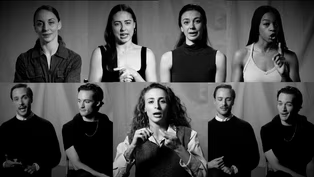
The Dance Troupe Reveals Their Injuries
Video has Closed Captions
The Graham dancers let loose with a laundry of list of injuries that have befallen them. (1m 36s)
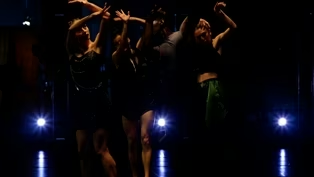
Video has Closed Captions
The Graham troupe are invited to join a group of Flamenco dancers in Sevilla, Spain. (2m 47s)
Providing Support for PBS.org
Learn Moreabout PBS online sponsorship

- Arts and Music
The Best of the Joy of Painting with Bob Ross
A pop icon, Bob Ross offers soothing words of wisdom as he paints captivating landscapes.











Support for PBS provided by: