Treasures of New York
Museum of Jewish Heritage
4/12/2026 | 26m 46sVideo has Closed Captions
Explore the Museum of Jewish Heritage – A Living Memorial to the Holocaust
Situated on the southern tip of Manhattan, the Museum of Jewish Heritage – A Living Memorial to the Holocaust dedicates itself to preserving one of humanity’s darkest moments in the hopes of building a better future. In Treasures of New York: Museum of Jewish Heritage, see how this remarkable institution educates through remembrance, combats hate, and ensures that the past is not forgotten.
Problems playing video? | Closed Captioning Feedback
Problems playing video? | Closed Captioning Feedback
Treasures of New York is a local public television program presented by WLIW PBS
Treasures of New York
Museum of Jewish Heritage
4/12/2026 | 26m 46sVideo has Closed Captions
Situated on the southern tip of Manhattan, the Museum of Jewish Heritage – A Living Memorial to the Holocaust dedicates itself to preserving one of humanity’s darkest moments in the hopes of building a better future. In Treasures of New York: Museum of Jewish Heritage, see how this remarkable institution educates through remembrance, combats hate, and ensures that the past is not forgotten.
Problems playing video? | Closed Captioning Feedback
How to Watch Treasures of New York
Treasures of New York is available to stream on pbs.org and the free PBS App, available on iPhone, Apple TV, Android TV, Android smartphones, Amazon Fire TV, Amazon Fire Tablet, Roku, Samsung Smart TV, and Vizio.
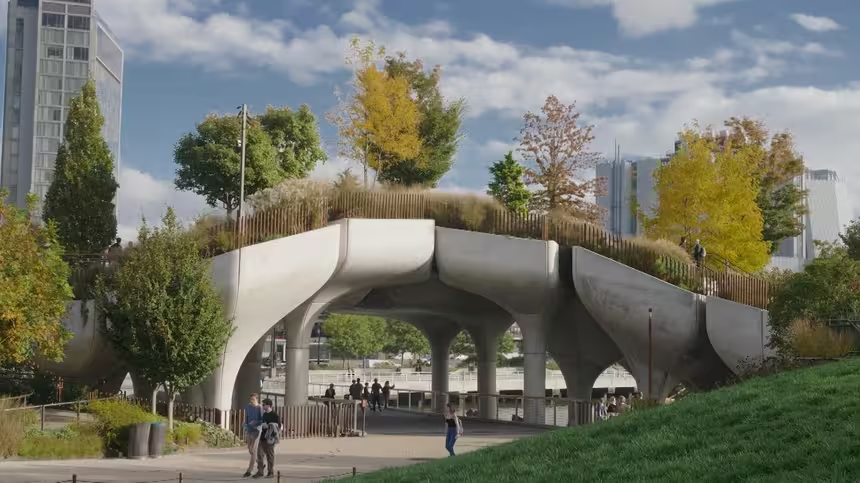
Discover Little Island
Little Island is a green retreat, offering live performance and interactive experiences.Providing Support for PBS.org
Learn Moreabout PBS online sponsorshipIt's a museum where Jewish history speaks in the first person.
Sharing testimony is just the most essential point of connection.
It's my story.
I've lived it.
I've been through it all.
Where loss and survival are indelibly intertwined.
It not only talks about hatred, but it talks about the beauty of Jewish heritage.
If we understand a particular culture, we're going to understand humanity more broadly.
And intergenerational connections are forged.
It showed me like, wow, these are actual people and people going through the museum might have the same revelation that I did.
A critical endeavor to ensure that the past is not forgotten.
It's a history that can help us make better decisions as community members today.
You've got to learn the lessons of what hate can do and never let them be repeated.
It's wonderful to have an institution that celebrates the present and the opportunities for the future.
Step inside the Museum of Jewish Heritage.
A living memorial to the Holocaust and a treasure of New York.
On the southern tip of Manhattan, in a most dignified structure, overlooking New York Harbor, Lisa Baer flips through the pages of her childhood passport.
How old was when the photo was taken?
Probably 11.
Changed a little bit.
There was a big red J on it and everybody knew you were a Jew.
The passport isn't just proof of her identity, but a historic document chronicling her survival.
It's amazing how many visas there are involved.
All with a, certainly, you can see the stamps with a swastika.
How much red tape there was, you know, to get out.
It's one journey in all these pages.
Lisa is a Holocaust survivor.
One of the last living witnesses to the cruelties that befell the Jewish people during Hitler's rise to power.
Fortunately, in 1940, she and her family escaped Germany, finding refuge here in the United States.
I mean, there's so much to the story.
There's, you know, so many details when I talk that I think about.
I'm the last one, literally the last one of the family.
This little thing, I think, is my visa to America.
A little stamp that's a stamp of freedom, actually.
She and other survivors can recall their stories freely and proudly at the Museum of Jewish Heritage, a living memorial to the Holocaust.
It's important for my story and other stories to be told to the next generation, but it's important, perhaps more important, to be told to the generation after that, and the generation after that.
Even if you know a lot about the Holocaust, and you know a lot, like I came in with obviously previous knowledge of it.
Do you think this uniform belonged to a man or a woman?
There's always more to learn.
We're a storytelling institution, whether it's our exhibitions, our programs, we all tell a story, and we try and tell the story of the individuals.
Within these hallowed walls, the museum has dedicated itself to preserving this dark period of history, in the hopes of building a brighter future.
It offers a reminder of what can happen when things go poorly, when bad decisions are made.
And knowing that we can learn from those mistakes, as horrible as they were, to hopefully create a world that's better for future generations is really important.
There is a lot of anti-Semitism and hate towards a lot of groups.
And I want to do my part in trying to mitigate that and trying to understand the issues more.
Jewish heritage is so vast and so rich beyond this 12-year period in not only Jewish history but world history.
And so this idea of having an emphasis on Judaism as much as an emphasis on understanding the dark periods in history is really important.
Not only does it talk about the atrocities, it also talks about the joy of life before for Jewish people and communities.
[soft piano music] Historically, New York City has been an intergenerational refuge, home to the largest Jewish population in the diaspora.
And yet, it lacked a proper memorial to commemorate the 6 million Jewish victims who perished in the Holocaust.
That is, until 1981, when Mayor Ed Koch stepped in.
He had fought and served in World War II as a soldier.
And he had seen firsthand what happened.
So he always had a commitment to teach the lessons of that history.
And the fact that he was Jewish on so many levels had an impact.
So for him it was very personal.
He created something called the Task Force on the Holocaust.
And we issued a written report.
And the report, the bottom line was that we should create a living memorial to the Holocaust.
And in 1982, the New York City Holocaust Memorial Commission was established.
In time, a location for the museum was proposed.
One that held great significance.
The base of Battery Park City.
Where it sits is at the precipice of so much.
You know, you can see Ellis Island.
You can see the Statue of Liberty both symbols of freedom of opportunity.
And I think that there's a lot in the Jewish story that connects to that.
Pritzker Prize-winning architect Kevin Roche was tasked with designing a building that would together serve as a poignant reminder of loss and a living emblem of hope.
It has six sides, which comes along with the hard history because it represents the six million Jews that perished during the Holocaust.
But it also is meant to represent the six sides of the Star of David.
And that is an incredible symbol that has carried through with the Jewish people.
It was designed to have three floors, each one going higher up, so that the story lines could be told sequentially.
And that's because the mission of the museum was always to describe the Holocaust within the context of Jewish life, before, during, and after the Holocaust.
Who were the Jews?
What life did they have?
How were they killed?
And how did they rebuild their lives?
Over a decade in the making, the Museum of Jewish Heritage opened to the public on September 15, 1997.
I think it was another way to say that there is a home in the United States to go and explore and think about this hard history.
A place where people can see and learn together.
I mean also a place where other communities, people who have different backgrounds, different families, stories of origin, can come and learn about what happened to the Jewish population during World War II.
It embodies the history and the potential future of the Jewish people.
It's a way of attracting people to a place where they can understand what has happened before.
Soon after opening, it became clear that more museum space was needed.
To grow its reach, an expansion was in order.
We needed space to bring in more people, to create more resources for the community, and to have some additional exhibition space other than just the core, but also to have a theater where we could have programming.
The plans were put in place to build what is an eastern wing of the original building.
In 2000, a ceremonial groundbreaking took place, and construction began soon after.
Some three years later, the Robert M. Morgenthau Wing opened.
This state-of-the-art, 82,000-square-foot addition more than doubled the museum's capacity.
It also created an opportunity to expand outdoors.
Artist Andy Goldsworthy was selected to dream up a unique installation called "Garden of Stones."
He purposely took big stones, hollowed out the insides, and put a small planting of a tree inside so that the tree would grow and life would come out of the stone.
And the Holocaust survivor families planted each tree.
There are 18 of the stones.
And this is a commemorative installation designed to show how life can reemerge from even the hardest surfaces.
Judaism is so much connected to seasons and the cycle of the seasons.
Just how the memorial is connected to the seasons, the museum is connected to its environment.
It serves its environment.
To an educational capacity, through a memory capacity.
Hello everybody and welcome to the Museum of Jewish Heritage.
I'm Isaac Simon.
I'll be your tour guide today.
Upon entering, visitors encounter the museum's core exhibition, The Holocaust, What Hate Can Do, a chronological journey of Jewish life before, during, and after this horrific catastrophe.
So this synagogue, along with other synagogues, Jewish businesses, and homes were systematically destroyed in an event known as the November pogrom.
Visitors become immersed in another time and place, punctuated by the profound stories of those who experienced these atrocities firsthand.
For Jack Kliger, this exhibit holds a deep personal connection.
That's my mother's photo.
It was taken in April of 1944, shortly after the Germans had marched in to Budapest.
The first thing they told everybody is they had to wear a Jewish star.
You'll notice that the Jewish star, it was cut from a piece of cloth and my mother sewed it on very hastily.
Her mother did.
She's 14 years old, the world's blowing up around her.
She's told to wear an identifying mark and she didn't know what the future held.
There's a combination of sadness that this was what she was going through at that point in her life, but also that smile was the smile she wore the rest of her life.
And it was both inside as well as outside.
So she was a very positive person.
So I feel proud.
This photograph of Jack's mother and other historical objects like it have been generously donated to the museum for preservation, contemplation and study.
The Museum of Jewish Heritage has a really amazing collection of over 45,000 objects and that includes everything from artwork to household items, ritual items, as well as documents, passports, letters, photographs, all documenting stories of Jewish life.
and constantly growing and often with a very New York story attached to them.
And every object is really speaking towards a unique history in and of itself.
A lot of works in our collection are not necessarily something you would look at and see as a valuable object or a significant object.
But hearing the story behind it really changes how you perceive it.
What you see here are all of the U.S.
affidavits that Lisa's mother had to secure in order for the family to enter the United States.
Everybody tried to get a visa to go somewhere, especially America.
Lisa Baer, who we met earlier, donated over 300 personal items to the museum, which document her family's escape from the Third Reich.
The council looked at my mother and three young kids, and he said, "You're going to be a ward of the America.
The only way that you will get a visa is if you can get $7,500 in your name in America."
And miraculously, the family got this money together from complete strangers who contributed to it.
Lisa's items really are emblematic of everything that our entire collection represents.
Survival, persistence, Jewish agency, identity, but also migration coming to the United States, including New York.
Here you can see a list of all of the expenses that Lisa's mother was keeping track of as they were leaving Germany.
The more I think about it, the more I admire her that she didn't fall apart with all this.
She was just a very upbeat person, despite all that was going on.
When we landed, we literally just walked off with our luggage.
You know, we were free.
We were in America, in the Golden Medina, the Golden Land, and you know, we all made it.
Survivors such as Lisa share their experiences in an official capacity through the Speakers Bureau.
Our speakers are engaged in this very noble act of writing themselves or speaking themselves into a collective narrative.
When Lisa Baer speaks with students in particular, her experience is a first-hand experience of Kristallnacht or the Night of Broken Glass.
It was late afternoon and like three or four burly guys broke down the door of our apartments.
So my mother, who was a short woman, five foot something, and she put her hand on one of these guys' arms and he said, "Listen, you can do in my apartment whatever you want.
You can take whatever you want.
Whatever you see you want.
You can smash whatever you want.
Please do not go upstairs.
My old parents live there.
They don't really don't know what's going on.
They'll be petrified.
And, you know, just, you know, I'm asking you.
I mean, she had the nerve to actually put her hands on this guy who could easily, who was probably twice her size.
And I remember literally hanging on to her apron strings, literally, because I was very scared.
And I guess the guy had a little bit of a heart, and he told his men, "Take what you want.
Let's get out of here."
And it was the wake-up call for everybody.
You know, we gotta get out of here.
Ernest Brod is another speaker who imparts his and his brother Manfred's story of survival.
Just three weeks or so before I was born, the Germans marched triumphantly into Vienna.
My mother heard about something called a Kindertransport, and she decided that the best opportunity for all of us to survive would be to send Manfred off so that she could continue to struggle with just the one child.
The ones that were still there, the Nazis decided on a roundup.
All the Jews of Vienna were required to report to, I'll call them encampments.
I had been a colicky child and coughed and sneezed and made terrible noises.
And the guard said to my mother, "Get him out of here before he infects us.
Take him to a doctor."
She went directly to the American consulate.
There was a visa in place for us to get to America under the very restricted quota that existed at that time.
That my mother was able to survive and keep us alive during that period of time is kind of hard to understand.
Survivors stories teach us a lot of things.
They teach us about hope, about grief.
And often, most importantly, they teach us about continuing.
The kids will remember that they actually saw a survivor.
They saw somebody who went through all this and still built a life for themselves.
I feel that it's important for them not to just learn it as history, but to learn it more as a real-life experience.
The Museum of Jewish Heritage has taken testimony one step further with survivor stories, an interactive dialogue for the future.
Were you in hiding?
I was in their house and eventually in the barn and that's where I was hidden.
It's an online exhibition but we have ways that you can view it on site.
And it's an opportunity to interact with ten of our own Holocaust survivors from our Speakers Bureau and ask them questions about their story and their journey and hear what they have to say as they reflect on their time during World War II and the Holocaust.
And while we are standing on the roll call, we were being selected for the gas chamber, the most feeble ones first.
Survivor stories is definitely the future of Holocaust testimony.
I can attest to firsthand the emotional power of being able to interact with someone who isn't directly in front of me.
We know that soon we'll be in an era in which we don't have first-hand accounts of what happened during the Holocaust.
Being able to hear the stories from the survivors opens up a world that we never experienced.
Another compelling interactive exhibit is called Courage to Act.
Designed specifically with children in mind, it highlights the heroism of ordinary Danish citizens who saved nearly 95% of their Jewish population during the Holocaust.
There's three composite characters.
They're presented as holograms in the exhibition.
Any way to mess with German soldiers without putting yourself or others at too much risk, take it.
There's an opportunity actually for students to physically touch a number of different objects in the exhibition.
Those opportunities for students to feel like they're part of the story in that sense while they go through is really important.
Kids like to know what happened.
They like to know what was experienced, where it was, who was a part of it, because there's always more to understand about the Holocaust.
In catering to this insatiable curiosity, the museum has expanded its educational offerings with its own high school apprenticeship program, which gives a group of New York City students an inside look at running a museum while exploring Jewish heritage.
Anita was only allowed to go outside sparingly, and all of that took place at night.
I've learned that a museum is a lot more than just artifacts and, you know, an exhibit.
There's so many different parts that go into it that I didn't even think of it when I applied.
A place like this teaches you more in-depth, more individual stories and actual facts, events, emotions and everything, which is something people need to know.
I didn't know that much about Judaism when I first came here, so I've just been getting to learn more about that.
You also get to work with others and be able to teach others things.
Yeah, you get a lot out of it.
Teaching, study, education, that's our guiding principles.
So, in turn, to be a teaching institution is to honor our heritage.
That's really what our heritage is.
Jewish Heritage is further illuminated at the Peter and Mary Kalikow Jewish Genealogy Research Center with millions of records at your disposal.
The Kalikow Center contributes to the museum's overall mission in terms of putting together, understanding the individual histories, the genealogies of people, where people came from, how their families developed over time.
This is my great-grandfather and this is that he was born on March 8th, 1867 in Kishinev, Bessarabia.
This is that texture, this is the shading, this is the color that brings history to life.
In the U.S., and particularly in New York, survivors and their children came here without long family histories.
And so there is and was always a sense of rootlessness that they had.
And finding their connections through history, through genealogy, gives them an ability to actually, in a way, go home.
Visitors are also reacquainted with their cultural roots through curated events.
The museum interacts with living memory on a language level, on a movie level, on a book level, on a food level, on a dancing level.
So in every domain you see in life, this museum encapsulates the Jewish experience behind it.
Two-thirds of the photographs are in black and white, and one-third of the photographs are in color, to reflect that two-thirds of European Jews were murdered during the Holocaust, and one-third survived.
Since its inception, the Museum of Jewish Heritage remains resolute in its ongoing mission of educating through remembrance and combating hatred through empathy, compassion, and justice.
If people don't know about the really hard things that happen, people don't hear about the struggles, people don't understand that sometimes really bad things are part of what came before us.
We can't make today better.
Survivors and members of the community will know that there will always be a place where people can learn and teach and teach future generations.
Passing things down from generation to generation is so essential to our people.
And for the people hearing it, to learn from the history, to know that there was such a thing as a Holocaust.
What message do you have for young people?
I want people to be aware that all this anti-Semitism, don't sweep it under the carpet.
Like we did in 1934, we always said, "Oh, it'll all go away, it'll go away," but it doesn't go away.
History could repeat itself, and we cannot ignore any of the things that are happening as far as anti-Semitism is concerned.
We have to be aware of it, and we have to tell our children to be aware of it.
Yes, it can happen anywhere.
Funding for Treasures of New York, Museum of Jewish Heritage, a living memorial to the Holocaust, is made possible by, the Sylvia A. and Simon B. Poyta Programming Endowment to Fight Anti-Semitism.
[Music]
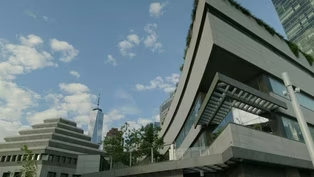
Museum of Jewish Heritage - Preview
Explore the Museum of Jewish Heritage – A Living Memorial to the Holocaust. (30s)
Providing Support for PBS.org
Learn Moreabout PBS online sponsorship










Support for PBS provided by:
Treasures of New York is a local public television program presented by WLIW PBS