
Quick Questions with Hasan Minhaj
Clip: Season 2 Episode 1 | 1m 46sVideo has Closed Captions
Comedian Hasan Minhaj answers a series of quick questions with host Sophie Elgort.
What is Hasan Minhaj’s pre-show ritual? What makes him nervous? Does he prefer rehearsed or improvised performances? Host Sophie Elgort gets the scoop from the comedian in a series of rapid-fire questions and a round of “This or That.”
Problems playing video? | Closed Captioning Feedback
Problems playing video? | Closed Captioning Feedback
Portrait Mode with Sophie Elgort is a local public television program presented by WLIW PBS
Quick Questions with Hasan Minhaj
Clip: Season 2 Episode 1 | 1m 46sVideo has Closed Captions
What is Hasan Minhaj’s pre-show ritual? What makes him nervous? Does he prefer rehearsed or improvised performances? Host Sophie Elgort gets the scoop from the comedian in a series of rapid-fire questions and a round of “This or That.”
Problems playing video? | Closed Captioning Feedback
Where to Watch Portrait Mode with Sophie Elgort
Portrait Mode with Sophie Elgort is available to stream on pbs.org and the PBS app.
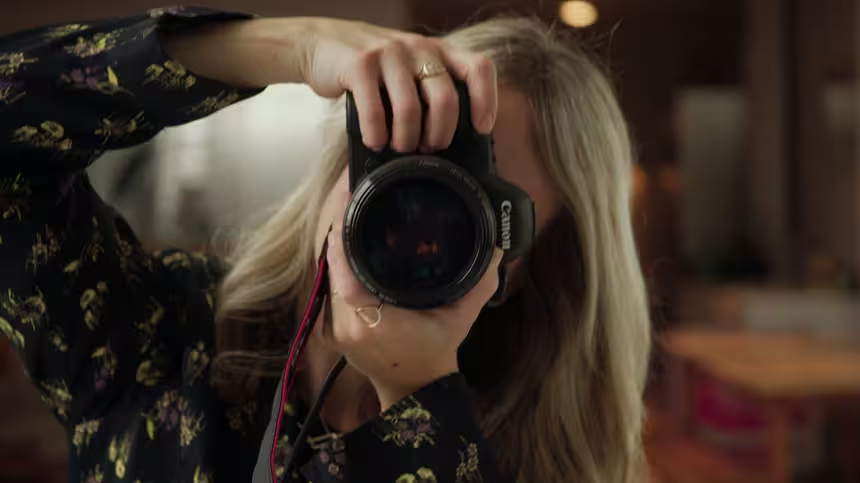
Capturing the art of conversation
In “Portrait Mode with Sophie Elgort," the photographer interviews iconic artists Nile Rodgers, Rita Moreno, Skylar Brandt and Arthur Elgort.Providing Support for PBS.org
Learn Moreabout PBS online sponsorship- Rapid fire.
Ready?
- Locked in.
- Last person you texted.
- My wife.
- Worst pers- - Worst person you, wait, that's, Sophie, that's you.
- That was not right.
- So this is your, what a Freudian slip.
- Worst advice you've ever received.
- Be yourself.
- Something that you've changed your mind about.
- Cold soup isn't that bad.
- Gazpacho?
- I used to think it was the worst.
Gazpacho is actually decent.
Ceviche is beautiful, it's a wonderful dish.
I used to think cold soup was the worst.
I've changed my mind.
- What's your pre-show ritual?
- I drink an espresso.
- The thing people assume about you that's usually wrong.
- That I'm always happy.
- Question you're tired of being asked.
- Tell me a joke right now.
- Something that still makes you nervous.
- I would say meeting people for the first time.
I think it's a lot.
- I have that too.
- There's a lot of expectation on it.
It's intense.
- Something from your career you still think about.
- My first open mic.
- Thing that you're most proud of.
- My children, my family.
- Okay, now we're gonna do this or that.
- Let's do it.
- Rehearsed or improvised?
- Improvised.
- Watching comedy or watching drama?
- Watching drama.
- Reading the comments or ignoring them?
- Ignoring them.
- Morning person or night owl?
- For sure, night owl.
But I have to be a morning person now, unfortunately.
- I understand that.
- Yeah.
- Writing or performing?
- Performing.
- Big laugh or slow burn?
- Slow burn.
- Air Jordans or Air Force 1s?
- Air Jordans.
- LeBron James or Steph Curry?
- LeBron.
- Slam dunk or three pointer?
- I wish I could slam dunk, so slam dunk.
- Jon Stewart or Trevor Noah?
- Oh my god, both.
Both, they're the best.
They're both the best, I love you both.
- That's it.
- That's it, yay.
Thank you.
- You write your sets.
- Yeah.
- Do you like writing it better or performing it?
- I like coming up with the idea, talking it out with a friend, or putting just like bullet points on a piece of paper, putting it on stage, and then the moment you get a laugh or a response, you're like, "Oh, that's it."
And for me, comedy was always this way to make sense of a chaotic world that didn't make sense.
It gave me a sense of control in a world that I didn't have control over.
- Making people laugh, is it something that makes it easier for them to hear something that might be true?
- Totally, and it's an involuntary reaction.
You can't make someone laugh.
So people can fake laugh in front of their boss- - Yeah, yeah, yeah.
- But if you make a room of people laugh, they can't help it, and I think it's really powerful.
There's a lot of conversation that says that comedy can be too mean or it can be not in good taste.
But there's another way to look at it, which is you can talk about things that are really dark, death, war, famine, tragedy, pain, suicide, and if you can laugh at it, you are now telling that thing, that boogeyman, that, "You don't control me.
You're not as scary as I thought you were."
And I think that's a very affirming way to also look at it.
And I've been able to think of it that way.
Like to me, it has been a gift that's changed my life.
- So can you tell me about your time on "The Daily Show"?
- It was my comedy undergrad.
I basically got to learn from Jewish Yoda, Jon Stewart how to be funny, how to have a perspective, and how to make a point.
At that point in my career, I knew how to write a joke, but Jon really taught all of us that there's different levels to the types of jokes, almost like, I don't drink, but there's top shelf liquor, and then there's frat house.
- The cheap shots.
- Yeah, there's like frat house beer that you could have, from a keg.
And so, Hasan, you can tell all sorts of poop jokes, and fart jokes, and stupid, silly jokes, but that's the keg beer that you have at a frat party.
And then there's really sophisticated joke writing, satire and humor that is just top shelf.
Like, oh wow, the way you constructed that turn, the language you used, the voice, all of it together.
I just, I grew up and I matured as a comedian on that show.
- So what's something that viewers wouldn't know about your time at "The Daily Show"?
- So a lot of people think that when you come in at 9:00 and you're in the pitch meeting, people think that it's just a joke machine.
But you actually start with looking at footage that can be very depressing, I'll be honest.
You're watching like CSPAN and CNN and Fox News.
It'll make you go crazy.
But you start with the argument that you're trying to make.
And that was something that was just a complete light bulb shift moment for me, which is, what are you trying to say, that's the foundation of what you're doing, and then jokes are just like the scaffolding around it.
And I always thought it was the other way around.
- That's really interesting.
- Yeah.
- Let's put the stool in.
I'd love to, while we still have this beautiful light.
And again, it's like every time I snap, you can shift a little bit in the chair.
I like that.
(camera beeping) That's good.
(shutter clicking) I know you have a podcast too.
- Yes.
- [Sophie] And you've interviewed insanely cool people on it.
- Yes.
- [Sophie] Malala, Barack Obama.
- Not trying to brag.
- How do you decide who you wanna interview?
- Either they have to have deep domain expertise, or I think that the juxtaposition of me and them would be very interesting.
So 40-year-old married man, father of two, talking to a 13-year-old boy about male loneliness, friendship, and then of course fractals and the coastline paradox, to me, that's very funny.
- Is there anyone on your dream list to interview?
- Muhammad Ali would be someone that I would have loved to interview, who he was as a civil rights activist, as a performer, what he stood for.
He was so many things.
He's really interesting to me because, when he was alive and they took away his titles, he was lambasted in the media, in the press.
He was not loved the way we love him and revere him now.
And I think it would be so cool to talk to someone like him now.
And so he was massively inspirational to me as a comedian.
I would say somewhere between Muhammad Ali and Bugs Bunny.
Those are two people I'd love to interview.
- Bugs Bunny.
- Icon.
Iconic comedian.
- Icon.
(camera whirring) - What a great sound.
- It is a good sound.
- Those are great.
You don't really hear that anymore.
(camera whirring slows) - You think you like that sound?
Listen to this sound.
(camera whirring) - Get my mic next to it.
Yeah.
I mean, that's great.
- I know you brought a photo - Yes.
- From your childhood.
- Yes.
- And we're gonna recreate it.
Tell me about the story behind the photo.
And why did you choose this one?
- So the year is either 1993 or 1994, I'm somewhere between eight or nine years old.
This is me.
That's me.
This is my younger sister, Ayesha.
Sometimes my parents would take us to toy stores.
My parents would let us play with toys in the toy store and we'd get super excited and I'd be like, "Oh my god, can we get this toy?"
And my parents would be like, "No, no, no.
But you can take a picture with it, it'll last longer."
So we have a photo album of all these toys that we never got.
And this photo is just a perfect summation of what comedy is like the fact that my parents brought young children to toy stores and just had them take photographs with it because a picture would last longer, is that incredibly painful or hilarious?
And I would say it's both.
Bring it.
- Bring it.
Okay, you have it in your right hand.
- Yes.
- Your other hand is kind of up.
- Here.
- Yep.
So that's what we need to do.
- Sure, sure.
I wish I could time travel.
- Hold on a little.
Will you move back a little bit, please?
- And go meet 8-year-old Hasan, be like, "You will own this one day."
This will all be yours one day.
- Okay, hold it.
And then let me do it on film.
Take yourself back to the moment.
(camera whirring) (intriguing music) So I know you brought a special object today.
- Yes.
- What did you bring?
- This is a very beautiful gift that was given to me by Dr.
Henry Louis Gates, who is an incredible history professor, but also someone who hosts the show "Finding Your Roots" on PBS.
When you do the show with him, he presents you a "Book of Life."
- So beautiful.
- And this is the collection of my family's story, going back several generations.
- Amazing.
- As a child of immigrants, this is something we oftentimes don't have access to.
It just means the world to me.
Probably the most moving thing is the story of my grandmother.
Going on the show, I learned that she was not raised by her biological parents.
She was raised by her maternal aunt and uncle.
And she had to live in British Civil Lines, which was basically pre-independent India.
There were sections that were similar to what was modern America Jim Crow, where Indians were allowed to live, and then Britishers lived.
She was able to access British schools through her caregivers.
And learning about her strength and resilience was really powerful to me.
This woman who raised me and my younger sister, and would give us chicken nuggets and hotdogs after school, was also this incredibly resilient person who was just an incredible human being.
She has now passed, but I think about her resilience and that she lives inside of me.
(kiss smooching) This is my Nani, who I love.
I love her very dearly and I miss her a lot.
- And then I loved how you had your fingers, you had one hand on the top.
So I wanted to ask you about family.
- Yes.
- And I know you talk a lot about your family.
- Yes.
- And now you have kids.
- Yes, I do.
- And a lot of your comedy has always been rooted in like real stories.
- Yes.
- Does this get messy now?
- Now that they're getting a little bit older, I have to navigate how much of this is gonna mess up drop off and pick up.
So right now I have a second grader, I have a kindergartner.
They're cool with it.
They're cool with it for now.
But I feel like we're a few years away from them being like, "What's going on?
What's happening on stage?"
- And is it harder to tell the truth and tell jokes in this time than when you started?
- The art form, it's grown a ton.
For me, the thing that I always have to navigate is I'm triangulating a bunch of different people in my life.
It's my parents' story, it's my sister's story, it's my story, it's my wife's story.
How do they all feel about this?
So I have to make this milieu of, okay, I'll take this from this story with me and my cousins, I'll take this from this story of me growing up.
Like you kind of merge things and you're kind of telling your entire family's story in that way.
But you gotta be, yeah, it's always like, it's super nerve wracking, the San Francisco shows, whew.
- Why the San Francisco shows?
- Because you just got, like I got my sister there and my brother-in-law there, I got my wife's family, there's just a lot of people that are like, "All right, let's see what he's talking about."
- So you're navigating not only the crowd of strangers- - Yeah.
- But the crowd of family.
- Yeah, like I'm saying **** in front of my mother-in-law.
This is not good language.
- I've been directing you the whole time.
- Yeah.
- But I know you're used to being also kind of a director.
- Okay.
- Would you be willing to turn the camera on me and tell me what to do for once?
- I don't know if I'm a director, per se, but I can pitch.
I have some- - Pitch it.
- Pitches, okay.
I'll have you stand here.
It's the light, as you know, light, composition.
- Light, we need the light.
I appreciate you.
- Thank you, sir.
This is my assistant.
This is, you know photographers do.
- Tell me something that I'm doing that looks good.
- You had me doing this, looking this way.
- [Sophie] Yeah.
You want me to do that?
- Let's do that.
Yeah, yeah, yeah.
- This is not my side.
- Scratch that.
Cut that pitch.
- All right.
- That pitch is killed.
It's off the board.
- Thoughts?
- That's great.
Yeah.
Fantastic.
- I like how you're treating it like it's a precious object.
- Totally, I think about this all the time with my kids and my laptop and hard drives.
I'm like, "Don't, don't, don't, don't, don't throw that."
- Yeah, me too.
- One last one for safety.
And it's a wrap on Sophie Elgort, ladies and gentlemen.
- It's a wrap.
- Wow.
Thank you, Sophie.
- Thank you.
Thank you so much.
- Thank you so much for doing this.
- [Sophie] I appreciate you.
(upbeat music) (upbeat music continues) (upbeat music continues)

- Arts and Music

Innovative musicians from every genre perform live in the longest-running music series.





 New Episode



Support for PBS provided by:
Portrait Mode with Sophie Elgort is a local public television program presented by WLIW PBS