Signature Dish
Taqueria Time
Season 4 Episode 7 | 29m 1sVideo has Closed Captions
La Tingeria in Falls Church, Taqueria Xochi in Arlington, Ixtapalapa in Gaithersburg
In this episode, Seth goes beyond tacos to uncover the true depth of local taquerias. He begins his journey at La Tingeria in Falls Church, where he enjoys the namesake tostadas de tinga. Next, he heads to Navy Yard for Taqueria Xochi, savoring a stacked Pueblan sandwich, the Chicken Cemita. Finally, he stops at Ixtapalapa in Gaithersburg to indulge in a festive Mexican soup: pancita.
Problems playing video? | Closed Captioning Feedback
Problems playing video? | Closed Captioning Feedback
Signature Dish is a local public television program presented by WETA
Signature Dish
Taqueria Time
Season 4 Episode 7 | 29m 1sVideo has Closed Captions
In this episode, Seth goes beyond tacos to uncover the true depth of local taquerias. He begins his journey at La Tingeria in Falls Church, where he enjoys the namesake tostadas de tinga. Next, he heads to Navy Yard for Taqueria Xochi, savoring a stacked Pueblan sandwich, the Chicken Cemita. Finally, he stops at Ixtapalapa in Gaithersburg to indulge in a festive Mexican soup: pancita.
Problems playing video? | Closed Captioning Feedback
How to Watch Signature Dish
Signature Dish is available to stream on pbs.org and the free PBS App, available on iPhone, Apple TV, Android TV, Android smartphones, Amazon Fire TV, Amazon Fire Tablet, Roku, Samsung Smart TV, LG TV, and Vizio.
Providing Support for PBS.org
Learn Moreabout PBS online sponsorshipANNOUNCER: And now, "Signature Dish," a WETA original series.
SETH: Today on "Signature Dish," it's taqueria time.
We're exploring the menu beyond tacos.
All right, you did not come to play.
Mixing things up with a top-shelf tostada.
DAVID: All that chicken's going to absorb all that juice.
SETH: There's so much flavor in there.
A supremely stuffed sandwich.
GERALDINE: The bread is a brioche.
It's going to be very sturdy.
SETH: And it's got to be sturdy because it looks like it's going to be supporting- GERALDINE: It has to hold a lot- SETH: ...a lot of ingredients.
GERALDINE: Yeah.
Definitely.
SETH: And a cure for what ails ya.
Okay, so we are using every part of the animal today.
TERESA: Yep.
SETH: That is just what the doctor ordered.
I'm Seth Tillman, WETA producer and DC native, and I love good food.
Nice to meet you.
That's why I'm traveling to restaurants across the DMV, at each stop, looking for the one thing you just gottta try... that Signature Dish.
We're first headed to Falls Church, Virginia.
Just off a busy stretch of South Washington Street is La Tingeria, helmed by Mexican American chef and owner David Peña.
DAVID: My father's from Aguascalientes, Mexico, and my mother's from Mexico City.
My father actually got here by accident.
They were telling him that there was a big opportunity in Washington to pick apples, so he told the people to send him to Washington and, when he came over here, they actually brought him to DC, so he was, like, "Where's the apples?"
I started doing construction when I was 16, 17.
And you know, I was getting paid well, and I thought, honestly, that was what my life was going to be.
But I've always had a passion for cooking ever since I was little.
SETH: Making a career change in his mid-20s, David began working in the kitchen at the Arlington stalwart Rustico, eventually, working his way up to sous chef.
DAVID: At some of these bigger restaurants, everybody has a meal together.
So we'll cook whatever we can and make a family meal.
We had leftover chicken and onions, so we just started doing our chicken tinga.
That's a family thing.
We've always did chicken tinga for like special birthday parties, New Year's or for like Christmas.
Eventually, they would make me do it like at least once a week, then once a week finally became twice a week.
And, one day, one of the guys, he was, like, "Hey, when are you going to open up La Tingeria?"
And the name clicked in my head, and it stayed there.
That dish, tostada de tinga, is one of those that I could never really find anywhere.
And if they did sell it, it was just... something was off.
It either was just too tomatoey, the onions were still too rough, so I was, like, "You know what?
Then I'm just going to put my faith in my own hands," and I decided to open up my own truck.
SETH: After eight years of running the truck, David dropped pork from his menu and embraced a fully halal kitchen.
DAVID: Once we started promoting halal, like we would sell out within the hour, hour and a half.
People were already waiting in line before we even opened, so that's when I really found out that was something that was missing.
That demographic of people weren't able to eat Mexican food.
SETH: The popularity of the halal menu led David to open up shop in Falls Church in 2021.
DAVID: It's been really an emotional ride.
It's been great.
Thank you, guys.
Enjoy.
Sometimes, I still can't believe it, you know.
And you see so many taquerias here, so we wanted to show that we were different.
Especially if you see all the artwork that we have here.
Like we're not filled with these Mexican clay pots and the Mexican flags and the sombreros.
We honestly just let the food speak for itself.
And we have our own vibe at La Tingeria.
SETH: Hey, David.
DAVID: Hey.
SETH: Hey, chef, good to meet you.
I could smell some onions from the vent fan outside.
What are you making?
DAVID: So, today, we're actually going to do our specialty dish.
And this is what we're named after: tostada de tinga.
SETH: And I see tinga on menus in taquerias all the time, but what is tinga?
DAVID: Tinga is just the marination of the meat.
Traditionally, it's a chicken dish, but we also make a brisket that we braise for eight hours.
Right here, we have our broth, our special chipotle sauce.
We're going to go ahead and blend all this up, mix up our chicken, mix it in with our caramelized onions.
So, before you got here, we had the 50 pounds of yellow onions, sliced them up, put it through our food processor, put a little bit of oil on our griddle top and then let that cook for 20 to 25 minutes until it got that nice, brown consistency.
SETH: Hoo, so you're slicing 50 pounds of onions every time?
DAVID: Almost daily.
So Seth, we make our chicken stock ahead of time.
We have some chicken bones, some carrots, some celery, some onions.
We roast that all up and then let that cook for about eight hours.
Once that broth is done, we strain it up, add our chicken breast, poach it for about hour and a half to two hours.
Once the chicken is done, we take it out.
And that's the product you see right here is the chicken once it's done poaching.
SETH: Lots of chicken ready to shred up.
Are we going to be shredding that by hand?
DAVID: No.
So that's what I used to do at the truck, but this guy saw me sweating one day in the hot heat, and he helped me out, because they do barbecue, so he surprised me with this bad boy.
SETH: You did not come to play today, chef, bringing out the industrial power tools.
(tool whirring) Wow.
DAVID: And that's how you shred 40 pounds of chicken in less than 30 seconds.
SETH: That is amazing.
DAVID: Now that our chicken is shredded, I'm smelling the onions and they're definitely ready, so let's pull that off the griddle top.
And you see how they're brown?
Like, when I started learning how to caramelize, I thought we were overcooking them.
But you know that's one thing the chef just kept telling me, "No, they need to be browner."
The sugar comes out and then coats these onions.
It just makes them really tender while they cook down.
All right, so we're going to add this to our chicken mixture.
SETH: You are not scaling it back for our benefit.
We're talking about a week's worth of tinga here, chef?
DAVID: No.
This is actually for maybe two days.
SETH: Wow.
DAVID: Yeah, so that's why we have to do this like about every single day.
SETH: That's why you are the tinga master.
DAVID: So, yeah, we're going to go ahead and we got our nice, colorful broth right here.
SETH: Oh, wow, yeah, this broth, it smells like the best chicken soup I've ever had.
DAVID: Oh, man, I agree.
And, right now, we're going to get our broth and our chipotle, get this blended up.
Right here is just some chipotle and some other special ingredients that we add but secrets that we can't let it go.
But here's some garlic, fresh garlic.
So I have a little bit of tomato paste in here.
That's one thing I can tell you, but we don't concentrate on putting too much tomatoes in here.
SETH: And, all these chipotle peppers, that'll give you a nice little, smoky counterpart to all those sweet onions, right?
DAVID: Correct.
Yes.
Absolutely.
So, now, we're going to go ahead and blend it up.
SETH: David blends the broth and chipotle sauce together in batches and then adds the mixture to the giant pot of chicken.
Good to the last drop.
DAVID: All right, so we got most of the flavor there.
But, obviously, we're going to have to hit it with a little bit of our kosher salt.
SETH: All right.
DAVID: And now we're going to mix it one more time.
SETH: All right.
Should I stand back here?
DAVID: Yeah.
Sometimes, it goes around everywhere.
SETH: Me and all the crew are standing in the splash zone here today.
(tool whirring) DAVID: So we're just going to add some more broth in there.
SETH: Oh, my God, there's so much flavor in there.
DAVID: All right.
So, Seth, now that we have our whole mixture ready, let's go ahead and let's start building up our tostadas.
SETH: All right.
DAVID: So, traditionally, it's always going to come on a hard shell.
One of the reasons is because it's really saucy.
SETH: So a little heft that's going to hold up this nice saucy tinga?
DAVID: Correct.
We're going to put some of that tinga chicken.
I'm going to get some of this lettuce.
And not too much.
It's not a salad.
It's just to garnish.
The queso fresco and some nice crema.
My classic style is just doing a bunch of zig-zags.
SETH: The chef's touch.
DAVID: Yep.
And there you have it, guys, our signature dish: tostada de tinga.
SETH: That is beautiful.
All right, chef, this perfect little tinga tostada, I can't wait to dig in.
DAVID: Let's dig in.
SETH: Let's get to it.
(crunching) A little bit smoky, a little bit spicy and very, very saucy, that is a terrific tostada.
DAVID: Thank you.
SETH: Perfect little balance of textures.
DAVID: And you can see too, that the onion's not overpowering.
Just because we tenderized and caramelized it so much, it just melts in your mouth as well.
If you think that one's good, wait until you try the eight-hour brisket.
That's where it's at.
SETH: And I've never even heard about brisket for tinga before.
DAVID: You probably will find tinga everywhere else, but it's probably just going to be chicken.
So juicy, that brisket, because of that eight-hour braise, it just holds all that moisture in very well.
SETH: This is all about taking the time to do it right, stewing that chicken, simmering that brisket, sweating out and caramelizing those onions.
DAVID: Absolutely.
You saw sweat, blood, and tears, and you saw me crying while I was slicing up those onions.
If you look at our menu, it's very simple, very small, but it gets us to focus on our main ingredients and just make sure that our quality is top-notch.
SETH: Yeah, and when you walk in, these walls, I mean it's almost mesmerizing.
DAVID: This was actually done by Mas Paz, a close friend of mine.
Mas Paz in English means "more peace".
When I actually met him, we had a name, but we just didn't have a self-identity, so he agreed to do our logo.
And I just fell in love with it, the whole name, this whole brand.
SETH: And, through everything you've done with embracing halal and the local Muslim community, you're all about welcoming all, right?
DAVID: Exactly.
We're just here for everybody.
And the awesome thing is that we actually do all of D.C.
United games, so we're inside of Audi Stadium.
The D.C.
United slogan, "All are welcome, all are united," we thought we would be a great fit because we welcome everybody and we feel that everybody should be united.
SETH: I love it.
And I love these tinga tostadas, but I can't go home without trying something sweeter.
Are we talking churros here?
DAVID: Oh, yeah, these are our big hit.
This is actually our one with our dulce de leche, so you see it'll have that nice, creamy texture in the middle.
It'll have the sugar coating with cinnamon on the outside.
SETH: Wow, that creamy dulce de leche that's hiding inside just taking it to the next level.
DAVID: Yeah, I love them, too.
I mean, I used to weigh 120.
Now, I'm like 180.
And I think it's all part of the churros.
People love when a food can bring back some type of memory.
And every time I smell those in the kitchen, it just reminds me of all the bakeries in Mexico.
SETH: Well, I really thank you for welcoming me into La Tingeria today.
And I know I'll be back here real soon.
Thank you, chef.
DAVID: We'll see you soon.
SETH: For my next stop, I'm off to DC's Navy Yard.
I'm visiting Taqueria Xochi, a pandemic-era popup turned full-service eatery, co-founded by Mexico City native Geraldine Mendoza.
GERALDINE: I always had a love of food growing up.
My mom has always been a great cook.
She was very experimental with things that she will make from different countries or different regions.
Being from Mexico City, it's kind of like a melting pot of all the regions of Mexico.
And I kind of fell in love with the industry, how you can take someone through an experience or a journey to that country.
SETH: Geraldine's hospitality career took off when she began working at China Chilcano, a Peruvian fusion restaurant run by Jose Andres.
GERALDINE: I started working as a server and then worked my way up.
There, I learned how to work the bar.
I feel working at China Chilcano gave me a great foundation on how to have great leadership skills.
During the pandemic, as most people working in the restaurant industry, we got furloughed.
We didn't know how long we're going to be furloughed for.
We're, like, "Okay, what's the next step?"
Because restaurants were our way of living.
With my partner, we were looking at dishes that were good to travel, that could be to-go, but then also something different.
SETH: Geraldine and her partners eventually opened a pint-sized storefront on U Street, focused on selling cemitas, towering sandwiches that hail from Central Mexico's Puebla region.
GERALDINE: Usually, when you open a restaurant, you plan it out for like two years or so.
You do a lot of R&D, a lot of trial-and-error, trying to see what will work, but this was very organic.
SETH: The success of the U Street storefront led to opening several other locations including their first full brick-and-mortar in the Navy Yard.
GERALDINE: Taqueria Xochi, it's a place that you can find Mexican hospitality, Mexican street foods, find those flavors that you'll find in mercados, in the taquerias, in the streets of Mexico.
And it's just like a comforting and reminiscent feeling of, "I want to try something that I would eat when I was younger.
But I couldn't find it here or find exactly the flavor that I will remember it," so, with a lot of hard work, we reached that a-ha moment.
It's, like, "Oh, that's how it tasted when I was younger."
This could be our little love letter to Mexico in a way, try and bring that sense of hospitality, food, authenticity, without being pretentious, just keeping it simple.
And we're very happy how the community has embraced us.
SETH: Geraldine?
GERALDINE: Hi.
SETH: Nice to meet you.
GERALDINE: Nice to meet you.
SETH: I am excited about the Xochi experience.
So what are you making today, chef?
GERALDINE: So, today, we're making a cemita.
It's a sandwich originally from Puebla, Mexico.
So this is what started the whole journey of Taqueria Xochi, and we're very famous for it.
SETH: So this is a pretty special sandwich for you guys.
GERALDINE: Yes.
Yes.
SETH: All right, I've had tortas before.
How is the cemita different?
GERALDINE: So, what makes a cemita, cemita is actually the bread.
The bread is a brioche kind of bread, and it's going to be topped with sesame seeds.
It's very sturdy, and it has a bit of sweetness to it as well.
SETH: Oh, nice.
And it's got to be sturdy because it looks like it's going to be supporting- GERALDINE: It has to pull a- SETH: ...a lot of ingredients.
GERALDINE: Yes.
Definitely.
So, to make a cemita, we first put Mexican mayo on both sides of the bread.
SETH: Mexican mayo?
GERALDINE: Yes.
It has a little bit of lime juice so it helps bring up the other flavors of the sandwich.
SETH: All right, so a little extra acidity?
GERALDINE: Yes.
And we just cover every part of it.
And then, at the bottom, we're going to put our refried beans that we make.
Now we're going to put our chicken milanesa.
So, for the chicken milanesa, before you got here, we sliced some chicken breasts, and we breaded it with some milk, eggs and some seasonings as well as breadcrumbs, and then we just fried it.
And we make it fresh.
Now we're going to put some onions, some tomatoes, and then we're going to put the avocado.
SETH: And I'm always so jealous whenever I come to a good Mexican restaurant.
Avocados like I have at home never look this nice.
GERALDINE: Yeah, it's a little bit hard to find good avocados.
So this is quesillo, which is from Oaxaca Mexico.
This, we pull it, and it melts.
It tastes great.
SETH: This is kind of like a string cheese for grown-ups right here.
GERALDINE: In a way, yeah.
Yeah, it's very similar, some people say, to mozzarella because it melts and how it's stringy.
We have a lot of our cooks come every morning and string out two or three bowls of this cheese.
SETH: I think I would enjoy that job, just pulling apart cheese.
GERALDINE: And then, lastly, we're going to top the bread with chipotle that we blend to give that little kick of spiciness to the sandwich.
So now we're going to put it in the press for about six to eight minutes to give that nice crispiness to it.
(sizzle) SETH: Oh, love that sizzle.
GERALDINE: All right, Seth.
So the sandwich is ready, and we're going to slice it.
SETH: All right.
So the cheese melted a little bit in there?
GERALDINE: Yes.
And, as you can see, you have that crispiness now to the bread as well.
(bread crunching) SETH: Making a wonderful sound as the knife slides through.
GERALDINE: All right, Seth, so this is our Xochi cemita.
As you can see, it's packed to the brim.
SETH: Stuffed to the gills with flavor.
Can we go dig in?
GERALDINE: Definitely.
SETH: Let's do it.
All right, chef, I don't know how I'm going to eat all this in one bite.
I'm just going to go for it.
Wow, that is a stacked sandwich both in terms of its size and its flavor.
Big and bold.
I love the freshness that you get with the avocado and the quesillo.
But I also love the little smokiness that comes with the chipotle peppers.
But my favorite part, that crunch.
GERALDINE: Oh, yeah.
SETH: The crunch of the chicken cutlet and that incredible bread.
GERALDINE: Yes, and that's why the sandwich is called a cemita, because of the bread.
The cemita bread, it brings it all together.
And it doesn't break when you take that bite.
And you still have that crispiness and that sweetness to it.
SETH: Yep, and it looks like we have a beautiful, colorful drink to wash it down with.
What is this, Geraldine?
GERALDINE: So this is called a mangonada.
It's kind of like, in a way, a mango smoothie.
You're going to have chamoy all around the glass.
It's going to be rimmed with a tamarindo and then a spicy powder, Mexican candy and then a tamarind straw.
SETH: All right, a little sweetness always sounds good to me.
Salud?
GERALDINE: Salud.
SETH: Ooh, that's refreshing, but not purely sweet.
GERALDINE: Yeah.
SETH: We get a little of that spice in there as well.
Wow.
This mangonada, the cemita, are these foods that you would just find all through Mexico?
GERALDINE: Yeah.
For example, the cemita, it was originally from Puebla, but now, because it's so popular, you can find it everywhere in Mexico.
There's a lot of street food like our esquites here as well, tlayudas.
It's a very rich and very diverse cuisine.
SETH: And this is the tlayuda here, chef?
GERALDINE: Yes, that's the tlayuda.
So that dish is originally from Oaxaca, but you can also find it everywhere in Mexico.
So it's going to be a very crispy tortilla.
You're going to have refried beans.
For today, we did it with carne asada and chorizo, some nopales, topped with lettuce, avocado and then radishes.
Some people might call it a Mexican pizza.
SETH: Pizza?
All right.
And, of course, it looks like some more of my favorite adult-string cheese on top here.
GERALDINE: Yes.
SETH: And nice and melted, too.
GERALDINE: Yeah.
SETH: Wow.
I'm making a mess, but I love it.
And I think, the nopales, really nice, earthy flavor on that Mexican pizza as well.
And when you guys started this in the dead of the pandemic, could you have imagined that it would have grown from a little storefront to what it is now?
GERALDINE: No.
I think that's what also makes this so special.
It was having worked with Jose Andres' group, having that schooling of hospitality, and I think all that helped us grow.
And it gave us also the opportunity to give jobs to people that we have worked with before.
But, in each store that we open, we learn new things as well.
And we try to incorporate our culture and try to bring that to the city.
SETH: Yeah, and it's one thing to have the knowledge of how to run a restaurant, but these incredible flavors kind of speak for themselves.
And there's a large menu, so I can't wait to come back and try even more.
Thank you so much, Geraldine.
GERALDINE: Thank you.
SETH: My last stop on this taqueria trail leads me up Rockville Pike to Gaithersburg, Maryland.
It's here you'll find Ixtapalapa, named for the Mexico City neighborhood where co-owners Teresa and Jose Valdivia grew up.
JOSE: Hey, are you doing?
PATRON: Doing good.
Thank you very much.
JOSE: I came to the US in 1979, first, to Los Angeles.
Then I really liked Maryland, and then, after a few months, I decided to stay here.
JOSE: When we came here, we would try the Mexican food, and it tastes not at all like Mexican food.
And then we started doing it at home.
We started making the sandwiches and some tacos and gave it to our friends.
And then that's when we come up with idea and say, "We might get a restaurant."
SETH: Jose and Teresa's restaurant career got off to an inauspicious start when they opened Taco Bar at a nearby gas station.
JOSE: And, of course, nobody trusts eating tacos in a gas station.
People said, like, "I don't think so."
At the beginning.
I was this close to throw the towel, and I told my wife, "I'm going to get back to my old work."
And then we started getting better and better.
SETH: The couple opened Ixtapalapa in 2017.
JOSE: We make our own mole.
We have pozole.
We have pancita just on the weekend, and we have tostadas de pata.
So we have more variety, just not just tacos.
SETH: From their humble beginnings, the Valdivias and their children now run four popular Mexican spots across Upper Montgomery County.
JOSE: We have over 100 employees for all four businesses.
We're making them part of the family also.
I feel pretty proud about it, you know, what I'm doing it here in the community.
We've been doing this for 25 years so far, and we're still on two feet.
SETH: I'm off to Ixtapalapa to try a hearty and unique Mexican soup that they only serve up on weekends.
Teresa, nice to meet you.
TERESA: Hola, ¿cómo estás?
SETH: Mucho gusto.
And it looks like we got a lot of stuff cooking on the stove here.
What are you making today?
SETH: All right.
Well, I didn't do any partying last night, but I've heard of Menudo, the band, and the dish.
And, uh, what are we looking at right here?
SETH: And we're using every part of the animal today?
TERESA: Yeah.
SETH: All right, nothing goes to waste.
TERESA: Nope.
SETH: All right.
How do you get started here?
SETH: All right, so cleaning this pancita, cleaning this belly, obviously a key step in this process.
TERESA: Yep.
SETH: All right.
And what does the cow feet add to the broth?
SETH: All right, that is a hearty looking broth right there.
SETH: I feel like I should stand back for this.
TERESA: Yep.
SETH: Oh, wow, as soon as the guajillo paste hits that oil, it's bringing out so much aroma.
SETH: Wow, beautiful color right there.
SETH: It's going to take the flavor of the soup over the top.
TERESA: Si.
SETH: After Teresa stirs and simmers the pancita a bit longer, she ladles the soup into a bowl, topping it with onion and oregano.
And then it's time to eat.
All right, Jose, Teresa, cannot wait to try this pancita, but I know it's a party dish.
It looks like we have a little hair of the dog here.
Salud?
TERESA: Salud.
JOSE: Salud.
SETH: Salud.
All right, that's the way to get the party started here.
All right, I'm going to try to get a little pancita and broth in my first bite right here.
That is just what the doctor ordered.
JOSE: Yep, perfect for a hangover.
SETH: That guajillo gives it such a nice, warm, comforting spice level.
And the pancita, I can see why it works so well, because it's springy and it just absorbs all those flavors.
Such a nice little textural balance in that soup.
JOSE: Yeah, this is one of my favorites.
That take me back home to Mexico City.
SETH: You know, when there's pancita on the table, there's going to be good times to be had.
JOSE: Always.
No doubt.
SETH: And if I dig around... oop, it looks like we got a little pata.
I'm going to try to get a little bit of the meat off the side of this bone right here.
SETH: Oh, the pata, it's got that nice little fattiness, and it just melts in your mouth, and some tortillas to go along with our soup.
Are there other good ways to take a stab at this besides the spoon?
JOSE: Actually, yeah, the tortilla, you can use it a different way.
You can, if you want it, you can roll it, like make like a little taco, and then you can bite it, and then you can eat the pancita.
SETH: All right.
I'm going to take your advice here.
JOSE: Also, a lot of people, what they do, you just cut a piece of the tortilla and you can get the piece of pancita and, from there, we go and eat it, the whole thing.
SETH: Got your own little taco.
Love it.
Love the way the tortilla goes with the soup.
And, you know, when I was first staring at all that pancita and pata, I was a little nervous, but, trying it, no doubt I would try this dish again.
JOSE: Yeah.
It's a good experience.
SETH: All right.
Well, I love a good tostada.
This is going to make a mess, I know that.
TERESA: Yeah.
SETH: Here we go.
JOSE: If you don't mess it up yourself when you eat it, the tostada de pata, you're not eating the right way.
SETH: All right.
I feel better now.
Getting it all over my face.
And, the pata inside of the pancita, it just kind of melts away.
But here, with the pata and the tostada, you get a little bit of a bite as well.
JOSE: A little bit more chewy, yep.
SETH: These flavors are so bold and vibrant.
This dish is just a party in a bowl.
And I'll be coming back here on a weekend to try it again real soon.
Thank you both so much.
JOSE: Thank you.
(music plays through credits) ANNOUNCER: To find out more about great food in the Washington Metro area, visit weta.org/signaturedish.
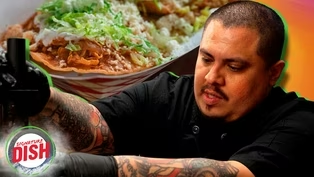 New
NewHow LA TINGERIA Preps 40lbs of Chicken with Power Tools to Make Tostada De Tinga
Video has Closed Captions
Clip: S4 Ep7 | 5m 33s | Seth visits La Tingeria in Falls Church, VA for their namesake dish, tostada de tinga. (5m 33s)
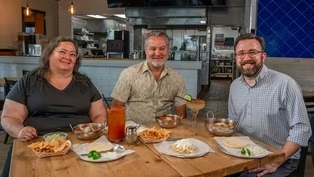
Preview: S4 Ep7 | 30s | La Tingeria in Falls Church, Taqueria Xochi in Arlington, Ixtapalapa in Gaithersburg (30s)
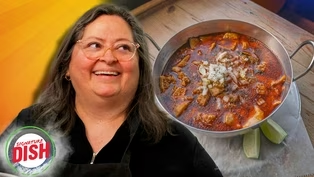 New
NewWatch IXATAPALAPA TAQUERIA Prepare Rich Flavorful Mexican Soup Pancita
Video has Closed Captions
Clip: S4 Ep7 | 6m 26s | Seth visits Mexican restaurant Ixtapalapa Taqueria in Gaithersburg, MD (6m 26s)
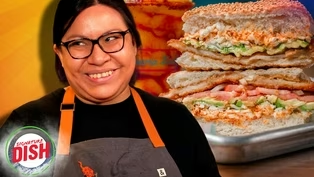 New
NewWatch TAQUERIA XOCHI Make a Cheesy, Smokey Cemita Sandwich from Puebla, Mexico
Video has Closed Captions
Clip: S4 Ep7 | 3m 3s | Seth visits Taqueria Xochi in D.C.'s Navy Yard neighborhood. (3m 3s)
Providing Support for PBS.org
Learn Moreabout PBS online sponsorship
- Food
Christopher Kimball’s Milk Street Television
Transform home cooking with the editors of Christopher Kimball’s Milk Street Magazine.



Support for PBS provided by:
Signature Dish is a local public television program presented by WETA