
Third Act
Season 27 Episode 12 | 1h 25m 34sVideo has Audio Description
A filmmaker honors his father’s legacy of art, activism, and resilience across generations.
Generations call Robert A. Nakamura the godfather of Asian American film. Tadashi Nakamura calls him Dad. Tadashi turns the camera on his father as they confront art, activism, and aging. From WWII incarceration to cultural awakening and a Parkinson’s diagnosis, Third Act is a tender portrait of legacy, inherited trauma, and the final chapter of a shared creative life.
See all videos with Audio DescriptionADProblems playing video? | Closed Captioning Feedback
Problems playing video? | Closed Captioning Feedback
Third Act
Season 27 Episode 12 | 1h 25m 34sVideo has Audio Description
Generations call Robert A. Nakamura the godfather of Asian American film. Tadashi Nakamura calls him Dad. Tadashi turns the camera on his father as they confront art, activism, and aging. From WWII incarceration to cultural awakening and a Parkinson’s diagnosis, Third Act is a tender portrait of legacy, inherited trauma, and the final chapter of a shared creative life.
See all videos with Audio DescriptionADProblems playing video? | Closed Captioning Feedback
Where to Watch Independent Lens
Independent Lens is available to stream on pbs.org and the PBS app.
Aesthetics and Unraveling the AI Hype
Ghost in the Machine seeks to unravel the AI hype to find the untold origins of “artificial intelligence.”Providing Support for PBS.org
Learn Moreabout PBS online sponsorshipPart of These Collections

Providing Support for PBS.org
Learn Moreabout PBS online sponsorship♪ So this is the GoPro.
Looks like... So it has a wide angle, so it's shooting both of us now.
But I'll see what the audio is like.
So is it on now?
Yeah.
Tad, voice-over: My whole life, I always knew I had to make a film about my dad.
Bob, archival: Testing.
Tad, archival, as a young boy: Dad!
My guest tonight is Robert A. Nakamura.
Mr.
Nakamura, what is your secret of success?
Bob: Secret of my success is hard work and a lot of study.
Tad, archival, as a young boy: I agree.
I agree.
-Does the audience know... -Yeah.
-that I'm talking to you... -Yeah.
My son... Is this mic...?
Tad: Yeah.
Oh, actually, no.
Sorry.
You're right.
Why do you want to make this film?
To further your career.
[Laughs] You'll be guiding it though, right?
'Cause you're the director and I just interfere because I'm a filmmaker.
You want me to look up here and talk?
Tad: No.
This is really good, Tad.
Tad: This is the third act of your life, right?
Bob: Right.
Tad: Retirement, people treating you like you're old.
I mean, "Third Act" works, but it's the third act, so what?
[Chuckles] [Claps] ♪ The film's going to be short, right?
♪ [Soft metallic thuds] Tad: Actually, you wanna just turn around and explain your setup real quick and what do you do?
Oh, OK.
Well, this is my office, but right now it's really where I'm sorting out all my negatives.
Rolls I shot.
Ugh.
Oh, it's not too good to do in front of the camera.
I got a lead shot in Life Magazine.
These are nice headshots we could probably... might use in the film because it's the whole family.
So I guess the most time-consuming is trying to assess whether we should digitize it or not for the film.
Tad, voice-over: I want to make the film my dad deserves.
I don't want him or his work to be forgotten.
♪ My dad is known as the godfather of Asian American media.
But, ironically, most people outside of our community have never heard of him.
I could start by talking about how he directed one of the first Asian American feature films or how he founded the first Asian American media arts organization.
But really, my dad is just a [Beep] badass.
♪ You want freedom?
I show you freedom.
Huh?
Right.
Go on, yeah.
♪ [Speaking Japanese] ♪ Archival: We have as our guest today Robert Nakamura, who's a filmmaker and professor here at UCLA.
As a filmmaker, you've explored the camp experience, both in documentary and dramatic film.
Bob: Oh, yeah.
I was about six years old when we were put into Manzanar.
The scars of that particular time have remained with me, and that's probably why I refer to that subject matter in my work.
Oda in "Hito Hata": All of us, along with 110,000 other Japanese Americans, were put behind barbed wire.
Bob, archival: We never saw ourselves in feature films or in television.
We needed to see ourselves reflected in this society.
Up to that time, we were invisible.
[Speaking Japanese] Tad, voice-over: My dad was one of the few people making films about Asian Americans at that time.
But, more importantly, he was using film as a form of resistance while empowering our community to do the same.
Baby: [Cries] Tad, voice-over: By the way, that crying baby, that's me just two weeks old.
I didn't know it then, but that was the start of my journey as Bob Nakamura's son, the kid destined to fulfill his father's legacy.
I know that sounds kind of dramatic, but let me explain.
[Rain and thunder] ♪ When my dad was my age, he made a film on his dad, my Jiichan.
[Speaking Japanese] Jiichan, translated: Life was always hard in Kagoshima.
Even as a child, I had always heard, "Go to America, go to America, "where money is scattered like winter leaves."
They used to say that money was "kusarugurai," enough to rot.
Tad, voice-over: When I first saw "Wataridori", it was like being able to go back in time.
I could see and hear what my Jiichan was like as a younger man.
And, plus, he was ripped.
Learning about his life and struggle not only made me proud to be his grandson, it gave me a better understanding of who I was as a Japanese American.
Jiichan: From the day after I arrived in Los Angeles, I have been a gardener.
As I look back, I don't know how I did it.
Riding a bicycle with a lawnmower tied on the back, the edger strapped to the front, and a rake in one hand.
Very often, little boys would throw stones and chant, "Jap, Jap," as I rode down the street.
Tad, voice-over: I always thought about making this film through the lens of a son.
[Baby laughs] Tad, voice-over: But, now that I've become a father myself, I'm starting to see things differently.
This is my new camera I'm trying to learn.
Do you like it?
Yes.
Yes.
Tad, voice-over: I'm realizing that the time my son and my dad have together is limited, and I wonder what my son Prince will know about his grandfather.
Prince: Daddy!
Tad: Hi, stinky boy.
This could be an opportunity for you, too, to just... while you're still, you know, thinking clearly and can articulate everything, kind of wanting to set certain lessons for Prince.
Careful.
Bob, voice-over: If I was talking to you and imagine Prince being a little older, I'd like to explain some of the things that I've gone through so you might be a little more aware of things than I was when I was younger.
Bob, voice-over: Everything comes back to camp and everything comes back to Manzanar.
♪ With the camp experience, I think I lost a lot of pride.
Because, before camp, before World War II, before Pearl Harbor, Jiichan had kind of worked his way up from a gardener to a businessman.
He owned a house, and we had a piano in the living room.
And so they were kind of joining the middle class, as much as a person of color can.
But then that was all wiped out.
♪ After Pearl Harbor, overnight, I was a Jap.
I had the face of the enemy.
Jiichan, he was under a lot of pressure because he was very high up in Judo.
Most of the Judo instructors, like other community leaders, were taken away and put into maximum security prisons.
And, for whatever reason, they missed my dad, but he was so worried about being taken away that he took everything that related to Japan, pictures, letters, anything with Japanese writing he buried in the backyard or burned.
Woman: [Sings in Japanese] Bob, voice-over: We were one of the luckier families because we weren't separated.
We were at least able to, when we did go to the camp, we were able to go together.
Many families were separated.
The second day I was there, I stepped out of our... our barracks and went to... to the bathroom, which was about 150 yards away.
And, as I came back, I suddenly realized that I didn't know what barrack I was in... my folks were in.
They all looked alike.
They were all black tar paper barracks, and there was absolutely, at that time, nothing to distinguish one from another unless you could read the numbers, which, at that time, I couldn't.
I remember crying, and finally my dad coming out and taking me inside.
After that incident, he got a piece of redwood from someplace and carved our name on it.
And I couldn't really read at that time, so he put a huge index finger pointing to the name Nakamura, and I was able to find our barracks by that sign.
[Singing in Japanese continues] You know, we have to look at it as 120,000 people uprooted, losing property, personal freedom, and being put behind barbed wire.
After the war, my father and my brother and I and my mother came back to Los Angeles with $25 and the clothes on our back, and he had to start all over, and today he is a gardener.
Tad: I mean, do you think there's a connection between your depression and... and being put in camp?
[Sighs] I don't know.
Maybe today is... this is all I have today.
[Laughter] Woman: Happy New Year!
[Overlapping conversations] Happy New Year.
Happy New Year.
[Indistinct chatter continues] You mind if I just sit?
Tad: Yeah.
[Indistinct conversations] Right... right now, I just don't feel up to socializing that much right now.
[Distant conversations] Yeah, some... sometimes I can do it, and sometimes I can't.
Today is just not a very good day.
Uh... I feel motivated, but I just can't carry on a conversation right now.
Tad: You did pretty good.
[Chuckles] Tad, voice-over: My dad didn't come out of his room for the rest of that day.
It's hard to see him like this, and even harder to film it.
I only recently found out about his depression.
It's something he's kept hidden for most of his life.
It's only since working on this film that he started opening up about it.
I am, by any measure, I'm in a really good place in terms of family, finances, creative work, friends, community.
But, regardless of that, every morning you wake up feeling miserable.
There's a feeling in the pit of your stomach, and you don't want to get out of bed.
Tad, voice-over: I do remember there were times when my dad would stay in bed for days.
He would tell us that he wasn't feeling well, and I just assumed he was under the weather.
As a kid, I never thought my dad was struggling with anything.
I just saw him as the perfect dad, my hero.
Tad, archival, as a young boy: Hi, it's me again.
I hear that your son is the best kid in the world.
Is that true?
Bob: Well, I don't know about in the world, but maybe in the United States.
Tad, voice-over: He never pushed me to be a filmmaker.
He wanted me to find my own path, and I found my passion playing football.
Bob: Tell me what game this is.
Hey, here we are, Centennial High School.
Spectator: Go, go, go, go!
[Game announcer speaking indistinctly] Tad, voice-over: I think that's the most fun part about football games, when, like, you hit someone really hard.
I don't know, I just kind of, like, snap and start screaming and get all into it.
And, hopefully, I play football next year in college.
Man: Number 7, Tad Nakamura.
Tad, voice-over: I always wanted to be the popular kid, the captain of the football team, the homecoming king.
I never wanted to be the nerdy Asian stereotype who was good at math.
And smashing into people with my head was the easiest way for me to prove it.
My dad isn't even a big sports fan, but he supported me every step of the way.
Bob: Say Ocean League champs!
Tad, voice-over: When I was in middle school, my dad started taking me to UCLA football games, and it's been our father-and-son tradition ever since.
So how you feel today?
I feel a little tired, so I slept in.
We were going to test ride the Tesla again.
Yeah.
I just was... too tired.
I felt OK when we were driving to the Rose Bowl.
I was even thinking of... of you taking Prince, uh... to the UCLA games.
Yeah, so I wasn't ready for being dizzy or anything.
♪ Bob, voice-over: Walking to the Rose Bowl, I felt totally out of control, and that's what really kind of... really scared me.
Can I get some water?
Tad: Yeah.
Oh, I feel I've got all kinds of symptoms right now.
I can't breathe.
I can't hear.
My voice is going.
My legs are getting really tired.
Tad: Just take your time, Dad.
[Speaking English] [Laughs] No.
Do I put "loss of balance"?
I... Yeah, weight loss here.
Yeah.
Do you have trouble breathing?
Yeah, kind of.
Yeah.
[Worker speaking indistinctly] [Exhales] I think I'm taking it better than I thought I would.
Tad: What did the neurologist say?
The, uh... The neurologist, I think, is pretty sure I have Parkinson's.
I'm pretty sure I have Parkinson's.
I have so many of the symptoms.
Tad: OK.
Um... OK.
Tad: Yeah, but you should probably eat.
So how's... how's all this impacted you?
You know, I'm, what, something like 12 years younger than he is, so I've known all the time that he's much older than I am.
So it's something that I've come to grips with throughout the years.
Tad: So... so you're not... There's.... You don't feel any more stress?
You're kind of not really worried about Dad these days?
You don't show a lot of emotion.
You don't let a lot of people in, I don't think, to your life so much.
You don't, you know, I wish you would do that more, actually.
I think you're anxious.
I think... I think you and Dad have a, you know, very strong and close relationship, and I think it is fearful for you to think about him not being here.
You know, all of us are, you know, in for a lot of grief, and we know it will happen.
But, you know, for me, I'm not going to... I'm not going there before, you know, before it happens.
Tad: OK.
Yeah, I know, it's fine.
The sun's... We probably have to stop anyway.
The sun's changing everything.
Tad, voice-over: This is not the film I thought I was going to make.
It's easier for me to just turn off the camera instead of dealing with what's happening with my dad.
I guess we all have our own ways of deflecting.
But my mom is right.
I am anxious.
I've always been anxious.
Anxious about who I would be without my dad.
And now, with this incurable disease, my biggest fear is starting to become a reality.
All: ♪ Happy birthday to you ♪ ♪ Happy birthday ♪ Tad, voice-over: I was 5 when my dad turned 50.
I always knew he was older than the other dads.
Ever since I was a kid, I would picture me giving the eulogy at my dad's funeral, and I would think about what I would say.
I have to say it's been a total surprise here.
Usually, Tad would give it away, but there was no inkling.
♪ Prince: Bobbob?
Hi.
Oh, hello.
Daddy.
Tad: Yeah.
How do you do it?
Tad: Take a picture of Bobbob.
Can you take a picture of me with the tomato plant?
Cheese.
Look it!
Oh, that's a good one.
Daddy, look.
Tad: Oh, that's a good one.
Now take a picture of me.
You're really burning up the film.
Cheese.
Tad: Hey, that's a nice photo of Bobbob.
♪ Bob: Yeah, we all, you know, in the family, Baachan, Jiichan, we repressed camp, and I'm just thinking about it now.
We never really talked about its meaning, how we really felt.
Coming back to post-war L.A., it was outright, unabashed racism.
There were times where I almost wanted to go back to camp.
At least in camp, you had friendly Japanese American faces around you.
♪ [Singing in Japanese] Bob, voice-over: We were driving, and the car in front of us stopped at the light.
We stopped behind him, and, for some reason, the guy took his foot off the brake and just rolled back into my dad's truck.
The guy gets out, struts over to my dad.
"You hit me and you're a dirty Jap gardener."
I can see Jiichan really holding it in, and he could barely start his truck.
And there were people on the sidewalk watching.
When he was confronted with something racist, I always wondered, why didn't he use his black belt and kick the [Beep] out of somebody?
Why can't you be more like the fathers in movies that'll protect you?
And this is very painful: I sometimes wish I had another father.
I guess that's another way to put it, that didn't have the Japanese face, that didn't have that accent and poor English.
I always wanted to be let off at the corner because I didn't want my friends to see where I lived.
I didn't want them to know my dad was a gardener.
All I could do was think of, why couldn't I be someone else?
And that's the ultimate self-hatred, is wanting to be someone else.
Tad, voice-over: I never knew my dad felt this way about himself or my Jiichan.
I always thought of him as this proud Asian American filmmaker.
So I guess it's just hard to learn that he was so ashamed of who he was.
And it hurts even more to know that he had no one to talk to, no one to help him understand what was going on, or how to cope.
♪ Bob, voice-over: The first time I realized I really liked the photographic image, I must have been 11 years old.
Jiichan had this big box, and my friend and I made it lightproof.
And we shot pictures, and we developed the film in trays by hand.
And I remember sitting in this box, where I'm on my knees in the dark.
All of a sudden, like magic, there's this form that comes up.
And anyway, for me, the process of it used to calm me down, allow me to focus.
♪ When I'm thinking in a creative way, it's kind of a way of shutting out the world, I guess.
I'm focused on shooting, and that cuts off the dialogue.
When I'm printing in the darkroom, that shuts off the inner dialogue.
I think anything that requires an intensity, I enjoy doing, because it just blocks off my thinking.
Tad, voice-over: My dad is revealing things that he's never told me, and it's a lot to take in all at once.
I don't know if this process is more triggering or therapeutic for my dad.
Maybe we both just need to take a step back and remember to breathe.
[Indistinct announcements over P.A.]
Oh, what a big boy you are!
Ooh.
Tad: Hey, where are we?
We're in Hawai'i.
Ah!
Tad, voice-over: We've been visiting the kingdom of Hawai'i for as long as I can remember.
My parents were busy making films out here, and we would all come on these production shoots disguised as family vacations.
Tad: Dad, where are we?
We're in Maui.
Tad, voice-over: Hawai'i is a sacred place where we go to ground ourselves and reset.
First for me, my sister and my parents.
And then, as we got older, my sister's kids.
Tad: Thanks.
Thanks, Mina.
Tad, voice-over: And now with my wife, Cindy, and our kid, with another one on the way.
Donuts!
[Laughs] Say, "Thank you, Daddy."
Thank you, Daddy.
Oh, boy.
64-1.
Bob, voice-over: When I first came here, it was kind of a moment of enlightenment.
I didn't realize till I stepped off the plane and started walking around what a change that was.
I began to relax.
It felt good to be part of the majority walking down the street.
Cindy, off camera: Do you know how to swim?
Bob, voice-over: Hawai'i offers me that out, that possibility.
[Laughs] Bob, voice-over: I feel really good when I come here, and I know it has some healing effect.
Yeah, I feel less bad about myself.
I'm really glad that you and Thai were able to come here often.
I think you got a lot out of it.
And so I really want Prince to see how that feels.
[Laughing] Hey, Daddy.
Hey, Daddy.
Because he... Daddy?
Tad: Yes?
Daddy, a bug put on my nose.
[Laughs] Tad: OK.
[Bell rings] [Sighs] Hey, sorry I'm so late today.
Oh, no, no problem.
Trainer: Switch.
[Groans] Let's move it.
Keep it going.
[Groans] Is it all right if I talk about Parkinson's?
Tad: Yeah.
I guess, uh... It is exercise, exercise, exercise.
One.
Bob, voice-over: That's not going to cure me, but that'll hold back the symptoms.
Trainer: Last one.
Big pull.
Exhale.
[Exhales] Nice.
Good job.
It's making me hopeful.
Two.
Three.
Four, three.
Keep it up.
You're doing great.
You're doing great.
Your reaction time is very good.
Bob, voice-over: The creative part of my mind is still working, and so I feel pretty good about that.
The thing that I'd hate to lose is my work.
Being ill forces you to do nothing but think about yourself, what you're feeling, what you're losing, et cetera.
And I hate that.
Depression and Parkinson's is allowing me to go back and look at the darker side of what I've done.
It's a more critical eye.
Looking back, the work I was doing was totally meaningless to me.
And it's hard to say this, but I see a lot of my success came from a feeling of inferiority.
I wanted to be a photographer.
I had my own studio.
The work that I did was good and sold, but I couldn't relate to the content of it.
Once you're in the commercial world, you're in it for the money, the prestige.
And, regardless of my Porsche and my financial success, it still was obvious that I was a Jap, exotic Oriental.
I was trying to be whiter than white, trying to achieve more.
♪ Tad: Did you...?
I mean, because... When I look back, I feel like I, for different reasons, felt like I needed to be the all-American guy.
At the time, what drove you?
I think a lot of the drive was trying to belong, and that part I regret.
And maybe that's my first real depression, when I was fed up with everything and I really didn't know what to do.
I got a hold of a newspaper called Gidra, which was... turned out to be the kind of Asian American movement newspaper.
And I read some articles and I realized there was a lot of people feeling the same way I was, and really not feeling part of this society, not being able to reconcile their Asian culture with the American culture, or just being totally invisible.
So I went down to the paper and said, "I have this photographic background.
"I really like what you guys are doing, "so I'd be glad to help out in any way I can."
One of the people there was Warren Furutani.
As it turned out, Warren was putting together a pilgrimage to Manzanar.
He said, "Why don't you come and photograph it?"
This is the first pilgrimage to Manzanar.
It was organized by Sansei, kind of activists who heard about camp, but had never really seen it.
Maybe it was a part of my parents not talking about camp, but the pilgrimage kind of woke me up.
♪ Up to the point of going to the first pilgrimage, I totally ignored camp.
It almost didn't exist.
It was repressed.
When we got there, going through the kiosk, I became very emotional, almost surprised at how I was feeling.
[Indistinct chatter] It allowed me to really look at it and call it a concentration camp.
With that emotionality, I just kind of automatically started shooting the faces of people.
It was just kind of instinctive, like being in automatic.
I don't remember shooting.
To me, they symbolized kind of the new generation who was... who's going to question a lot of things that happened to Japanese Americans.
I was creating a visual idea of community.
It wasn't until the pilgrimage that I realized the potential of what I could bring to the movement.
My own personal experience, my perspective, I can use all of that because I found an audience.
♪ My life changed around totally in the 70s, when the anti-war movement and Asian American movement started.
[Camera shutter clicking] It was like we were building something, whole new concepts, like ethnic studies, and you could see progress.
We were questioning white society in general.
Everything I did before, I began to look at as kind of [Beep].
I had all the skills, and now the movement gave me the content for my work.
The movement more or less solved all my problems: my artistic problems, my identity problems, my sense of self-worth, sense of belonging.
It gave meaning to my life.
Tad, voice-over: My dad talks about the movement more than any other part of his life.
And he made sure I understood that his personal transformation was part of a global Third World struggle and locally inspired by the Black Power Movement.
It was during this time that my dad enrolled in the EthnoCommunications program at UCLA's film school, where he made "Manzanar," one of the first films about the Japanese American concentration camps.
And, in 1970, he founded Visual Communications, or VC for short, a collective of Asian American filmmakers, the very first of its kind, which still exists today.
Bob, voice-over: With the VC films, we were trying to see how we could contribute toward the movement at that time.
We were kind of innovative in our own way because no one else had done what we were trying to do.
We needed historical films, we needed to document ourselves.
The key was, how do we use media to serve the people?
[Recording of woman singing in Japanese playing] Jiichan: People do not believe me when I tell them I am now in my 70s.
To think that I, Harukichi, a village bad boy, has now become an elder.
[Laughs] I cannot get over that, and I have to laugh.
[Recording of woman singing in Japanese continues] My wife and I used to talk of returning to Japan when I retire.
In my mind, this is no longer possible.
My place is here in this country with my grandchildren and the grandchildren of my old comrades.
Bob, voice-over: The movement fed into shifting my perception towards how I saw myself and how I saw Jiichan.
I didn't see him as a full-fledged dimensional person until the movement.
When I did "Wataridori," I think a lot of it was trying to make up for... [Chuckles] for the way I looked at him at one time.
[Dogs barking] Itadakimasu.
Itadakimasu.
The burgers are good.
Prince: Um, Daddy?
Tad: Yeah?
What's our movie called?
Tad: Our movie's called "Third Act."
Is there a first act?
Tad: Yeah, the first act was when Bobbob was at Manzanar.
What's the second act?
Tad: When Bobbob started making movies and when Bobbob met Nanda and when I was born.
How did he met Nanda?
Bobbob claims that he saw me from across the room.
And he remembers I had long, black hair like yours, and I was wearing bike pants.
And he fell in love with me right there.
What?
[Laughs] Were you guys married?
No, we weren't married.
Jeez.
Yeah, I know.
How do you fall in love?
Isn't that a story?
I can't believe that.
I know.
[Laughs] ♪ [Sighs] ♪ It makes you believe in destiny.
You have to think there's some... some fate or reason or luck.
Actually, the story of how we got together, I see now more through his eyes than I do through mine 'cause he's told this so many times.
Bob, voice-over: It was at a JACL conference in Washington.
It was very exciting.
All the activists were there.
And I met this woman, Karen Ishizuka, which is Mom.
I have to admit, you know, she really impressed me.
Besides being very, very beautiful, she was interested in the movement.
We were kind of on the same wavelength.
But there was no possibilities of getting together.
We're both married and live in different cities and all that.
Dad and I were both married before, and we were both married to white people, and that had a lot to do with why we got divorced.
There was just sort of a cultural incapacity that showed itself over time.
So I had Thai.
You know, that was a big reason that I hesitated getting divorced, but we finally did.
Bob, voice-over: In terms of meeting Mom and eventually getting married and having a family, I didn't expect any of it.
Karen, voice-over: Thai and Dad, I mean, he just instinctively and intuitively knew what to do.
I knew that he would really be fulfilled with having a son, and that's what I wanted to give him.
Bob; voice-over: One day she said, "I want to give you a son," you know.
And I go, "Oh, I don't know if I..." "Life is really good now.
"I have... I'm teaching at UCLA.
"I'm part of a community.
"I have this wife who understands "and participates in what I want to do.
"And I don't want to change."
But she insisted, and she was right.
Karen, voice-over: Thai had always said what she wants for her birthday is a little baby brother.
I said, "You know, I always try to get you what you want, "but I'm not sure I can do that, I can give you that."
So we had the birthday party for her at the house, and I started, you know, in labor.
♪ Tad, voice-over: So what was Dad doing that whole time?
Karen, voice-over: Dad was taking pictures.
And so he was, yeah, he was all excited.
Bob, voice-over: Yeah, Mom was right.
I really enjoyed having a son.
I enjoyed having you.
And kind of added a piece to... to my life that became even more important than my career.
♪ Tad, voice-over: My mom would tell me that, before I was born, she had a vision of who I'd become and how I turned out exactly how she saw it.
And my sister would also remind me that the only reason I exist is because she asked for me on her birthday.
All this to say I never felt like my life was my own.
I was put on this earth to fulfill a specific role.
I now see it as some sort of destiny or fate.
But, growing up, it just felt like pressure.
I mean, my birth announcement was literally a film slate.
And then, at two weeks old, I was thrown on set.
And not just any film set.
My dad was directing "Hito Hata: Raise the Banner," the first dramatic feature made by and about Asian Americans.
Oda in "Hito Hata": When World War II broke out, little Tokyo nearly died.
Tad, voice-over: This ambitious film was Visual Communications' attempt at telling the epic story of Japanese in America and required a monumental community effort to pull it off.
[Cries] Tad, voice-over: I always wanted to make my parents proud.
And not just them, but the entire community that was watching me grow up.
[Clapping and cheering] But, somewhere along the way, that want became a need, a responsibility, maybe even a burden.
Karen, voice-over: So, I do remember we went to a conference together.
I introduced you as "the new and improved Bob Nakamura."
And I remember that you just got so mad at me.
You just said, "Do you realize how much pressure that is?"
I think that was the first time that I realized that your perspective and our perspective was really different.
You took, uh, you know, sort of being his son more to heart.
Tad, voice-over: Growing up, I didn't know how to deal with that pressure.
Maybe that's why I tried so hard to be the all-American kid.
It was my way of making everyone proud while doing something different than what my dad did.
But, by the end of high school, I gave up my dream of playing college football.
I just wasn't good enough.
The identity I had built was now gone, and I needed to find a new one.
Graduation announcer: Tadashi Harukichi Nakamura!
[Clapping and cheering] Bob: Yay!
Yay!
Bob: Face this way so I get the light better.
OK, good.
Our grad.
OK, congratulations, Tad.
Thanks.
[Indistinct chatter] Tad, voice-over: It's funny how the universe works.
I went to college at UCLA, and, if I'm being completely honest, the only reason I took my dad's class was to get an easy A. But filmmaking came naturally to me.
This came as a surprise to both of us.
I always thought you were the jock and you had to yet find yourself and what you kind of believed in.
And so that was a surprise.
And then, later, it was a real surprise that you wanted to continue on with your filmmaking.
Tad, voice-over: Now, more than ever, I was seen as Bob Nakamura's son.
But, with that pressure, also came privilege.
Everything was laid out for me.
I just had to step up to the plate.
My dad sensed that I was finally ready for my next lesson, and there was only one place where he could teach it.
♪ Where are we?
Oh, this... this is what we used to call the park.
This is a park area near the hospital, I think.
So this is the only place that had the big trees.
And then there's... there's the apple... There's a pear orchard right there, and that's where I got caught by the local police, the Manzanar police.
I was knocking off pears down to my buddies down below, and I looked down and my buddies were gone, and there was this guy staring up at me, so... Said he was going to turn me in, which is kind of stupid, come to think of it, 'cause I was already in camp.
[Laughing] Tad, voice-over: I was making a film on the 1969 Manzanar pilgrimage, that historic trip when my dad found his community.
And it was my first attempt at telling my dad's story.
I'm Bob Nakamura.
I was on the first Manzanar pilgrimage.
After we're finished here, go to the cemetery and do the... on a tripod.
Do this really long pan just along the mountains.
Tad: OK.
Tad, voice-over: Seeing Manzanar through a camera lens, I suddenly felt the pain, the beauty, the anger that was held there.
I didn't have the words to describe it, but I had my camera.
♪ And my dad knew exactly what was happening.
Tad: Faster, faster.
Bob: [Chuckles] OK.
Tad, voice-over: Ever since then, I've been his right-hand man, the one person he could trust to expand his institutions, to teach his classes, to execute his vision.
[Buzzing] [Tapping] Tad: So it's OK if we cut your hair for the camera?
Yeah, yeah.
Uh... Tad: So, I think I need to shoot more things that could, you know, be used for B-roll or be interpreted different ways.
Like getting a haircut?
Tad: Yeah.
I mean, I said this before, but this whole issue of Parkinson's, depression... uh... really takes away your independence.
So, Tad says you look like Benjamin Franklin.
Yeah, that's the $100 bill.
Right, they should put you on the $100 bill instead.
Bob, voice-over: I'm depending on Mom, who's becoming a full-time caregiver now.
You know, I feel really bad about putting everything on everyone.
[Buzzing] I don't have a fear of dying per se, but the process is what worries me.
I can take dying, but living in a nursing home is something that scares the [Beep] out of me.
[Buzzing continues] ♪ In my condition now, I feel like I'm not putting my best foot forward in terms of the film, where, 10 years earlier, you know, I might give you a better articulation of my ideas.
And I just don't want the film to kind of just lay there.
I want it to be a successful film.
I'm probably putting too much pressure on you.
Tad, voice-over: I always knew I had to make a film about my dad.
I just thought we would do it together.
♪ [Cries] Oh.
Tad: Hey, Mom, get in the light, get in right here.
Come over here?
Tad: Yeah.
[Sneezes] Ah-choo, ah-choo.
Cindy: Bless you, bless you.
Tad: It's 3:00 in the morning.
Me and Malaya, just hanging out.
This is what we do every night.
This is a good time to just quiet down.
Things are a little scary, but just trying to focus and enjoy this time with her.
Not trying to worry about all the other stuff.
[Coos] Malaya: [Sneezes] Oh, bless you.
Oh, bless you.
Tad: Do you want to hold the camera?
Prince: Yeah, yeah, yeah.
Tad: There.
Prince: Daddy, can you press the button?
Tad: You know, it's already... it's recording now.
All right, ready?
Can you see us?
Hi.
Can you see us?
Oh, no, here, move your hand.
Prince: Oh.
Tad: You have any advice for how to be a good dad and finish this film?
Well, I... I think, you know, you have to compromise something, but it's that age-old question of, you know, your work versus the family.
There was a lot of things in "Hito Hata" that, you know, I would have liked to have finished out, but I think we ran out of money, and I was running out of energy with the new baby and new family.
[Cries] Up here.
Open.
You know, I may cringe a lot when I see "Hito Hata," but then I see you and how you've grown up, so I figure I didn't [Beep] up both places.
Prince: Just a little bit faster.
T, help!
Help!
It's kind of up to you, and, um... [Chuckles] I'm glad I don't have to make the decision, so... Yeah, so, I didn't get to bed till, like, 3:00 last night.
Oh, you working or...?
Yeah, but the reason I stayed up was 'cause I just... I realized I should have shot us eating in the car at Tommy's.
Yeah.
Yeah, I got to just figure something out, 'cause technically we should... I could shoot everything, right?
Anything and everything.
Yeah.
But then part of me wants to just also live in the moment and, you know, get my mind off of it.
Off of the film?
Off... Yeah.
And do what?
Well, just, get my... you know, not... take a break.
I'm shooting all the time, and so I'm thinking about the film, and I'm stressing out.
Yeah.
I'm getting anxious.
You know, so it's technically, like, Thanksgiving is going to be a production shoot.
Christmas is going to be a production shoot.
The reality is that we don't know how many more Thanksgivings we're going to have together, right?
So do I cherish that and really just enjoy it, or do I kind of turn it into a production shoot?
Yeah.
I almost think you have to turn it into a production shoot.
Otherwise, it'll go on forever.
[Clapping and cheering] [Band playing] How does it taste?
♪ ♪ Tad, archival: My whole life, I've always known about the sacrifices my Jiichan made for myself, as well as the rest of my family.
Jiichan, my existence is a result of your struggle.
Therefore, my life is dedicated to your dreams.
Thank you.
♪ I realized that I haven't gone to Jiichan and Baachan's graves at the... uh, at the cemetery.
♪ I can never get rid of the guilt about wishing he weren't Japanese.
I... That, I'll never get over that.
[Lawnmower chugging] I was planning to do a whole film, a bigger film on Jiichan and his life.
But it never, just never, never happened, which I regret, but, you know... Tad: Did you have any stories or even scenes in mind for the film you never made?
Bob, voice-over: I could have presented a kind of deeper look into his life.
Less history and more soul.
♪ Tad, voice-over: Less history, more soul.
I know my dad is talking about the film he never made on my Jiichan, but I can't help but feel like he's telling me what I should do with this film.
Maybe he doesn't want me to suffer from the same regret he has, or maybe he's hoping I can accomplish what he wasn't able to.
But, now that I'm in it, it's clear why he was never able to make that film.
It's just too painful.
♪ [Moans] Tad: Do you feel OK?
Huh?
Tad: Do you want to get up?
[Groans] In a little bit.
Yeah, life is coming to an end.
We all know it's coming to an end, but... until you get something, you know, say, you have Parkinson's, or, I'm sure, cancer or something like that, you don't realize things can end.
[Sighs] Ever since I met Mom... I've had this terrific... [Voice breaks] [Sniffs] [Sighs] I've had a very good life.
Yeah.
[Sobs, sniffs] I was hoping you... you wouldn't be a serial killer or anything like that, but I... I never saw you in particular becoming a filmmaker.
And, you know, maybe getting back to film, maybe part of the... my... being a person of color in a... in a hostile, racist environment.
I remember thinking, you know, and... that... [Sighs] [Sniffs] that I didn't... I didn't deserve to be this happy.
[Coughs, sniffs] [Sobs] Yeah, I am... [Weeps] [Wind whooshing] [Traffic zooming] Prince: I think the presidents I liked are Lincoln, Jefferson and George Washington.
Those are my favorites.
Karen: Those are your favorites?
How come they're your favorite?
Because I like them so much.
And the one that I hate is Trump and... and Roosevelt, FDR.
Karen: Roosevelt?
How come... how come you don't like FDR?
Because he put Bobbob in jail.
Tad: Hmm.
Prince: What do you do in jail?
Bob: Went to school.
[Chuckles] What?
So, Bobbob was your age when he went to... when he went to Manzanar.
Bob: I only remember just places where we used to hang out and play.
Tad: You think you could still find them?
Oh, yeah, I know exactly where they are.
So I guess, partly being a filmmaker, I know all the effort it is and cost to get cameras, sound, and the crew together to come out on location.
So I feel really responsible right now, so I'm gonna do the best I can, but it's hard processing sometimes, so I'm hoping you get some other... other shots besides me.
Yeah, but don't... I mean... [Clears throat] Yeah, don't put pressure on yourself.
I don't want to put more pressure on you.
The camp experience or just generally living in a racist society... really messes up your mind.
And I'm only... laying it out because you're doing the... you're making the film.
If anyone else... I wouldn't... I wouldn't say some of the things that I'm saying in front of the camera.
People will understand that this goes on and on and it continues, and I don't see any cure for it other than dealing with it through, in our case, the arts.
I'm kind of passing it on to you.
♪ Karen: Oh!
Jack.
I'm out.
Karen: [Laughs] Oh, Bobbob's out!
I owe you... I owe you 100, and I owe you 150.
[Laughs] Oh!
On a roll.
[Laughing] Prince is on a roll.
[Laughs] Tad: Do your touchdown dance.
[Laughs] Ready to go?
Prince: Yes.
Where are we going?
Manzanar.
All right.
Tad, voice-over: This will be also the first time Prince goes to Manzanar.
Even at this age, why do you want to take him there?
Well, I guess it's getting back to homecoming as... one hand, I want to show him where his grandfather was in... in essentially, a prison.
But, at the same time, I'd like to show him where I used to get the branches to make slingshots with and, you know, there's some really negative stuff with this.
I can't help myself.
There's positive things that I wouldn't mind showing him.
Prince: Are we still going to Manzanar?
Yeah, we're coming really close now.
♪ ♪ Prince: What's inside that window?
Wow!
Bob: This is how it was a long time ago.
It looks the same.
Look at the mountains.
Hmm, that looks beautiful.
This is the lizard track.
There are lizards all over the place.
Look, here's another hole here.
That's a snake hole.
That could be a snake hole.
We didn't have things to play with, so we... we played with lizards and scorpions and snakes.
Kept them in bottles.
Yeah, those were our pets.
Which way do you want to go?
Which way do you want to go?
Do you want to go to... This, scorpion way.
Oh, so we're gonna have to go that way.
OK.
I'm scared.
I might get stung.
♪ What do you think these are?
I think this used to be the men's bathroom.
Yeah, this is... a toilet was here.
A toilet was here.
Every one of these was a toilet.
Can you imagine sitting here?
Yeah, I'm sitting here.
Going to the bathroom with two other people on either side?
There you go.
[Chuckles] OK.
But would that feel weird, though, if you had to go poo-poo next to someone else going poo-poo?
That's inappropriate.
That's inappropriate?
Yeah.
Let's go look at the... remake here.
Prince: What?
What?
What?
♪ Prince: Where are you?
Tad: Oh, I found Bobbob.
Where?
Right there.
Wait.
Where?
There?
That was the second grade?
Yeah.
Oh.
That's a wrap.
[Chuckles] ♪ Jiichan in "Wataridori": We are all from the same village, old-timers and new arrivals.
In a poor village, people must cooperate in order to survive.
We have brought this habit with us to America.
If I need money, I can always go to our tanomoshi.
If someone is sick or needs help, every one of us here would do what is necessary.
I think, without this village spirit, we could not have survived the Depression, the war and the prejudice.
[Speaking Japanese] [Laughing] [Closing music of "Wataridori" ends, applause] Tad: This film is my favorite film that my dad made, and it always has been my favorite film.
Uh, you said, by interviewing all these Issei, it really did give you a buzz.
Just want to talk about what that did for you on an emotional level.
Um... uh... Well, also, I think what's very relevant of this film is that, to me, this is a reminder that the Japanese American community is and was a working-class immigrant community.
What's really meaningful for... for us all was everyone welcomed us and supported what we were... what we were doing, uh... during that time.
I'm getting stuck again.
I'm sorry.
Uh, getting a little emotional.
Um... So, my Jiichan is Harukichi Nakamura, and, up until that point, you know, he was just Jiichan.
He was a cute, cuddly old man, kind of looks like this guy does now.
[Scattered chuckling] In the scene where he wins the hand, he does this little "Hee," right?
[Voice cracks] I haven't heard that in a while.
[Scattered chuckling] And, you know, it's those little things that you don't think about.
Um... So, you know, I think this is a special day because my son is here, and I think this is probably the first time he sees his grandfather as the godfather of Asian American media.
[Scattered chuckling] Just as we're learning to be parents, we're learning that our mothers, our fathers are getting sick, right?
Or they've already gone.
So, I think, for our generation, it's real now.
And so, you know, I really want to thank you for the work you've done.
All of this is crystallizing the legacy that you've built, and the legacy that I'm extremely proud to carry on, but I know I'm not by myself.
And, yeah, one more round of applause for my dad.
[Applause] This film is really different for you, I realize, from the other films that you've done.
Um... You know, before, you've always had Dad in your back pocket.
You know, this one, it puts both you and he, you know, in a totally different relationship.
This is a way to say good-bye and to come to grips with your own fears.
You know, I think, in many ways, you are the new, improved Bob Nakamura.
[Seatbelt clicks] Yeah, I got directions.
So, how are you feeling today?
Hmm, OK.
So, you think the new meds are helping?
I think so.
♪ ♪ So, it says we're right here, so it's F. I think it's this one.
Oh, there it is.
Down there, in the corner.
♪ ♪ Well, now that you're here, how are you feeling?
Uh, I feel OK.
I don't... feel guilty or anything like that.
I feel fine.
But I still think, in the film, I'm not sure.
You're not sure if this scene will work in the film?
Yeah.
How come?
Well, it's kind of a plastic Hollywood cemetery.
It's not very cinematic.
♪ Actually, working on this film, I'm at peace with Jiichan, and it's nothing that he did.
Yeah, I made them proud, and it's not because of what I did, it's that their standards weren't that high.
[Chucking quietly] ♪ Tad: I mean, for me, he's been declining pretty rapidly this year.
You know, we have less time with him than maybe we thought last year.
I think just emotionally and mentally, he's very, very solid, and he's very centered.
Um... Tad: Wait, hold on.
[Soft whirring noise] Dad.
Tad: Yeah, we're... we're filming, Dad.
Can you go back up and... just for a little while?
We're... Tad's filming me down here.
[Tad chuckles] Hi.
Hi!
Hi.
Hi.
Prince: Why is it so soft?
Tad: How is it, Dad?
Tad: Hey, Prince, do you want to film?
Yeah.
Tad: OK, here.
You're recording now.
Can you see all three of us?
Can you see Malaya?
Prince: Yeah.
Zoom, zoom, zoom.
Karen: [Laughs] I like those moves.
I'm gonna eat you.
[Making chomping noises] Tad: Are you watching TV with Bobbob?
Huh?
Yes.
Tad: Yes?
Dad, where do you want to go eat?
Rainbow Drive-In.
[Chuckles] OK.
Thank you.
Wow, this is really good.
Karen: Oh, good!
Mmm!
♪ [Wind whooshing] So what are you thinking about?
Uh... Thinking this might be the last time I see Hawai'i.
The end is coming up.
I got to prepare... prepare myself.
Tad: What do you want us to do with your ashes?
I was thinking... of Hawai'i.
The ocean.
Or... Manzanar.
Hawai'i in the ocean?
Yeah.
You don't have a favorite place?
[Chuckles] Rainbow Drive-in?
OK.
We'll sprinkle it on... on the gravy?
Yeah.
OK.
♪ ♪ Well, I was just thinking this is a... might be a good end shot, right?
Fade to black and roll credit... I'm kidding.
Yeah.
I have to say, the place still has its spiritual feel for me.
It's still there.
And it kind of verifies feeling at peace.
Before, I kind of looked at it as maybe kind of negative, but now I feel free to kind of claim Manzanar as a place of power.
♪ ♪ Tad, voice-over: I always knew I had to make a film about my dad.
I thought I had to do it for him.
But I realize now I really had to do it for myself.
♪ ♪ ♪ ♪ ♪ ♪ Announcer: Independent Lens is made possible by the Action Circle for Independent Lens with major funding from the John D. and Catherine T. MacArthur Foundation; Acton Family Giving; the Ford Foundation; the Jonathan Logan Family Foundation; and contributions from the following... Additional support for this series has been provided by the Corporation for Public Broadcasting and by contributions to your PBS station from viewers like you.
Thank you.
Video has Closed Captions
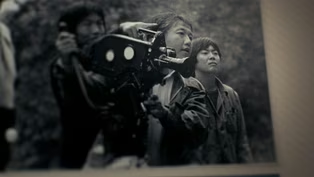
Preview: S27 Ep12 | 30s | Filmmaker Tadashi Nakamura honors his father, Robert A. Nakamura, and their shared legacy. (30s)
Providing Support for PBS.org
Learn Moreabout PBS online sponsorship








Support for PBS provided by: