
Violinist Allison Taylor | CHASING CRESCENDOS
Special | 11m 4sVideo has Closed Captions
Violinist Allison Taylor traveled to India, where she realized she didn't know about the instrument.
From the careful preparation of her reeds to long rehearsals, bassoonist Eleni Katz shares a glimpse of her musical journey. Born to a family of artists in Wisconsin, she began playing clarinet until her teacher suggested she tried bassoon as a way to stand out. Now, she is tasked with blending in with the New World Symphony orchestra as they take on Tchaikovsky's Symphony No. 5 in E minor.
Problems playing video? | Closed Captioning Feedback
Problems playing video? | Closed Captioning Feedback
Major series funding for GREAT PERFORMANCES is provided by The Joseph & Robert Cornell Memorial Foundation, the Anna-Maria and Stephen Kellen Arts Fund, the LuEsther T. Mertz Charitable Trust, Sue...
Violinist Allison Taylor | CHASING CRESCENDOS
Special | 11m 4sVideo has Closed Captions
From the careful preparation of her reeds to long rehearsals, bassoonist Eleni Katz shares a glimpse of her musical journey. Born to a family of artists in Wisconsin, she began playing clarinet until her teacher suggested she tried bassoon as a way to stand out. Now, she is tasked with blending in with the New World Symphony orchestra as they take on Tchaikovsky's Symphony No. 5 in E minor.
Problems playing video? | Closed Captioning Feedback
How to Watch Great Performances
Great Performances is available to stream on pbs.org and the free PBS App, available on iPhone, Apple TV, Android TV, Android smartphones, Amazon Fire TV, Amazon Fire Tablet, Roku, Samsung Smart TV, and Vizio.
Buy Now
Great Performances Newsletter
Subscribe to the Great Performances newsletter to keep up with the latest full episodes to stream, exclusive content, and more!Providing Support for PBS.org
Learn Moreabout PBS online sponsorshipMore from This Collection
Explore the preparation and processes of New World Symphony’s young musicians in Miami as they work alongside soloists, conductors and mentors to prepare for live concerts and train for professional orchestral positions in this new digital series from Great Performances on PBS.
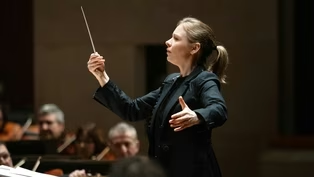
Conductor Gemma New | CHASING CRESCENDOS
Video has Closed Captions
Conductor Gemma New leads the orchestra with a focus on creating a collective musical experience. (11m 25s)

Bassoonist Eleni Katz | CHASING CRESCENDOS
Video has Closed Captions
Bassoonist Eleni Katz shares a glimpse of her musical journey at New World Symphony. (11m 11s)
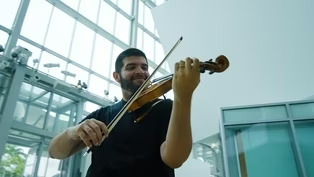
Violinist James Zabawa-Martinez | CHASING CRESCENDOS
Video has Closed Captions
Born in Austin, James knew from an early age that he wanted to play the violin. (10m 50s)
Providing Support for PBS.org
Learn Moreabout PBS online sponsorship(light expectant music) ALLISON TAYLOR: Before every performance, I run through the things that take more focus and concentration during the concert.
I ground myself.
I talk to myself and say, "you're ready.
You know this.
You have an amazing group of people around you who you can trust."
If something goes wrong on my end, I have this sea of people who are there to catch me.
(uplifting music) (audience applauds) (uplifting music continues) (intense boom) (waves crashing) (uplifting music) (uplifting music continues) (uplifting music continues) (orchestral music) So it's not clear, but that rhythm is: (plays violin rhythm) CHAD GOODMAN: Good, yeah.
An so for violins, this bar here- this is 156.
ALLISON TAYLOR: My dad is a professional musician.
When I was two years old, before I was in school, I would go and see my dad play, and he used to play with a jazz violinist.
And so it was then that I first saw the violin, first was introduced to the world of performing, and basically started begging to play violin specifically.
And they kind of were like, "she's two years old, she doesn't know what she wants to do."
But I kept asking, and so to kind of appease me, they put me in violin lessons, and I've been playing ever since.
(playing on violin) (orchestral music) (orchestral music continues) CHAD GOODMAN: Yeah, big difference in that previous melody of 449.
It's gorgeous.
We do this again on Friday, and we will address a lot in the opening.
Beautiful solos, by the way.
Yeah.
(group applauding) Beautiful.
So thank you all so much for your time with this.
We're gonna end here today.
Appreciate it.
(group applauding) (woman chuckles softly) This piece is... ALLISON TAYLOR: It's a hard piece!
CHAD GOODMAN: This piece is really hard, right?
ALLISON TAYLOR: Yeah.
(pages flipping) GEMMA NEW: Oh, just be careful here.
The xyl-the marimba... needs to match the firsts, and what happens is these guys rush.
CHAD GOODMAN: They rush them when they get to these (she hums) three.
(he hums).
GEMMA NEW: It's very minor.
(Allison humming) ALLISON TAYLOR: I went to university at University of Michigan.
And in between my sophomore and junior year, I went to India to explore the world of Indian music, in my case, Carnatic violin.
(soft music) Now, going into this program, I thought to myself, "violin is the one thing in this I know something about."
I go across the world, get to India, turns out I know nothing about this thing.
(soft music continue) Not only is it played differentl it's not played like this, it's played like this.
You put the scroll on your ankle and you sit on the floor as you play.
It's tuned differently.
The Western style of notation of reading music is not used.
I realized I had a pretty ethnocentric view of what it meant to play the violin.
There is so much about music and about my violin that I don't know and that I will not know, and that there is to learn.
(soft music fading out) (indistinct chatter) (orchestra plays "Umoja" by Valerie Coleman) (orchestra continues playing "Umoja" by Valerie Coleman) (orchestra continues playing "Umoja" by Valerie Coleman) (orchestra continues playing "Umoja" by Valerie Coleman) One of the pieces we're playing on this weekend's concert is Valerie Coleman's "Umoja".
It's not often that I perform pieces by living composers.
Of the amount of music I play by living composers, I don't know what percentage are women composers, but it's a very small percentage of that already small percentage.
(orchestra continues playing "Umoja" by Valerie Coleman) VALERIE COLEMAN: The beginning starts off with this vista and we have little sparkles of, of light.
That happens a little bit before the melody starts to come in- the melody that you... I'm going to hear you play.
(orchestra continues playing "Umoja" by Valerie Coleman) This is more about a nurturing song.
This is kind of more mother... motherhood, like that quintessential sound and purpose of motherhood to me.
And then: (Valerie hums) (orchestra playing "Umoja" by Valerie Coleman) And this moment: (Valerie hums) (orchestra playing "Umoja" by Valerie Coleman) This is to me the Black experience of the baby boomer generation.
Each generation has their own stamp on how they walked on this earth, right?
These were the civil rights acti These were people that were pushing forward the notion of equality.
This is kind of that dedication to their steadfast commitment to family, to community.
(orchestra playing "Umoja" by Valerie Coleman) And so from there, it just starts to build.
And when it's all said and done, that's when we finally get... (Valerie laughing) (Allison humming) Right!
Exactly right.
Yeah.
(orchestra playing "Umoja" by Valerie Coleman) My father died when I was nine years old, but before he passed, he was really in short-band radio.
He loved to talk to the truckers that went by, so he would whistle to announce his presence.
And my dad was somewhat of an inventor- a very creative person-and he created this melody: (Valerie whistling melody) Does that sound familiar in the music?
ALLISON TAYLOR: Absolutely.
(orchestra playing "Umoja" by Valerie Coleman) VALERIE COLEMAN: It's a way of just saying, "you know, Dad..." Oh, God.
I'm getting choked up!
Oh... (orchestra continues playing "Umoja" by Valerie Coleman) ALLISON TAYLOR: How do you feel about categorizations such as being referred to as a great woman composer or a great Black composer, as opposed to just a great composer?
VALERIE COL I would prefer the l A great composer, of course.
As we continue to advocate for composers of color, women composers, non-binary and such, I think it's important that we start to look at the music and recognize it's great music.
And yes, Black composers are going to write about Black culture.
That's a part of not only just who we are, our upbringing, but it's our voice.
It's our creative voice.
And I believe that any composer should be writing about their experiences at the end of the day, because that is the music that is a living force, and that transference onto the page is not something that we just, you know, it just comes out.
It's a painful process.
It's birthing something.
It's a sacrifice unto itself.
And it should be because then you're creating life.
(uplifting music) ALLISON TAYLOR: Instead of fixating on this idea that classical music is dying and we need to do something to save it, I think it's more important that institutions that are alive now and orchestras and ensembles that are doing well prioritize building new audiences and finding out how to stay relevant, figuring out what it is that people want to come see so that we're not so worried about the future of this art form.
We're more worried about the present.
(uplifting music continues) (audience applauding and whistling) (soft music fades out) (air puffing rhythmically) (air puffing rhythmically continues) (air puffing rhythmically continues)


- Arts and Music
The Best of the Joy of Painting with Bob Ross
A pop icon, Bob Ross offers soothing words of wisdom as he paints captivating landscapes.









Support for PBS provided by:
Major series funding for GREAT PERFORMANCES is provided by The Joseph & Robert Cornell Memorial Foundation, the Anna-Maria and Stephen Kellen Arts Fund, the LuEsther T. Mertz Charitable Trust, Sue...