
Voices Rising: Asian Americans in Motion
Season 3 Episode 8 | 1h 13m 34sVideo has Closed Captions
An evening spotlighting the accomplishments of Asian Americans in dance and sports.
An evening spotlighting the accomplishments of Asian Americans in dance and sports. Featuring New York City Ballet principal dancer Mira Nadon, “So You Think You Can Dance” dancer Alex Wong, Final Bow for Yellowface co-founder Phil Chan, former pro tennis player Neha Uberoi, dancer Mai Lê Hô and Dr. Alexis Colvin. Moderated by Duke Dang and Michelle Yu. In partnership with The Serica Initiative.
Problems playing video? | Closed Captioning Feedback
Problems playing video? | Closed Captioning Feedback
In Motion is a local public television program presented by WLIW PBS
Voices Rising: Asian Americans in Motion
Season 3 Episode 8 | 1h 13m 34sVideo has Closed Captions
An evening spotlighting the accomplishments of Asian Americans in dance and sports. Featuring New York City Ballet principal dancer Mira Nadon, “So You Think You Can Dance” dancer Alex Wong, Final Bow for Yellowface co-founder Phil Chan, former pro tennis player Neha Uberoi, dancer Mai Lê Hô and Dr. Alexis Colvin. Moderated by Duke Dang and Michelle Yu. In partnership with The Serica Initiative.
Problems playing video? | Closed Captioning Feedback
Where to Watch In Motion
In Motion is available to stream on pbs.org and the PBS app.
Providing Support for PBS.org
Learn Moreabout PBS online sponsorship(mellow music) (bright music) (gentle music) (gentle music continues) (gentle music continues) ♪ L to the A to the Y to the E to the R ♪ - [Vocalist] It's heavy on this side if you wanna come.
- [Vocalist] It's heavy on this side.
- [Vocalist] Right?
♪ Layer, layer, layer ♪ - It's heavy on this side if you wanna come.
♪ It's the L to the A to the Y to the E to the R ♪ ♪ To the H to the Y to the T-H-M ♪ - [Vocalist] It's heavy on this side if you wanna come.
♪ It's the L to the A to the Y to the E to the R ♪ ♪ To the H to the Y to the T-H-M ♪ - [Vocalist] It's heavy on this side if you wanna come.
♪ It's the L to the A to the Y to the E to the R ♪ ♪ To the H to the Y to the T-H-M ♪ - [Vocalist] It's heavy on this side if you wanna come.
♪ It's the L to the A to the Y to the E to the R ♪ ♪ To the H to the Y to the T-H-M ♪ - [Vocalist] It's heavy on this side if you wanna come.
♪ It's the L to the A to the Y to the E to the R ♪ ♪ To the H to the Y to the T-H-M ♪ - [Vocalist] It's heavy on this side if you wanna come.
♪ It's the L to the A to the Y to the E to the R ♪ ♪ To the H to the Y to the T-H-M ♪ - [Vocalist] It's heavy on this side if you wanna come.
♪ It's the L to the A to the Y to the E to the R ♪ ♪ To the H to the Y to the T-H-M ♪ - [Vocalist] It's heavy on this side if you wanna come.
♪ It's the L to the A to the Y to the E to the R ♪ ♪ To the H to the Y to the T-H-M ♪ - [Vocalist] It's heavy on this side if you wanna come.
♪ It's the L to the A to the Y to the E to the R ♪ ♪ To the H to the Y to the T-H-M ♪ - [Vocalist] It's heavy on this side if you wanna come.
♪ It's the L to the A to the Y to the E to the R ♪ ♪ To the H to the Y to the T-H-M ♪ - [Vocalist] It's heavy on this side if you wanna come.
♪ It's the L to the A to the Y to the E to the R ♪ ♪ To the H to the Y to the T-H-M ♪ - [Vocalist] It's heavy on this side if you wanna come.
♪ It's the L to the A to the Y to the E to the R ♪ ♪ To the H to the Y to the T-H-M ♪ - [Vocalist] It's heavy on this side if you wanna come.
♪ It's the L to the A to the Y to the E to the R ♪ ♪ To the H to the Y to the T-H-M ♪ - [Vocalist] It's heavy on this side if you wanna come.
♪ It's the L to the A to the Y to the E to the R ♪ ♪ To the H to the Y to the T-H-M ♪ - [Vocalist] It's heavy on this side if you wanna come.
♪ It's the L to the A to the Y to the E to the R ♪ ♪ To the H to the Y to the T-H-M ♪ - [Vocalist] It's heavy on this side if you wanna come.
♪ It's the L to the A to the Y to the E to the R ♪ ♪ To the H to the Y to the T-H-M ♪ - [Vocalist] It's heavy on this side if you wanna come.
♪ It's the L to the A to the Y to the E to the R ♪ ♪ To the H to the Y to the T-H-M ♪ - [Vocalist] It's heavy on this side if you wanna come.
♪ It's the L to the A to the Y to the E to the R ♪ ♪ To the H to the Y to the T-H-M ♪ - [Vocalist] It's heavy on this side if you wanna come.
♪ It's the L to the A to the Y to the E to the R ♪ ♪ To the H to the Y to the T-H-M ♪ - [Vocalist] It's heavy on this side if you wanna come.
♪ It's the L to the A to the Y to the E to the R ♪ ♪ To the H to the Y to the T-H-M ♪ - [Vocalist] It's heavy on this side if you wanna come.
♪ It's the L to the A to the Y to the E to the R ♪ ♪ To the H to the Y to the T-H-M ♪ - [Vocalist] It's heavy on this side if you wanna come.
♪ It's the L to the A to the Y to the E to the R ♪ ♪ To the H to the Y to the T-H-M ♪ - [Vocalist] It's heavy on this side if you wanna come.
♪ It's the L to the A to the Y to the E to the R ♪ (audience cheering and applauding) (audience continues cheering and applauding) (audience continues applauding) - Good evening, good evening, everyone.
Welcome to "Voices Rising: Asian Americans in Motion," brought to you by The Serica Initiative and ALL ARTS.
My name is Duke Dang.
I'm the executive director of Works & Process, the performing arts program at the Guggenheim Museum, and tonight, I'm honored to be our moderator.
Now, before I dive into our guests, can we give a round of applause for Mai Lê Hô please for that incredible opener?
(audience cheering and applauding) You know, Mai Lê grew up in France to French-Vietnamese parents.
She was a hip-hop dancer, and she found her way here to New York City because she wanted to find the heart, the root of hip-hop culture and house dance, and she found it.
And I love how she was really thinking on her feet with LayeRhythm and what she shared with us with "Brick Layer," and I think everybody here is also thinking on their feet.
I'm gonna introduce our guests.
First, we have Mira Nadon.
(audience cheering and applauding) Mira is a principal dancer with New York City Ballet.
She grew up in Boston.
She started studying at the School of American Ballet in 2014.
She joined the company as an apprentice in 2017, and in 2023, she became a principal dancer.
She's been awarded with the Princess Grace Award as well as the Clive Barnes Award in Dance.
Our next guest is Phil Chan.
Phil is the co-founder of Final Bow for Yellowface, as well as being the president of the Gold Standard Arts Foundation.
He graduated from Carleton College.
He's an alum of the Ailey School, and he's also the author of "Final Bow for Yellowface: Dancing Between Intention and Impact" and "Banishing Orientalism."
He's also a choreographer where he's set works for Ballet West as well as the Oakland Ballet where he is the resident choreographer, and he was recently honored with Dance NYC's Dance Advocate Award.
Give it a round for applause for Phil.
(audience cheering and applauding) And finally, we have Alex Wong.
Alex started his career as a dancer with American Ballet Theater.
He eventually became a principal soloist with Miami City Ballet, but, most likely, you know him from being a dancer and a contestant on "So You Think You Can Dance" where he was a finalist but also has returned multiple seasons as an all-star.
In addition to that, he has been on Broadway in "Newsies" and "The King and I," and he's crossed over into pop culture, dancing with people like Taylor Swift, and Ariana Grande, and Mariah Carey, and Dolly Parton, and just last weekend, Alex was saying he was dancing on "SNL" with Sabrina Carpenter.
Is that right?
- (laughs) Yeah.
- Yeah, so give it up for Alex.
(audience cheering and applauding) So we'll dive right in with Mira.
Your mom was a lawyer, and your dad was a professor of government.
Neither of them really knew much about dance or ballet.
What drew you to dance?
- Yeah, I mean I didn't really have a dance background in my family on either side.
I think both sides of my family were very academically oriented.
Both my grandfathers were college professors.
My paternal grandmother's a librarian.
My maternal grandmother was an engineer.
So there just kind of wasn't any artistic outlets in the family, but my parents said I would just be running around the house and dancing around.
So they thought, "Let's put her in ballet."
Kind of like, I feel like so many little girls do that.
And it kind of always was just my after-school hobby, and I always took it very seriously, but I don't think they ever anticipated it going this far.
So definitely when I got to kind of that middle-school age and it became clear that I could have a future in it, it was a big learning curve for all of us because we just didn't really know what was out there.
- Well, boy, have you gone far because not only are you a principal dancer at New York City Ballet, the "New York Times" has called you, and I quote, "a once-in-a-generation kind of dancer."
Hello.
(audience cheering and applauding) I mean, those are significant words.
Do you ever feel pressured or expected to carry the weight of the Asian-American community on your back?
- Yeah, I mean, hearing phrases like that, that's a lot to live up to, but I think I've been pretty good at having a healthy balance of what I need to do is just go into work every day, and do my job, and do my job the way that I know how to do it and the way that I know I can, and not trying to have too many expectations on myself, and kind of, like, trusting myself that I'll be able to do what needs to be done.
- Yeah, so just do it and be yourself, yeah, great.
So you've made history with one of the most elite, traditionally Eurocentric institutions in American dance.
Have you ever felt stigmatized or made to perform certain roles because of your identity?
- You know, I think that we are in a time where we have people like Phil doing such amazing work that there's a lot more awareness around some of those things.
I don't think I've personally been put in a position where I felt cornered into portraying a stereotype or something like that.
But I think that's maybe because I joined the company relatively recently, and we have evolved.
But I think personally I haven't had to deal with that too much.
- We'll loop back to that 'cause you do really reference some of the work that Phil has done through Final Bow for Yellowface.
So we need to thank Phil for that.
We stand on your shoulders.
But along those lines, you know, (all laughing) along those lines, ballet does carry a long lineage of aesthetic traditions.
Kinda dovetailing on the last question, have you felt pressure to conform to certain ideals of what a ballerina looks like?
And if you have, have you had to redefine or expand that image?
- Yeah, I mean, I think that, like, ballet's so silly in the way that sometimes you have roles that, like, always blonde people do these roles, (laughs) and brunettes do other roles, and we've definitely faced that, I think, with some of our, like, hero and villain casting and having to address that, and maybe it's not intentional to people that they're casting, but it kind of, we have some, like, unintentional biases there.
Again, I think that I've been very lucky to have been cast very broadly and been given opportunities just, hopefully, based on merit and not other things, but I think it's definitely something that, you know, is prevalent and that you have to keep an eye on.
- Well, Mira, I've seen you dance many times.
It's definitely on merit, right?
Yeah.
(audience cheering and applauding) So last question, do you see the ballet world becoming more inclusive, and what changes still feel necessary for true equity and representation?
- Yeah, I mean I really hope so.
It really is kind of mind boggling that I was the first Asian female principal at New York City Ballet, that we've had this institution for so long, and I've been the first, and I hope that that can kind of just show people that the door is open and that they can achieve that, and hopefully, you know, the community is welcoming and will really open all those doors to everyone.
- Yeah, great, great, great.
So we'll move to Alex now.
Alex, you got your start, like Mira, in ballet when you were five.
You used to choreograph dance routines in front of your family.
They saw the talent in you, started asking if you wanted to dance, but your answer was, "No, dancing is only for girls."
How did that perception change?
What was that, like, light-bulb moment?
- So I actually started in jazz and tap, and I think it was, like, when I was five, I would just choreograph these, who knows what, probably hideous, but I would perform it for my family.
And then, you know, I guess I didn't know I was dancing, but I was very set on dancing's only for girls, and I have no idea where that came from, so I'm just assuming, like, media that we consume, you know, on the daily, and so somehow I had gotten that idea, but I kept on dancing, and figure skating was what I tried first.
So I guess I that wasn't for girls.
Probably (laughs) I saw it on the Olympics and stuff, but they eventually was like, "How about we bring you to this, like, local school year-end show, and if you don't wanna dance after that, we won't ask you anymore."
And so I was like, "Okay, sure."
So I went, and there were guys on stage.
There were, like, male dancers.
- Guys or a guy?
Because, you know, so often- - I think there was, like, two guys, probably.
- Two guys, okay.
- And that, obviously, like, changed my entire perspective, and I was like, "I wanna start immediately," and I had to wait until, you know, after summer break 'cause (laughs) it was like their year-end recital, but I started with jazz and tap, and that completely changed everything.
- We know you as a ballet dancer, but really your roots weren't ballet.
- Correct.
- Yeah.
- So my roots are, I started with jazz and tap when I was seven, and then my teacher, when I was 10 or just before 10, was like, "If you wanna get serious in dancing, you have to take ballet."
And she said, "You can only go to this one school."
And she literally sent me to another school, which if you guys know the dance community, like, no one ever does that.
So she sent me to another school, which was (laughs) very far away at the time.
It was, like, an hour and 20 minutes driving.
And so, yeah, my mom drove me three, four times a week, and it was god-awful.
I could not stand ballet.
Like, it was so boring.
And (laughs) I remember sometimes I just couldn't bear the fact to, like, take the class, and I remember having, like, ballet clothes under my regular clothes, and it would just be like, "Forgot my clothes," (hands smacking) and I would just sit and watch class because I couldn't bear the idea of doing it, but then, like, shortly after, like a year, I was in competition, and everyone was like, "Oh, my gosh, what has he been doing?"
You know, it was like, 'cause it really helped with, like, my jazz technique and all the things that I was very focused on at the time.
So I did it, but I didn't understand why the teacher was picking on me.
I'd be like, and they're like, "Poke this, fix this," so then I'm like, "Everyone's doing it like this.
Like, why are you picking on me?"
(laughs) But yeah, so then it probably wasn't until about three or four years after doing it, which then became every single day, where I was kinda, like, neutral about it, and then eventually, I kinda fell in love with, like, this idea of, like, I guess classical perfection.
It's, like, really the only dance form, in my opinion, that has an idea of what perfect might be, and you just can never achieve it.
(Alex and audience laughing) - Well, before we move on, let's give it up for parents, right?
(audience cheering and applauding) All that driving that they do.
And so you've crossed over from ballet to Broadway, and TV, and pop culture.
How has that versatility shaped your sense of identity as an Asian-American performer?
- Well, so one of the main reasons I actually pursued ballet first, so as you know, like, I trained in all styles of dance, but at, like, 15, I was kind of at a crossroads, and the idea of pursuing commercial work or even something on Broadway, I was like, "I don't see any Asians on TV."
I'm like, "What am I gonna book, some Asian in 'West Side Story'?
Like, what is this?
I'm not booking anything."
And at that time, I knew that, like, there was Asians in ballet companies.
I felt like the ballet world was a little more colorblind than, you know, the commercial dance world.
And I knew I would have a career in a ballet company, and so that's kind of what I pursued at the time.
And I won Prix de Lausanne, and that kind of brought me to New York, and American Ballet Theater, and then Miami City Ballet, and after about seven or eight years, I was kind of looking for a change, and "So You Think You Can Dance" had come around to auditions in Miami, and I kinda just auditioned on a whim.
It was, like, something I felt like I was, like, wanting to do, and I had started seeing more Asian representation on TV to the point where I was like, "I think maybe I can make a career outta this.
I'm starting to see people.
I'm starting to see, you know, different colors and everything on TV."
And I was like, "I think I can do this."
So I went on, and it really reignited my passion for the other styles of dance that I had left behind for a little while.
And then I realized it was, like, something I really wanted to do, and I kind of dove into it.
I had to quit my job before I knew, like, my position in Miami City Ballet before I knew if I was gonna make the show 'cause the first time I did it, there was this contract thing, and then they were fighting, and I had (laughs) to withdraw, so, yeah.
- Yeah, so how was it to be on "So You Think You Can Dance," having that reach of millions of people watching and voting for you every week?
Did you feel a sense of freedom, responsibility that that visibility provided you?
- Sure, you know, it wasn't really on my mind.
It wasn't the first thing on my mind.
Like, stress is the first thing (laughs) on your mind and learning these new dances that you just have, like, a few days to prepare, and everyone is watching you live, so, like, if you mess up, everyone sees you mess up immediately, and then your phone blows up like, "Hey, it was okay.
You did a good job."
You know, it's like, (audience laughing) "I hope your foot's okay."
Like, you know, so that was more on my mind than this visibility thing, but, you know, after the fact and during, like, I ended up getting, like, a lot of messages, like, being like, "Oh, like, my son saw you perform, and, like, he's just, like, looking at the TV, and he's trying to do your dances."
And then sometimes you'd see videos of, like, these kids, like, doing things.
And I realized like, "Oh, this is, like, such a big impact."
You know, there was, like, people, so many people even to this day are like, "Oh, my gosh, like, you were one of, like, the first Asian dancers that I saw on TV, and, like, it just, like, made such a difference.
You inspired me to start dancing," and things like that.
And, like, I guess I don't, like, think about it that often, but then, like, when I hear these stories come back to me, I'm like, "Oh, my gosh, people really are watching, and, like, I have inspired a lot of people," which is like a really, really great thing to have done.
- Representation matters.
- Representation matters.
- Yeah, yeah, so- - And I mean, like, as you see, like, from a young age where I was like, I purposely went into ballet because I didn't feel like I could, you know, have a viable career.
- Yeah.
Well, thank you for leading the way.
We're gonna just dig a little bit deeper here.
- Okay.
- So you experienced anti-Asian racism during the pandemic, having rocks thrown at your head, and you, fortunately, thank you, spoke out about it in a very public way.
There's a dissonance as Asian and Asian-American dancers are being lauded for the ways their bodies move on stage, and yet these very same bodies are still being subjected to acts of violence and hate.
Can you speak about this double-edged sword and what eventually sparked your decision to go public with it and not be silent?
- Yeah, absolutely, so it was, yeah, it was a bunch of younger kids, and at the time, during COVID, there was a lot of people, like, I don't know, like, gangs of bicycle kids, and they would ride on the wrong side of the street and just, like, take up the whole block, and one day, I was riding past them, and, like, there was, like, two, I think they just, like, threw, like, you know, like, handfuls of pebbles at me, and I didn't really think anything of it.
I was honestly kinda like, "You're an idiot, whatever," (laughs) and I kept going, and then I stopped, and I was like, "Actually, that's, like, really annoying," and I thought about it 'cause I had been seeing, like, a lot of Asian hate, especially during COVID, and I remember seeing this, like, old Asian grandma standing outside of, I think it was, like, Chelsea or something, and, like, somebody had shoved her down, and then, like, the doorman just, like, closed the doors, and I was like, "That could be my mom," you know?
And thinking about that, I was like, 'cause as an person that grew up with an Asian upbringing, I think, more often than not, we're told to, you know, stay in line, stay in check, you know, prove yourself, don't complain, and, like, your work will speak for itself.
So I'm not really the type to, like, really complain.
I'm kind of really just like, "Okay, let my work speak for itself, and, you know, everything will else will follow."
- And isn't that interesting that, in dance, it's often, like, this mantra of you're here to be seen but not heard- - Mm-hmm.
- but we're trying to break that.
- Yeah.
- Yeah.
- And I also noticed that, like, sometimes the loudest people in the room get what they want, you know, and so initially, I wasn't gonna say anything, but then I thought, "Well, if I don't say anything, the reason why they probably threw rocks at me was they thought, "Oh, look at this nice Asian boy.
He's probably not gonna fight back," and I didn't.
I literally just went, (hand rasping) and I rode off, right?
I wasn't injured, but what if they had thrown rocks at, like, my mom or my dad?
Like, what if it had been someone else?
And I just felt like I should say something because if we always stay silent, like, I'm perpetuating the same stereotype that has been an issue, and thankfully, like, I wasn't hurt and emotionally also not really hurt, but I was like, "I think people probably should hear that, and I should probably just say something," and I just posted, you know, the video on my socials just to kind of, like, show support, really, and it blew up a little more than I had anticipated, but I think I just wanted to make sure that people knew, and I didn't wanna stay silent because that's kind of what we always do.
- Yeah.
Yeah.
(audience applauding) You know, thank you for not being silent, and, you know, Alex has 4.5 million (laughs) followers on social media, so that's quite a speakerphone to amplify the message, so what's the saying?
If you see something, say something.
- (laughs) That's what it is.
- So we've saved Phil for last because I think, you know, Phil definitely embodies that message of, if you see something, you need to say something.
And Phil is known for his initiative, Final Bow for Yellowface.
Since 2017, almost every major American ballet company has signed- - Every, every major- - Every, oh, yes, yes.
(audience applauding) - Yeah.
- Every.
(audience applauding) See, these are the shoulders that we stand on.
So every major American ballet company has signed the Final Bow for Yellowface pledge, and it states, I will read this, "I love ballet as an art form and acknowledge that, to achieve a diversity amongst our artists, audiences, donors, students, volunteer, and staff, I am committed to eliminating outdated and offensive stereotypes of Asians - yellowface - on our stages."
So as co-founder of Final Bow for Yellowface, you've worked to challenge and change outdated stereotypes in classical ballet.
How did the initiative begin, and what has the response been from the dance community, Phil?
- Yeah, it's been a wild ride since 2017.
It started with a phone call from Peter Martins, who was then the artistic director of the New York City Ballet.
And he was sort of between a rock and a hard place where he was getting lots of letters from audience members, from donors saying like, "Hey, I'm not comfortable with how the different cultures in the second act of 'The Nutcracker' are depicted."
For those of you who are not ballet people, the protagonist, Marie, goes to the Kingdom of Sweets in the second act, and she meets all these different countries represented by candies, and the non-European ones are a little bit more caricatured than the European ones, but also Peter felt this pressure not to change "The Nutcracker."
It's the most performed ballet still to this day at the New York City Ballet.
What, like, six, seven weeks between Thanksgiving and New Year's?
- And it makes the most money.
- And it makes the money for the whole ecosystem, so you can't really just, like, get rid of it, so what are you supposed to do?
So we talked about the history of how Asians have been represented in our media, so looking at ballet, opera, theater, but then also film and television, radio, video games, you know, trickling down across the centuries, but also how Asians have been represented historically in ballet, which has then, like, created this whole bunch of research for me personally to, like, really understand the historical roots of some of these caricatures.
So I left that meeting convincing Peter to make some subtle changes to the makeup, choreography, and costuming, not canceling the dance, and said, "How can we make it more representative of something that's a little bit more respectful?"
We put out this pledge on yellowface.org because my co-founder, Georgina Pazcoguin, and I, she was a soloist with the New York City Ballet, we decided, "Well, if New York City Ballet's willing to change, why not every company in America, especially since we're saying, yes, diversity, equity, inclusion, yes, we want non-white folks to come into this art form and feel included?"
But then, like, "Ching, chang, chong, here's your culture on stage.
Like, I'm sorry, we're not willing to change it 'cause that's our heritage."
Like, those two things didn't make sense, not congruent, like, and it's not gonna work.
So this pledge, we really wanted to emphasize this idea that we're practicing inclusive advocacy.
"I love ballet."
That's what the pledge starts with.
So it's saying, like, we all love ballet.
We have this shared love.
It needs to be bigger for it to survive, so how are we gonna fix that problem?
And I think that's a large part of the success of this- - Yeah.
- this movement.
- And, you know, Mira, you touched on this briefly where you said, you know, now at New York City Ballet, you know, you're cast on merit.
Things have changed, and you continue to be at New York City Ballet, but you were at New York City Ballet when this initiative started.
- Yeah, Phil and I were just talking that I think the year that I got in the company and my first "Nutcracker" was the year that the tea dance was changed, so yeah, kind of correlated.
- But also, like, not that long ago, too.
- But also, yeah, crazy that- - Change happens.
- you know, in 2016, they were still wearing wigs, and painting their faces white, and having that stereotypical makeup.
- So now, 2025, are you like, "It's just normal now"?
- Yeah, I mean, I hope so.
- I can speak for- - In the company.
- New York City.
I don't think anyone misses the way it used to be.
- Yeah.
(Mira laughs) - Although I have to say- - You know, you still see the dance, and you see the toe touches, and the pirouettes, and I think that's what people are there to see, you know?
- I also love what Peter Boal at Pacific Northwest Ballet did.
He transformed that dance.
He just recostumed it to be instead of, like, sort of a coolie, like a railroad worker, it's now a green tea cricket, so he comes out, and he does all these big jumps, and, like, it's so perfect for the choreography, and the cricket is a symbol of spring and hope in Chinese culture, so it's like it fits so well.
- And luck, right?
- Yeah, and luck, it fits so well with the story, and it's a positive representation of Chinese heritage and culture without changing the Balanchine choreography, so both can be possible.
We don't have to get rid of anything.
(audience applauding) - So I'll throw this to you, Phil, but if anybody would like to come in, please do.
Are there Asian stereotypes you're personally sick of seeing in dance or in life?
- I think one of the frontiers that I'm looking at is, and this has been a lot of my research as well, is looking at the history of Orientalism in ballet, so this idea that we like setting these stories in the exotic Middle East, or in China, and all these other places.
My second book, "Banishing Orientalism," is about this where I looked at 100 orientalist ballets from Louis IV to today, and I wanted to ask myself, like, besides, like, it's just fun to put on a fun costume, like, why do we love stories set in these exotic places?
And my thesis, essentially, is that it allows us to break taboos.
We can be creative.
It's probably the greatest driver of creativity and innovation in the Western performing arts, Orientalism, because when you don't know what that culture over there looks like, sounds like, what their rituals are like, you get to make it up, and that's when you find all of this innovation in the art form.
So one of the areas that I see is this, like, highly sexual Asianness that we can only express a high degree of sexuality, especially for women, if it's, like, an Asian woman, if it's in a harem, or if it's like a "Bugaku," right?
It's not like, you know, Sleeping Beauty, the Swan Queen.
Like, those aren't sexy ladies, right?
But the Oriental characters are.
And so I'm wondering, is it possible for our art form to tell stories with agency for Asian women characters and not just be like- - Whoo.
- the slut.
(audience cheering and applauding) - Now- - And also the flip side of that, too, is, if we wanna show Asian women with sexuality, why don't we have Asian women tell that story on their own terms?
Where are the Asian women choreographers telling their own stories?
So that's the other side of this work as well.
- Now I'm gonna veer a little bit off topic because I'm gonna take us into opera (laughs) a little bit because Phil is also working in the opera realm.
I was fortunate to see his production of "Madama Butterfly" at the Boston Lyric Opera, and it was such an incredible treatment of this iconic music that is so beautiful, but instead of having this docile Asian woman who is pining over a man to come and rescue her, instead, it tells a history of America, the concentration camps that Japanese were interred in, placing it in that context, and instead of having the son live, the son dies of tuberculosis, right, because- - Spoiler alert.
(audience laughing) - because of lack of government health support, and she ends up living, right?
And this is such a great way of handling the story of "Madame Butterfly."
I mean, can you- - Yeah.
- dive into that a little bit and seeing how this woman is so empowered, and she takes charge of her life rather than waiting for a man to come rescue her?
- Yeah, so this production came out of a year-long process called the Butterfly Process, which BLO supported.
It's a series of conversations with historians, performers, artists around this work, essentially scholars asking three simple questions.
What's good about "Madame Butterfly," What's problematic about "Madame Butterfly"?
And what's the way forward to keep this beautiful work from being performed into the future?
Three simple questions, right?
So part of that for me was looking at this woman, this character, and how could we make this, instead of a fantasy by an Italian, instead be an Asian-American story?
And where were the Asian-American stories that we could weave together to tell this narrative?
The Cio-Cio-San in my production, she doesn't die at the end.
It was at the height of COVID.
I'm seeing, like, Asian women being pushed on the subway, like, followed home, stabbed.
Like, why do we wanna see another work of art where that is the trauma, the tragedy of the story happens at an Asian woman's expense?
But the text says that she has to die at the end.
And so I began thinking, like, what else could it be?
Which is my favorite creative prompt.
Okay, so what else is a death?
What's a death that maybe more people could identify with than committing harakiri in, like, an honorific killing?
And another death was, like, losing a child.
You know, imagine a woman who loses her child.
That's a part of her that dies, and the tragedy is she has to keep living, right?
And that's almost like a life tragedy that we can be sad for, but it isn't at any character's expense, right?
It wasn't like, "Oh, that poor, tragic Oriental gal killed herself.
What are we having for dinner tonight, sweetheart?"
It's like, "Oh, that's my story."
- Yeah, yeah.
- You know?
- So, Phil, clearly, you're like, "I gotta change things.
They can't stay the way they are."
Was there a specific moment when you realized nothing was going to be done, "I need to initiate the change"?
- Yeah, if we're being really honest, Final Bow for Yellowface, after leaving Peter Martin's office, it was 2017.
It was right after the 2016 election, and there were, like, really horrible things happening in the world, families being torn apart at the border, just, like, horrific things, and I just felt so powerless and hopeless, and I realized that this one area was, like, one little thing that I could make a difference for.
Like, I couldn't change the whole world, I couldn't make it better, but, like, I can get my little backyard in order.
I can get my house in order.
And what I had control over was ballet stuff, and the problem in it was something that was my responsibility or that I could fix, so what was in my power to make happen, and it had this, like, ripple effect beyond my wildest dreams.
But, like, I think that is the decision that all of us have to make in these hard moments.
Like, I can't fix everything.
I'm hopeless, but what's one little thing?
What's one thing I can do today?
What's one little thing I can do this year in my little, tiny corner of the world that I can make better?
And I think if we all do that, that's how the needle gets moved.
Right?
- Yeah.
You're doing it, Phil.
You're doing it.
(audience applauding) So now I'm gonna just throw some questions out to all three.
For young Asian Americans who might be watching the series and dreaming of a future in dance, what message or piece of advice would you most want them to hear?
Why don't we start with Alex?
- What piece of advice?
I mean, honestly, I would just say work really hard.
I mean, it's similar advice that I would give anybody.
I don't think I have specific advice for an Asian.
You know, I think, like, it comes down to work ethic.
Maybe it's just been also what's been drilled in me, but it comes down to work ethic, and hopefully, your work will speak for itself.
Let yourself be undeniable.
You know, if anything is against you, make yourself so outstanding that it can't be.
- Yeah, I mean, I- - Mira.
- agree with all of those sentiments, and I think really holding onto and finding what makes yourself unique.
Like, you're always gonna do your best work when it's authentic and natural to yourself, and you really have to stay true to that and find that within yourself.
- Phil?
- I was asked by a magazine once, like, "What inspires your choreography?"
And, like, they wanted like, "Oh, like, calligraphy," or, "Bamboo forest," or something like that.
(audience laughing) And I said, "Overconfident, mediocre white men (audience cheering and applauding) because, like, the only reason they're getting opportunities and they're doing it is 'cause they're putting themselves out there, and I know I have something to offer, and I have something to say, and I have something good to offer, so why are they getting the job and not me?
Because they're going out there, so, like, I just need to step up and take it."
- Yeah.
- Go.
Go.
- Step up.
(audience cheering and applauding) Step up.
All right.
How do you each balance artistry and advocacy, the desire to be known for your craft while also recognizing the larger cultural weight that can come with visibility?
- Sometimes it sucks.
It sucks because you get a lotta haters on the Internet, which, Alex, I'm sure you know about as well.
When you put yourself out there, especially in this social media age, there's a lot of that, and you come face to face almost every day with, like, the ugliest underbellies of our racist society.
That's hard, and so having people, having a community like this is so important for us to stay resilient, to stay in the work.
That part can be hard.
It can also be hard being known as an advocate but also having a creative streak, having something creative to say because sometimes you get put in one box or the other.
And so I think sometimes as artist-advocates, we have to be able to do both.
We have to be able to be willing to have the courage to say what the spaces we want to inhabit look like and then also try and get jobs in those spaces, or we have to make our own spaces.
Challenging institutions to be better while still trying to get jobs at those spaces is really, really hard.
- Yeah.
- Right?
But I think, for me, it's like, I guess at this point I'm willing to take the bullet so that the next generation can have an easier time.
- Yeah.
- You know?
Like, someone else is gonna be excellent behind me, and, like, fine, I'll pry open that door for you.
- Yeah.
- You know?
(audience applauding) - And, Mira, how do you balance artistry and advocacy?
- Yeah, I mean I think that this is all a bit more new for me.
I think that, like, a lot of people didn't even know that I was half Asian, and to be honest, like, that wasn't something that I felt negatively impacted me growing up or the opportunities I was given, and then once I achieved this rank, then it became more commonly known, and now I feel that I have more of a responsibility to be a visible role model and, you know, like, be a part of this community and- - Yeah, and tell your story.
- try to pave the way forward.
Yeah.
- Yeah, and you, Alex?
- I think I just try to spread positivity through my art, and I hope that that positivity is wide enough to help pave the way for others.
- Yeah.
I'll close the session with actually not a Asian American-related question at all but more of an art question, which is, right now as artists, what do you need?
- Money.
(audience laughing and applauding) - We appreciate- - We're Asian, right?
I'm Chinese.
Come on.
Like, we love money.
(audience laughing) We love it.
Let's just be honest.
No, but, you know, there is an infrastructure issue in the United States where we don't have government support.
The foundations' giving to the arts has dried up, so basically our entire ecosystem is relying on individual donors and ticket sales.
That's, like, the entire arts model now, and that's really hard to sustain a robust ecosystem that can take creative risks with artists that can be daring when, like, we can't really afford to pay for that.
We can't afford to tell new stories.
We have to tell a reboot.
You know, you're gonna get, you know, "The Phantom of the Opera 5" 'cause we can't afford to tell new stories, you know?
So, yeah, thank you to all of you who are arts lovers and patrons, and support every little bit you can, any arts organization in your community.
Like, it makes a huge difference right now.
- And on top of that, you need to let the people who represent you know how important the arts- - Yes.
- are to you.
(audience applauding) Mira, as an artist, what do you need right now?
- Yeah, I mean I was thinking new work, and new fuel, and inspiration, but honestly, that does come from money, and funding, and having the resources to be able to have those things to then provide to your artists.
- The New York City Ballet is right now in contract negotiations.
- Yeah.
- So, like, they deserve to be paid.
They're the highest- - Yeah, thank you, Phil.
- largest budget dance company in America.
Their dancers are the best in the country.
They should be compensated like the all-star athletes that they are.
(audience cheering and applauding) - Thank you.
(audience applauding) - And, Alex, close it out.
What do you as an artist need right now?
(audience laughing) - Well, obviously money for everybody, (all laughing) but as a general thing that I actually kind of always live by is I just strive for happiness.
So that just kind of, like, rules.
I'm like, "Okay, like, does this make me happy?
Does this still make me happy?"
And if the answer is yes, I do it.
And that's just kind of all I strive for.
- Great.
Phil, Mira, Alex, thank you so much.
And thank you.
(audience cheering and applauding) - Hello, I'm Dr.
Alexis Colvin.
I'm the chief medical officer for the US Open as well as a sports medicine surgeon at Mount Sinai.
We're all gonna do an exercise, so you need your hands free, cell phones down, bags down.
And what you're gonna do, I'll tell you when, is I want you to get up from your chair, but the catch is I want you to try to do this without holding onto anything.
If you're very advanced, try crossing your arms like this, standing up, and then sit back down.
Ready?
Okay.
Oh, we've got some very enthusiastic people here.
(audience laughing) Okay, go.
And down, excellent.
Anybody sweating?
No?
Okay.
So that test is called the sit-to-stand test, and believe it or not, it is actually predictive of many factors with health.
The actual test is how many times you can go from sitting to standing without support in 30 seconds.
And you can do this in the privacy of your own home.
If you actually look on the CDC website, they actually have what the values are that you want to hit.
But if you are 60 or over, if you are a male, you want to get at least 14, and if you're a female, you want to get at least 12.
So what happens if you fall below that number?
You're actually at a greater risk of falls, and Asian Americans, particular females who are at high risk of osteoporosis, plus falls is a bad equation.
So that's one simple thing to work on at home.
In addition to predicting falls, how you do on that test also has been correlated with how you would do after heart surgery, how you would do after surgery for lung cancer, so it's a very simple test but very predictive in many ways.
If you go home, you're doing, like, 100 sit-to-stands in 30 seconds, it's too easy for you, the next, more challenging cousin is called the sit-to-rise test, and so what you're doing in this is you actually are going to go from a standing position, sit down, and stand back up without support if you can.
So that one is actually not for time, and there was actually a study published about 10 years ago looking at 2,000 people ages 50 to 80, and what they saw was, the better you do on that test, the less likely those people were to die actually over a six-year period.
So why are these tests, relatively simple tests, predictive of health?
Well, you know, different from an EKG, or a chest X-ray, or a lab test, they're actually testing our functional ability to do things, and so if you break down those movements, there's actually a lot of parts to them that you need to be able to do it without support.
So you need balance, you need lower body, you need core strength, and all those things are really important as we get older to stay independent, to do things like take the stairs, bring home your groceries, but also to do the things that we love.
So, you know, we've had some incredible panelists tonight, the dancers, and then next we're gonna hear from a professional tennis player.
If those things don't inspire you to move, then the only thing I want you to remember tonight is that movement, and exercise, and maintaining balance, and strength, and flexibility is going to help your future self, and your future self is gonna thank you for taking care of your health.
Have a good evening, and we'll move on to the next speaker.
(audience cheering and applauding) - Hi, everyone, thank you so much for joining us tonight.
It has been a wonderful evening thus far.
My name is Michelle Yu.
Some of you may know me.
I'm a journalist here in New York City.
I was at NY1 News.
I was also at SNY, the home of the Mets, for 10 years, and I think a venue like this, it's not a brag, I am the first female Asian sportscaster in New York City, so.
(audience cheering and applauding) It's wonderful to be here, and currently, I'm a financial anchor at Asset TV, and I also cover a lot of tennis.
And that brings us to a great segue because right next to me we have a former professional tennis player, was ranked 196 in the world.
Please welcome Neha Uberoi.
- Thank you for having me.
(audience applauding) - Neha, it's so wonderful to have you here, and I'm just so interested in your whole story because as a Southeast Asian player, girl growing up in New Jersey, in Princeton- - (laughs) Yes.
- you ended up going to play all around the world.
How did a child like you with your upbringing go through this tennis journey?
- (laughs) Yeah.
Well, I wasn't alone, and it definitely, in my generation, was something quite different from what my other South Asian or Asian-American peers were doing, and I think a lot of the credit goes to my parents, to my father being a first-generation immigrant, coming here for graduate school and having five daughters, Michelle.
You know where I'm going with that, but.
- Yes.
(Neha laughs) - And, you know, he was an avid fan of tennis.
I think he went to the US Open 14 years in a row, would sit as close as he could, watching, you know, all the greats play, and I think his vision for his female daughters to become professional athletes was really uncanny at the time, and he faced a lot of hurdles trying to reach that goal, as did we.
But I think what makes the story so unique and profound is that we got to do it together as a family.
- Well, obviously, Neha now no longer plays tennis, and she is doing something wonderful, and I'm gonna tell you a little bit about it now.
She is a licensed mental health clinician, a nonprofit leader, and of course, as a psychotherapist, she develops individuals and athletes to overcome challenges and develops personalized mental health skills to optimize emotional well-being and performance.
And I'm gonna dive right into that because mental health is a big topic these days amongst athletes, amongst everyone.
Naomi Osaka, obviously- - Yes.
- made that very well known in the sport of tennis that this is something that we need to pay attention to.
As a Southeast Asian, as a female- - South Asian, yes.
- How- - Yeah.
- I'm sorry about that.
How important is it that we make sure that we take care of ourselves?
- Yes, that's such a loaded question.
I wanna break it down.
I think, in the last 10 years, we have realized that athletes have unique needs that are different from other populations, other demographics, and that we need healthcare providers.
We need a lot of teams and people around them to serve those unique needs, particularly around mental health and mental performance.
So I think there are a lot of, you know, very famous, very successful celebrity athletes who've done a very good job using their platforms to bring awareness and attention, and things are really changing for that.
Definitely not something that was heard of in my generation.
It was, "See a sports psychologist because you're having problems competing," and it was a very siloed thing about your performance, not about your well-being.
And I think, you know, we're starting to move away from that.
But there's definitely a lot of work to be done because athletes are commodities at the end of the day, and there will always be tertiary or secondary when it comes to big business of sport.
I think as a South Asian or an Asian American in general, there is and was so much stigma around mental health.
You know, you don't share what's going on with you outside of your family.
You keep it in.
You go pray more.
This is just a bad time, the astrology, right?
There's so many other excuses (audience laughing) for getting help outside of your family, particularly as immigrants.
And I think, you know, maybe we can talk about this later, but there is this element of shame as well that is very heavy.
So when you do have a problem, not only can you not name it, but you also cannot talk to anybody about it, and I certainly, in my own career, struggled with that, being a good Asian girl, doing what I was told, trying to be the best, and having a lot of difficulty, a lot of struggles, just saying yes but really having a lot of turmoil inside and not getting help when I needed to.
- I know you moved to Florida when you were nine to go train, and you went, actually, with your sister- - Yes.
- who actually also played on the WTA tour.
- That's right.
- Talk to me a little bit about the familial journey, and how important was that?
Because I know, to us Asians, family is everything.
- It's everything, yes.
So I think it was a blessing and a curse.
You know, I think she's my ride-or-die.
I think we are attached at the hip.
Even now, we call each other one look, one (exhales), we know what's going on, you know, with each other.
She has just been someone who's been with me on this wild ride, and I'm so lucky.
I'm so fortunate to have had my sister with me.
I think I wouldn't have made it through without her.
Same side, you know, because it was so enmeshed in the family, we couldn't escape whatever it was we were dealing with, so sort of both edges of the sword were there, and then the sacrifices.
We talked about, you know, driving kids an hour and a half to ballet school, I mean, just the amount of sacrifice my whole family did for our tennis careers, from my mom cooking for an army 'cause we'd come back starving, and learning nutrition, and learning massage, and, you know, giving up their free time, and, you know, my parents' and my father's business so he could travel with us.
I mean, it was really a full family sacrifice, which was wonderful because we were protected from a lot of things that, you know, outside influences, but then we couldn't escape it either.
You know, every loss, every win was shared, and it meant a lot.
Everything, the stakes were very, very high.
- I'm curious, growing up with your sister, she being your ride-or-die, did you guys together, as South Asians, experience any prejudice, any racism down in Florida or just traveling around the world being these young females playing tennis?
- Absolutely, we did, absolutely.
First of all, and I would say, I don't wanna stereotype, but I do see this as a trend among our own Asian communities is that oftentimes a lot of the putting down or, you know, the disbelief comes from our own communities to begin with.
So when we're looking for support, we feel jealousy.
We feel, "You can't.
What are you gonna do?
You'll never go to college.
You're wasting your time."
There was disbelief that two skinny little Indian girls could stand up to people like, you know, the Williams sisters, right?
And we had to work really hard as a family to not let that in.
Apart from that, a lot of our counterparts didn't look like us.
They were white, Russian.
They developed faster physically.
They were taller.
They were naturally, I would say, stronger.
We had to work extremely hard for every ounce of muscle that we put on.
And there was a lot of trash talking that happened in my generation on the WTA tour and on the circuit before that, called racist remarks, lines judges.
You know, there was just open, blatant cheating, favoritism, who got the wild cards, who looked like they could be the next celebrity star, who didn't.
So, you know, everywhere we went, we didn't see that we were following in anyone's footsteps, and not say that there weren't other South Asian athletes that had come before us and did well, but in that moment, it felt extremely isolating.
And I think my sister and I developed a very good sense of humor, some great comebacks, and a really deeply rooted pride in our ethnicity, our heritage that, till today, is quite shocking for a lot of other Asian Americans.
They're like, "Whoa, why are you so into your culture?"
You know?
(laughs) And for us, it's extremely important.
We took from our rich, vast history, and we really, you know, we read stories, and we just knew a lot about our culture and armed ourselves with that, but I would say that it was not easy.
My father took the brunt of that for us so we didn't have to see it, but it came from the littlest things like when we would go to Morocco to play a tournament, and all the little blonde girls were wearing bras and, you know, shorts, and we were wearing full-sleeve everything, but we were getting whistled at, and, "Oh, first time to Morocco?"
and they were whistling Bollywood tunes to us and knocking on our doors at night.
You know, these are very scary things, to just blatant racist remarks, calling us monkeys, and other such slurs while in the heat of play, so definitely something we've experienced and, you know, part of the game.
(laughs) - But how did that mold you into who you are today, what you want to do for athletes?
- You know, I think it made me tough, have a tough exterior.
Again, I think it really made me feel very proud of my roots, of who I am, my name, what I look like, what my community looks like, and I really want to change the narrative on who gets to be in and around sport.
And I want to encourage others like me to see sports as a viable career option for them, whether that's the front office or the field.
Didn't see a lot of that when I was on the tour, you know, not even, not the massage therapist, not the doctor, not, you know, the agent.
No one knew my story, knew where I came from.
There was no familiar face.
And I think it's a really big ask, culturally, to say, "Hey, make your kids professional athletes," right?
But it's not a big cultural ask to say, "Take that PhD, take that finance degree, take that management consulting experience and put it in sport.
Find a job in sport, you know, if you're passionate about it."
So it's sort of just that one degree shift over that allows us to have an ecosystem that looks very different from the one of our past.
- You talked about agents.
You talked about the brand, and I think branding now for athletes is a very different thing than when you played.
- Absolutely.
- And it does sometimes depend on what you've done on the court or on, you know, whatever sport you're playing and also what you look like, unfortunately still.
How would you say that has changed, for the better or not, and how do you think it can get better with marketing?
- Ooh, that's a great question.
So I think you're giving the power back to the athlete to share their story and create their own narrative, which is very empowering with things like the NIL, social media, you know, brands, where doesn't necessarily even have to do with their success in sport but just with, you know, their brand identity, so I think that that's a very powerful thing and a great equalizer, and I think we'll find more unique voices in sport.
I find that people are tired of the same mold that we've been given.
They're looking for new faces, you know, more mixed backgrounds, more interesting stories, so I think, in that sense, it very much is a powerful tool for us to change the narrative, but then, at the same time, because I work in mental health, Michelle, I'm very weary of social media, its use, its damages, betting, betting culture, and how that attacks the athlete with very, very few guardrails for the well-being and security of athletes, as well as their own mental health, you know, the cyberbullying and the very explicit messages that athletes receive, so I would say that, you know, even though I'm pretty anti-social media just for the profession I do, there are some benefits to that, for sure.
- Well, you bring up a very popular but also unfortunate topic, the cyberbullying with the betting.
Sports betting has changed all of sports.
And I've seen some of the female tennis players show the comments of what happens if they lose a match, these really disgusting, outrageous comments that people say, including, "I hope you die," or things like that.
- Yeah.
- I could go on.
How do you tell athletes now what is gonna help them mentally to overcome these types of things?
'Cause before it was, "How do I respond to losing," right?
- But now- - How do I talk to my coach, right?
- Yeah.
- Yeah, yeah, yeah.
- How do I talk to my coach?
Why did I miss that forehand?
- Yeah.
- But now, okay, how do I face social media and people telling me that I should die?
- Yeah, I don't have a good answer because there aren't systems and structures in place to kinda tell them, "Hey, report it here, do this, or, you know, we have security that's sufficient for you."
We don't.
We're building it.
We're seeing it, and, you know, it is the reality we have.
My answer is limit its use to begin with.
Maybe an agent or a manager can do that for you so you're not actually even reading those messages or aware of them.
I know that that's not a sustainable answer, but it definitely can help as we start to build structures.
So it is a very difficult question that you're asking.
It's the right question, you know, but what do we do?
Some of them just shrug it off, you know.
They don't understand the gravity of it.
Some of them take it very personally and very seriously, and so that's, again, to my point that just, you know, give someone else the device and let them do that for you.
- I know you have young children.
- [Neha] Yeah.
- Are you putting them into tennis right now?
(Neha laughs) And if you are, what type of advice are you giving them, and how do you wanna see things differently than when you played as- - Yeah - a young child?
- It's like be the change you want to see, right?
- Live in front of you.
- (laughs) Easier set than done, Michelle.
You know, they definitely know the game.
They're seven, five, and two, for context, so they're still quite young, and I have gone through my own evolution very rapidly of, "Oh, my God, I can't teach my kids this sport."
I'm way too intense.
(audience laughing) You know.
They need to do everything right, you know.
I'm in the garage with them working on the three-year-old's toss and making sure she turns and points, and my husband's in the back, like, "Calm down," you know?
And I'm like, "No, you gotta learn how to unit turn," you know, like, (laughs) so I think it's a learning lesson for me as a parent to understand that this might be something better delegated.
I want my children to have a good association with tennis, but more than anything, what I'm most excited about is to share with them the discipline that I've learned through becoming a professional athlete and applying that to any medium or passion that they may have.
So that's what I'm really looking forward to is them leading me and me providing them with the knowledge of, "Oh, well, this is how you can dedicate yourself and be one of the most elite people in this thing you're doing."
So the short answer is kind of.
They're kind of playing tennis.
(laughs) Ask me in a year.
(Neha and Michelle laughing) - When you talk about being a parent coaching an athlete, I know there's a lot that goes into it, and we've seen it in the pros.
Jelena Dokic just released a documentary, obviously, that was really horrible what she went through with her father.
There's a lotta that that has gone on, Jennifer Capriati- - Yes.
- Mary Pierce, all of that.
Athletes today, what message would you give them?
And before you say your message, I also wanna ask you, growing up, what was maybe one or two things that your parents may have said to you that made you angry because you didn't do something right, but you felt you did all the right things when playing?
Did you ever feel pressure, not from the outside but from the inside, from your family when you were playing?
- Oh, very much so, I mean, I come from an Asian-American family.
(Michelle laughs) Our mantra at home was, "No mistakes in Kumon, (Michelle and audience laughing) no mistakes on your forehand."
That was the mantra at home, so you can imagine what my childhood was like, right, with that mantra, and we laugh about it now because, you know, we got to achieve the things we did.
But, you know, your question of what advice or, you know, what it was, you know, I think that we, as a community, are never afraid of hard work.
We are extremely hardworking.
I would love for us to shift that to working smart, particularly in sports.
Learn how to work smart.
I don't know if, you know, this is similar for you, but my parents would say, you know, "Keep your head down and let the racket do the talking."
"Oh, she did this to me.
She did that to me."
"Keep your head down and do the right thing.
Smile, be grateful, be gracious," right?
And I'm teaching my children something a little bit different now, Michelle.
I'm saying, "Speak up for yourself.
Advocate.
Raise your hand.
Be first.
Go forward.
Tell them no."
And I think that that might help us move the needle to getting what we deserve, and what we need, and not feeling guilty about it or ashamed about it.
So working smarter is what I'd love for us to do as a community.
- And I know you're doing a lot, also now doing a nonprofit called South Asians in Sports.
Tell us a little bit about that.
- Yeah, so this originated from my time on tour where, again, we didn't see a lot of people in the ecosystem of sports either in the front office or on the field, and I really wanted to create an opportunity to advocate for and bring more South Asians into the sporting universe, into the business of sport particularly.
I've been building this network of South Asians who work and play in sports since 2017.
We're a nonprofit, and I thought, "Oh, there couldn't be too many of us," and, boy, was I wrong.
(laughs) There are so many, particularly Asian and South Asians, working in sports, thriving, who have really paved the way as the first, the only for many years.
And we're really looking for a community like this, South Asians in Sports, to be able to connect with each other and to bring in the next generation of people working in sport.
So over the last eight years, we've seen a growth to about 1,000 members.
We have mentorship programs, networking events, virtual and in person.
We have educational talks.
But I think where the magic is, is when we're all in a room like this, and we're connecting with each other, and everyone can pronounce the names that are in the room correctly, and, you know, we're just one degree of separation from each other.
That's a very powerful thing when you come together as a community and sort of changing that narrative of, "Let me lift them up."
There's enough room for everyone to succeed here, and we're really seeing that in real time every time we do an event, every time we have a mentorship program, which we've been doing for the past seven years.
You know, we just had someone, a startup, two entrepreneurs get funded through sort of the network.
We have one girl who said, "I never dreamed of working in sports," and now runs the social media of the number-one cricketer in the world, right?
So these are the kinds of stories that we're creating, the kind of change we're doing, and because of my background, this is sort of that little 1% that I'd like to give back.
- What you're saying now hits back to something you said earlier in the conversation, that we used to be jealous of each other because not a lot of us were doing the same things, and we used to say, "Well, we're looking at them," but now I think what's important and what's moving the needle for us as Asian Americans is that, like you said, we are supporting each other in everything that we're doing, like an event like today.
How important is it that there is this unity?
Because it only takes one voice to make a change, and I think we're doing such a good job, slowly uplifting one another and putting that jealousy away.
- Yes, actually, I'll tell you.
The former presenter here, Dr.
Colvin has been someone who's advocated for me.
We were together at the USTA when I served on the board, and I told her, "Hey, I'm a mental health professional.
I work in sports," and she's been a true advocate for me, always including me in anywhere she can, connecting me to people.
And there's no expectation, right?
It's not on a platform like this.
It's these small little things like, "Hey, Neha, let me bring you into this conversation.
Let me pull you a seat here.
You know, I see your value.
I see your passion.
I see you."
And, you know, that's a very, very powerful thing to be able to do for another person.
The network, obviously, does this in a little bit more of a organized capacity.
But if we can do that for ourselves, if we can stop for a moment and say, "Am I jealous of the next South Asian tennis player that'll achieve better than me?
No, I can't wait for her to do that.
How can I help her?"
right?
That's that mindset shift that we need as a community.
- Looking back now, what does it mean to you to be a South Asian tennis player representing the United States?
- It just means that I'm an American, you know.
I'm an American, and I played this sport, and I got to represent my country.
I think that, you know, I'm very proud, and it still shocks me and bugs me sometimes when maybe the older generation says, "Do they really see you as an American?"
You know, "Do they really see you as an American?
Yes, I see myself as an American, right?
- People actually say that?
- Oh, yeah, "But they don't see you as an American, do they, Neha?"
you know?
- Wow.
- It's the older generation, right?
- Yeah.
- And, you know, I don't take it to heart.
That was their experience, but it's not mine, and I've had to fight for my place, and I've had to fight internally for my place as well, but I believe that I represent the America I wanna see.
I love who I am, and I truly believe that, you know, it's not in spite of my identity.
It's because of my identity.
- Well, keep that identity going because you are doing a fantastic job representing- - Thank you.
- all across us here.
(audience applauding) Neha, thank you so much- - Thank you.
- for being here today, and voices continue to rise, as I say.
Thank you all for coming.
Take care, everyone.
Thank you.
(audience cheering and applauding) (bright music) (bright music continues) (bright music continues)
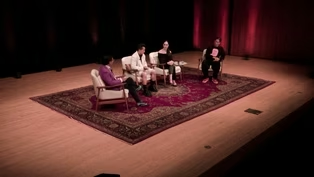
Voices Rising: Asian Americans in Motion: Preview
Video has Closed Captions
Preview: S3 Ep8 | 30s | An evening spotlighting the accomplishments of Asian Americans in dance and sports. (30s)
Providing Support for PBS.org
Learn Moreabout PBS online sponsorship New Episode
- Arts and Music

Innovative musicians from every genre perform live in the longest-running music series.
 New Episode
- Arts and Music

Intimate portraits of six of the most influential and celebrated classical music artists.



 New Episode



 New Episode
 New Episode
Support for PBS provided by:
In Motion is a local public television program presented by WLIW PBS