
April 13, 2026 - Full Show
4/13/2026 | 26m 50sVideo has Closed Captions
Watch the April 13, 2026, full episode of "Chicago Tonight."
Efforts to ban no-knock warrants statewide. And WTTW’s Geoffrey Baer rides the rails in a new special.
Problems playing video? | Closed Captioning Feedback
Problems playing video? | Closed Captioning Feedback
Chicago Tonight is a local public television program presented by WTTW
WTTW video streaming support provided by members and sponsors.
April 13, 2026 - Full Show
4/13/2026 | 26m 50sVideo has Closed Captions
Efforts to ban no-knock warrants statewide. And WTTW’s Geoffrey Baer rides the rails in a new special.
Problems playing video? | Closed Captioning Feedback
How to Watch Chicago Tonight
Chicago Tonight is available to stream on pbs.org and the free PBS App, available on iPhone, Apple TV, Android TV, Android smartphones, Amazon Fire TV, Amazon Fire Tablet, Roku, Samsung Smart TV, and Vizio.

WTTW News Explains
In this Emmy Award-winning series, WTTW News tackles your questions — big and small — about life in the Chicago area. Our video animations guide you through local government, city history, public utilities and everything in between.Providing Support for PBS.org
Learn Moreabout PBS online sponsorship>> Hello and thanks for joining us on Chicago Brandis Friedman.
Here's what we're looking at.
Let's be clear.
When there is no accountability, there is no justice.
A bill in Springfield brings the fight to ban no-knock warrants statewide.
>> Chicago's 6 great terminals almost made.
The city seemed like Oz.
>> And Jeffrey Bear takes us all aboard while he explores Chicago's rail system in a new W t Tw special.
First off tonight, Pope Leo says he does not fear the Trump administration and we'll continue to speak out strongly against the war in Iran.
The Chicago born contact responded today to President Trump who criticized him in a link.
The social media post over the weekend saying he's not a fan of the pope and that he's, quote, weak on crime and terrible on foreign policy.
Trump's post came after the pope suggested that a, quote, delusion of omnipotence was fueling the U.S.
and Israel's war in Iran.
>> If things are nice there will not >> For more on the back and forth, you can visit our website.
A measure that would ban Chicago cops from participating in hate groups or far-right.
Extremist groups passes in a city council committee today, 3 aldermen voted against the measure.
One of them is 18th Ward Alderman Derek Curtis, who argues such a measure should apply to all city employees, not just Chicago police officers.
There are no public allegations that city workers in other departments have documented ties to anti-government or extremist groups like the Proud Boys were the Oath Keepers.
The measure would also give the civilian Office of Police Accountability a 40 to investigate officers accused of actively participating in such groups.
Cpd says it supports the measure and believes every city employee should be held to the same standards.
The full city council is expected to vote on the measure Wednesday.
new affordable housing development in Englewood will pay tribute to a slain Chicago police officer while also providing dozens of residential units and commercial space.
>> This location is about more than just housing.
This building.
Given this location.
>> It's where our 2 communities me.
Chicago Lawn and West Englewood.
That will be able to come together.
It will be a symbol of what is possible with communities organize when residents leave and when investment follows the vision of the people.
>> Officials and organizers broke ground this morning at 63rd and Western where developers will build 44 affordable one and 2 bedroom apartments as well as 2500 square feet of commercial space Alderman Stephanie Coleman office says it marks the first significant housing development in Inglewood and over 30 years.
And a room will be dedicated to Chicago police officer Ella French who was killed in the line of duty in the 8th police district back in 2021.
The Chicago sky are getting a head start on revamping their roster ahead of tonight's draft days after dealing star Angel Reese to Atlanta for 2 future first-round picks.
The sky bolstered their roster this weekend.
The team now has 3 of the top 5 picks from the 2024 draft after acquiring forward Jackson and point guard Jacy Sheldon Sky also brought on defensive.
Stand out.
Dj Carrington 7 time All-Star Skylar Diggins and as there is Stephen's who was on the skies championship team back in 2021, the team also re-signed a number of players, including the franchise's all stop all-time leading score.
Courtney VanderSloot the sky hold the 5th pick in tonight's draft.
That starts at 6 o'clock Central.
What a ban on no-knock warrants could look like.
Should a state bill passed?
That's right after this.
>> Chicago tonight is made possible in part why the Alexander and John Nichols family.
The Pope Brothers Foundation.
And the support of these donors.
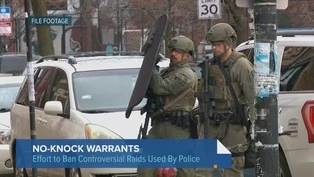
>> There is a renewed push in Springfield to pass a state law banning no knock warrants in.
Jeannette Young is one of the leading forces behind the bill that is named after her.
It comes 7 years after Chicago police handcuffed young while she stood naked in her home as they executed a search warrant at the wrong address.
This bill would ban no-knock warrants in all except exigent circumstances where the safety of officers or others threatened require officers to provide 30 seconds notice before entering a home ban, pointing firearms at children unless they present a clear and present danger execute warrants between 09:00AM and 07:00PM unless a judge determines otherwise and require medical assistance to be nearby.
When officers are executing a search warrant.
Joining us now, our state Representative Angelica Good Quayle whose district includes West Lawn and clearing on the southwest side and state Representative Kam Buckner whose district includes Bronzeville High Park and the South Loop.
Welcome to you both.
Thank you for joining us.
Representative Buckner, let's start with you, please.
Would you explain for our viewers at home just what a no-knock warrant is.
>> Yes or war is something that is very rarely used by police officers.
It's to use is used was used to enter.
So it's normally when there are indications questions about whether or not there may be drugs in the residence, but there's no Police enter the premises without a once again asking themselves which can cause folks, you know, pretty startled in most cases, but also there are issues where these are not being pursuit on the road on the right homes.
Right?
And so try to do here is find a way to deal with the issue assessment that had happened to her.
And then we've great wealth and around the state.
>> In what kinds of situations are, no knock warrants typically executed.
>> Traditionally, they have been a really, really women of the failed war on drugs when people have cops have some type of until, but there may that may be our colleagues.
promises and what the attempt to do is to get there before the evidence can be lost.
But once again, because this is a relic of a foregone error folks there, you know, just flushing drugs down the toilet is no as big of an issue of used to be especially certain drugs like marijuana, which right now legal in something that we that we regulate are part of members here.
And so we've said is that unless things are extremely violent and aggressive, cops not be taken indoors, in the state Illinois.
>> Representative, good adequate or this bill would prohibit no-knock warrants for cases where the only alleged crime is drug possession.
As we just heard Representative Buckner referring to.
What concerns do you have about that?
>> The way the bill was presented how we had individuals testified.
They were trying to give a distinction between low level and high level crimes.
And for me, it's a crime.
It's a crime.
And they don't know that we necessarily confer say that the because it's a low level is high was defined by the by the presenters that it's a no need for a no-knock warrant.
We don't know what's necessarily inside of a home or in a building.
And so the warrant is executed.
And so for me, the concern was it's very difficult to go ahead in and calculating.
I human reaction.
Human nature in a high level incident like this and it's oh, I don't know that necessarily putting it black and white is the safest for the police officers or for those on the other end as well.
Especially the topic came up about children being inside the premise.
And so I think we need to review a little further just because of some of the things that were set forth the bill.
>> It sounds like representative, like you're saying it's is it to some degree a matter of clarification of the language or would you like to see delineate its very specific alleged crimes or offenses that, you know, might fit under the reasoning for no knock warrant verses.
That might not.
>> I think we need to review everything again.
The presenters talked about low level low level offenses, high level.
They talked if you are experienced police officer like SWAT or the tactical team that you would be more of an aggressor than actually carrying out.
I think that's unfair and unjust that a little discriminatory against law enforcement because they're trained and they have more experience.
And so I think it's really breaking down right?
There are specific hours sent to the bill, too, as well as Warren can be executed.
And so I think we need to go back in again and just have those conversations with those experiencing as well as with Representative Buckner.
Representative Buckner.
>> Do you have any response to some of Representative Goode adequate concerns?
>> There was listen to first of said me, my friend and colleague here, we don't disagree on the need to to have some reforms to think differently.
And I know her background where she's coming from and the space.
Well, as that the that the bill speaks for itself, right, that the language is there no direct testimony or some question.
So about folks who brought their own personal experience to the conversation.
But the bill as Black and white and the truth the matter is, I know that like just want to differentiate between low and high level crimes, but the truth of the personnel matters and the law distinguishes between misdemeanors and felonies, police policy distinguishes when it's going to be okay to do a high-speed chase someone.
That's not what it's OK to put your weapon when it's not.
So the totality of circumstances does matter here.
But what I will remind folks that we have brought together Motley Crue, really, folks who believe in this, right.
We we've got the Illinois Rifle Association, which is not which would call very progressive group.
You know, talking about why this is important, whether support this So I think are ways for us to make this better.
And I'm looking forward to those conversations, Representative Buckner, how?
Because we know that this is, you know, a foot in the city of Chicago as well.
How similar is the state bill to the citywide efforts to reform warrant execution in Chicago?
>> Very similar.
I think we have a little bit.
We have some more more leeway for Constand are exigent circumstances when somebody is a violent.
>> Person accused of a violent crime a threat to safety of themselves or someone else.
Ben, we give them the ability to continue to use these wars.
I'm not sure that those problems City, they are very close.
I think ours has some sort of our rules.
>> Representative grant quite large.
You have concerns about how this bill might affect rural versus urban departments differently.
>> Oh, absolutely.
you know, in in Chicago, we might be able because it's an urban, city.
If someone calls for backup or needs an assistant.
Write this bill also addresses about having and you hear medical staff on site when the warrant executed in the rural areas.
We have to think about Calling for backup are getting a team together means probably borrowing law enforcement from other counties.
And that would include the EMT's as well.
And so I think that's something that very important that we need to look at in to because we can't just assume that there's enough staffing in order to execute a warrant the rural areas.
We need to make sure that we bring those folks into the conversation as well.
>> Another that you mentioned earlier is that this bill would restrict most Warren execution to the hours between 09:00AM and 07:00PM.
What are your concerns about that time frame?
>> Well, it was interesting because one of the prisoners use the example of how the the warrant that was executed for Anjanette Young was signed at 10:00AM and didn't quite understand why it took so long for the morning to be executed.
here.
We're putting specific hours as to when Warren is executed again.
If the tech teams are often that they they're waiting for a judge to sign off on it, they still need to regroup and make sure that they look at the entire area that they're going to go ahead execute the search warrant if their schools in the area.
If there's children involved just families, that's residential high-rise.
And to all those things play a factor.
And so again, I think we we definitely need to come back and talk about those those parameters for law enforcement.
What we don't want is someone to come in execute the warrant.
And then here's a police officer who get shot because we have to be rushed that we have to execute a war between certain hours that that's not that's not acceptable at all.
Representative Buckner.
>> Yeah, I say this no-knock warrants are one of the few policies, intentional policies that intentionally put civilians and police on a collision course by design.
We're worried about his gunshot, which I am.
I think that we have to have a better way to approach this once again that they want is extremely violent because think this a violent situation that they're moving into.
Then there needs to you know, ways to deal with that.
And this bill, give the ability to do that.
But once again, more than 46%, almost half the arts in Chicago do not result the risks.
So nearly half of the time we're sending officers or officers into harm's way and in doing that in the most egregious possible, which is kicking somebodys door about announcing yourself is just not smart policy.
It's not smart for the people who live in homes.
That's not smart for the officers to carry out his duties every single day.
>> Representative Buckner, does legislation does it also called for additional training for officers who are executing these words?
>> It doesn't.
it will also part of is is making sure one if this passes that municipalities and and counties who doing the surveys wars.
How Bility to the Illinois Law Enforcement Standards Board, create whatever the new policy mechanisms are around us and finding a way to make sure their officers are trained on what it is to to executing warrants safely and the way that is adhering to what this loss is, what this bill says.
>> Additionally, when would a judge be able to override the limitations that are that are set by Warren executioner that are set on warrant execution by this bill would do that.
>> But it does.
Is forces a hearing?
First of right, problems with no knock warrant that they They're all about speed and speed is not necessarily mean efficiency or success.
All right.
What this does is it requires a judge to look at the totality of the circumstances to look at the history to look the familiar and the spatial in geographic issues because just like is different.
There's some different doing this places, just the city to make it the same in certain neighborhoods in the city may be harder to execute horses.
that's like.
Some of the worst decision.
Que.
We've got 30 seconds left.
I want to give Representative Goode adequate are the last word.
What would you like to see done here?
>> We're definitely going to have to come back to the table.
I think we really need to examine this.
I want to bring law enforcement from rural areas specifically and with our police officers.
Look, our CPD officers are actually doing training from what I understand this week about no knock warrant.
So I don't know that necessarily legislation is something that needs to be implemented.
I think we're ready discussing and having those conversations.
But I want to make sure all law enforcement from all over the state is included in and and is able really participate in and what's going to happen and what's going to put on black and white.
>> All right.
That's where we're going to have to leave it.
Thanks to both for joining us.
state representatives Angelica get adequate Ward and camp out near thanks.
And we're back with more right after this.
>> All roads lead to Chicago or all rails lead to Chicago.
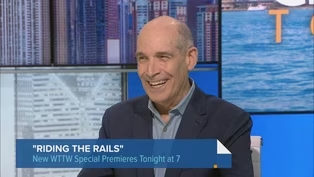
I should say the Windy City is also known as the rail capital of America and its on full display in a new W t Tw special called Right Rails.
Our very own training busiest Jeffrey Bear takes us through the evolution of rail travel and how it got Chicago's landscape and culture on track.
Here's a sneak peek.
>> It's just no denying the magical appeal of trains when the Stones J the sheer power.
The thrill of the journey.
And there's no place that captures that magic more than America's railroad capital.
Chicago.
>> joining us now is our favor conductor, Jeffrey Bear.
Welcome back more acute food, OK?
So as mentioned, you're a train.
Enthusiast yourself.
Yes, I and throughout the documentary, you know, we see other rail fans.
I didn't know that they had a Yeah.
Bind over your shared interest.
What do you think it is about trains that peaks people's interest so much?
I ask everyone I interviewed in this show.
Why do we love train so much?
And they all said the same thing.
I don't It's like they're just so big and powerful.
All and cool.
yes, the others like some kind of magical appeal and I can't really put my We heard someone say there's, you know, there's something a little bit calming about it.
And there is right.
Just kind of the, you know, the sound of them, you know, marching down the track home.
Yeah, that's a rhythmic feeling.
This sort of rocking you a little bit like a baby as you go along there.
Exactly.
How did Chicago become the epicenter of the nation's realty?
Well, that word a location, location, location.
Actually.
My father-in-law in St.
Louis used to say that St.
Louis blew because they they declined to take the railroads back.
Unlike many teen, hundreds and Chicago was like, bring it on So and of course, they had a little Mississippi River that they had to get across, which was, you know, not easy to it.
It's a you know, >> it really has to do with our location at You know, the tip of Lake Michigan and then you read across the the right across the state.
You've got the Mississippi River and that waterway.
And you've got, you know, you get here from the east.
So we were already this sort of very much a transportation center by water even before the railroads.
And so I think it's kind of also just natural for the railroads to jump on board or the city's iconic trains stations show up in popular media quite a bit.
As mentioned in the special.
Here's a little bit of that.
>> The terminals might be gone, but they live on in the movies from high roller high jinx.
It worth that much to Yeah.
2 life-threatening mistaken identity.
>> 2 baby saving G men.
And including up Union station after this scene.
Fortunately, it was filmed on a sound stage.
>> Makes me want to watch a few we you know, we saw some some stations that are no longer standing what happened to all of the stations in the rails that are now defunct, right?
There were 6 great rail terminals in Chicago.
We in the program more than any other city in the country.
Partly this is because you could not go from the West Coast to the East Coast without stopping in Chicago, getting off the train and going to another station and be like today if you wanted to go from California, New York and have to fly into midway, go to O'Hare and then fly on to New York, which nobody wants know and and, you know, the taxi services made a lot of money with all transferring people from one station to another in Chicago.
you know, over time we with the crosscountry rail travel was a clip, spike cars and airplanes.
And so there were fewer and fewer trains coming in am track consolidate everything into union station so that that's the one historic station that's still there.
I mean, the that street station still there with the building was torn down.
Metro still use it.
South Shore line.
Metra Electric still uses that the railroad along the along the lakefront.
We Ogilvy for the the old Chicago, Northwestern Pacific.
But the only historic railroad station still there is Union Station Union station, OK special.
It also digs into how reels shape Chicago's identity.
For instance, of course.
>> Many black Chicagoans owner way via train during the first wave of the great migration to Chicago.
How to trains become sort of a symbol of liberation for African-American.
You know, we wonderful.
She's a poet and and a professor reviewing never heard over and And she take her over to 11th Street, which is Illinois Central Station was.
>> this is where.
You know, thousands of African Americans from the south came off the train with hope in their hearts.
You know, as we've said, its cause, it's kind like a sacred space.
And even so articulate about the way that this transformed Chicago, this influx.
We also talk about the Pullman porters.
We go out to the Illinois Railway Museum, drive a steam engine in the end of the show we talk with their it is the porters.
And you know, well, you have this luxurious train.
We also show where the Pullman porters corridors were essentially servant's quarters in the train.
thing, the size of a phone booth with the toilet because they couldn't use the toilet that the customers were using.
Passengers.
And, you know, we talk about the whole life of the Pullman porters as well in this show, right?
Our transit system.
It looks a lot different from the days of the Pullman porters, though, why did we moved away from that traditional mode of travel to you know what we see today else?
Buses, cars, of course.
>> cars >> really, you know, interstate highway system basically.
Was kind of a boondoggle put the real literally put the railroad passenger railroads out of business and air travel.
Now, in fact, you know, when I was a student in Europe, I spent a year abroad.
We rode trains everywhere, even in Europe.
Now, you know, kids are or who are doing.
There's there there's year abroad are flying not taking the trains as much but Amtrak, the actually this year apparently is having the best the biggest year they've they've had in a long, long time.
So people are coming back to the railroads, especially gasoline prices the way they are now.
And obviously, we're just looking at the L there.
We have one of the biggest transit systems in the country.
you know, we we're still, you know, people are still you know, a lot of challenges right now with the L specially since COVID.
you know, the L system is still there, still they're struggling.
Still depend on a quite a bit, OK?
So we don't have time to show the clip.
Folks are gonna have to Very jealous of the fact that you got to drive a steam locomotive.
>> How fun was that?
Oh, it was just like a bucket list thing, you know, and I have to say how these train crews survived like with how they lived past the age like 30, I don't know because the fumes and the heat in that cab were unbelievable.
I mean, our actually our cameraman, Tim Boyd got heatstroke.
Oh, deer in the cab.
I hope that ha 2010 is okay.
Great website to for the show.
Everyone just use the Web.
Sorry.
Well, I'm gonna talk about it right now.
Jeffrey Bear, Congrats again.
Another show.
Thank you so much for joining Salute course.
And you can watch riding the rails with Jeffrey Bear tonight at 7 right here on W T Tw.
>> You can also watch it online at W T Tw Dot com slash rails.
There you can find more railroad history like details on America's biggest train heist.
How railroads standardize time and much more.
And that's our show for this Monday night.
Stay connected with our reporters and what they're working on by following us on Instagram at W T Tw Chicago and join us tomorrow night at 5, 30 10 now for all of us.
Here is how to Brandis Friedman, thank you for watching.
Stay healthy and and have a good night.
>> Closed captioning is made possible by Robert a cliff.
And ball a Chicago personal injury and wrongful death with
 New
NewBill Would Ban No-Knock Warrants Across Illinois
Video has Closed Captions
The bill would ban no-knock warrants in all but “exigent circumstances.” (11m 42s)
 New
NewGeoffrey Baer Explores Chicago's Rail System in New WTTW Special
Video has Closed Captions
The Windy City is also known as the rail capital of America. (8m 12s)
Providing Support for PBS.org
Learn Moreabout PBS online sponsorship
- News and Public Affairs

Top journalists deliver compelling original analysis of the hour's headlines.

- News and Public Affairs

FRONTLINE is investigative journalism that questions, explains and changes our world.












Support for PBS provided by:
Chicago Tonight is a local public television program presented by WTTW
WTTW video streaming support provided by members and sponsors.