
Capehart and Continetti on closing messages and predictions
Clip: 10/30/2026 | 12m 15sVideo has Closed Captions
Capehart and Continetti on closing messages and midterm predictions
Jonathan Capehart of MS NOW and Wall Street Journal opinion columnist Matthew Continetti join Amna Nawaz to discuss the week in politics, including the last week of the midterm campaigns, predictions on which party will control Congress and the closing messages from President Trump and candidates.
Problems playing video? | Closed Captioning Feedback
Problems playing video? | Closed Captioning Feedback
Major corporate funding for the PBS News Hour is provided by BDO, BNSF, Consumer Cellular, American Cruise Lines, and Raymond James. Funding for the PBS NewsHour Weekend is provided by...
Capehart and Continetti on closing messages and predictions
Clip: 10/30/2026 | 12m 15sVideo has Closed Captions
Jonathan Capehart of MS NOW and Wall Street Journal opinion columnist Matthew Continetti join Amna Nawaz to discuss the week in politics, including the last week of the midterm campaigns, predictions on which party will control Congress and the closing messages from President Trump and candidates.
Problems playing video? | Closed Captioning Feedback
Where to Watch PBS News Hour
PBS News Hour is available to stream on pbs.org and the PBS app.
Providing Support for PBS.org
Learn Moreabout PBS online sponsorshipAMNA NAWAZ: With Election Day just around the corner, the last week has been filled with last-minute rallies and campaign events as the parties deliver their closing messages.
Just today, The Cook Political Report shifted a dozen more house seats toward Democrats.
To discuss all that and more, we turn now to Capehart and Continetti.
That's Jonathan Capehart of MS NOW and Matthew Continetti, a Wall Street Journal opinion columnist and scholar at the American Enterprise Institute.
David Brooks is away tonight.
Great to have you here.
JONATHAN CAPEHART: Hey, Amna.
MATTHEW CONTINETTI, American Enterprise Institute: Good to be here.
AMNA NAWAZ: Good to see you both.
All right, let's just look ahead.
Three days to go now.
It seems very likely the House will flip to Democratic control.
Matt, do you see Republicans hanging on to the Senate?
And how big of a wave are you expecting in the House for Democrats?
MATTHEW CONTINETTI: Well, I'd say the House is probably going to be 15-to-20 seat majority for the Democrats, and then for the Senate, I do see Republicans holding on, but just by their fingernails.
A 50/50 Senate, I think is a very probable outcome.
And that means that Vice President Vance is going to be spending more time casting tiebreaking votes on Capitol Hill than hitting the campaign trail ahead of 2028.
AMNA NAWAZ: You agree with that?
JONATHAN CAPEHART: Look, I'm out of the prediction game.
AMNA NAWAZ: You're not going to give me something to play back to you later?
MATTHEW CONTINETTI: You can't get out of it that easy, Jon.
I'm on the line here.
(CROSSTALK) JONATHAN CAPEHART: Watch me.
Look, I will believe all the prognosticators and the Republican operatives who are freaking out that the House is gone.
I will grant it -- no, 50-50.
I know some Democratic operatives who would love for a 50/50 outcome simply because it will take the 2028 candidates, let them off the hook for whatever Democrats wouldn't be able to get accomplished if they had both chambers.
Now, the thing about the about the Senate, and what gives me pause about whether the Democrats will take the majority is, in a lot of key races, I'm looking at ticket-splitting, ticket-splitting in Florida, ticket-splitting in Texas, ticket-splitting in Michigan.
And so until the American people go and vote and we see how they have actually voted, then we will know.
MATTHEW CONTINETTI: Well, that really is the case that makes this election very unusual... AMNA NAWAZ: Yes.
MATTHEW CONTINETTI: ... is that you have the toss-up races increasing in number, all on Republican territory.
There are two toss-ups, I think, that RealClearPolitics rates in Democratic states, Michigan and Minnesota.
And Minnesota seems farther out of reach the closer we get to the election.
So, if the polls are right, that means it could be a very long night for Republicans, but the polls might not be right.
AMNA NAWAZ: We will wait and see.
As you say, and we always say, it's in the voters' hands now.
Let's talk about the closing messages we have been seeing from the candidates and from the parties.
Matt, as you have seen, the president has been busy on the road in this final stretch.
He's been going back to states that he very handily won back in 2024, including Mississippi and South Carolina, Texas and Ohio.
He's got visits planned to Iowa and Kansas this weekend.
In terms of a closing message, we have covered this too, he's really intensified a lot of his anti-Muslim rhetoric, specifically targeted at the Michigan race and the Democratic candidate there, Abdul El-Sayed.
He's been commenting on men's bodies.
He's been boasting about how much money oil companies are making.
He's not centered on affordability, which is the number one issue.
Is this the closing message Republicans want?
MATTHEW CONTINETTI: It's not the closing message that the Republican political class wants, but is it the message that is necessary to motivate Trump's supporters to come out?
That, I think, is still an open question.
And, again, we're just going to have to wait.
When Trump goes to these states, he's there to mobilize the base of the Republican Party.
The voters most devoted to him who we have seen are not as enthused to come out when he's not at the top of the ticket.
And the story of the past two years has been parts of that 2024 Trump coalition have veered off.
Young men have veered off.
Independents have moved farther toward the Democratic Party.
Hispanic voters, of course, have moved toward the Democratic Party.
What's left is the base rural and working class white vote.
That's what Trump is trying to mobilize.
And, right now, Republicans are very nervous that they might not show up too.
AMNA NAWAZ: Jonathan, what do you make of that?
JONATHAN CAPEHART: And why should they show up?
I mean, great, the die-hards are there at the -- at his rallies listening to him do the greatest hits.
But they're also the folks who are paying high diesel prices, high gas prices, high health care prices, if they have health care, dealing with -- dealing with inflation.
So, in all the groups you talked about, young men, Latinos, even African Americans, he did better with them in '24 than he did in '20, those are all the same people who are living in the reality of Earth One and voted for him because they thought he was going to do something about those issues.
And we will find out on Tuesday, but it looks like they're not there.
That's how he won reelection.
You can't -- he cannot have won the White House solely with rural white voters.
AMNA NAWAZ: Can I ask you, though, is there a danger here for Democrats?
Because there is a very strong anti-Trump message in their closing messages here.
Could this wave, whatever it is, could it hide weaknesses, that this isn't necessarily an affirmation vote for the party necessarily, but it's a rejection of the president?
JONATHAN CAPEHART: Oh, I think the Democrats running absolutely know that the votes are rejection of the president.
A lot of the people who are running are running because they don't -- they do not like the president's policies and what he's doing.
And if you look at, say, Senator Jon Ossoff and a bunch of other Democratic candidates, they have been very good about taking their anti-Trump message and marrying it to real issues, take it corruption -- tying the corruption to the affordability crisis and talking about what they would do about it.
So it this is not an either/or.
This is a this is a both/and.
They are talking about both, because you can talk about both.
AMNA NAWAZ: What do you make of that, Matt?
MATTHEW CONTINETTI: Well, I think if this election is like 2018, there, the anti-Trump message didn't really shift the overall dynamic, right?
I mean, you had the Democratic House, but Republicans retained the Senate.
And heading into the pandemic, it looked like Trump could win reelection, especially if he drew a far left opponent.
This election is more like 2006, where the Democrats take both chambers of Congress.
In retrospect, 2006 signaled a shift to the left that persisted up through the 2010 Tea Party midterm.
AMNA NAWAZ: I want to talk about Alaska.
We have covered it a lot this week, specifically the Senate race there.
The New York Times reported this week that the Democratic Party and the campaign of the Democratic candidate, Mary Peltola, played a role in recruiting another Dan Sullivan to run, that is Dan J. Sullivan, to dilute the vote of the Republican incumbent Dan S. Sullivan.
Mary Peltola even last night denied any involvement or knowledge in that.
Jonathan, we all know here look these kinds of political tricks and stacking of the ballot, this is a story as old as time in America, third-party candidates being recruited as well to dilute votes.
But was this a smart move for Democrats, or does this just fuel all the claims of fraud and rigged elections that President Trump has been making?
JONATHAN CAPEHART: I mean, this is a story I could not muster any kind of enthusiasm for.
AMNA NAWAZ: Why not?
JONATHAN CAPEHART: Well, because as you just said, these sorts of things happen all the time.
Was it a boneheaded move and they got caught doing it?
Absolutely.
But I go back to why we're even talking about Alaska in the first place.
A week ago, we were sitting here talking about the president of the United States directing the attorney general of the United States to sue proactively Alaska to prevent them from certifying the election -- the election for Senate in Alaska if the Democrat won.
There are at least three sins in what I what I just said.
That is what I'm focused on.
And, as we see, the administration is hell-bent on gumming up the works with the Alaska Senate race.
AMNA NAWAZ: Does this now devolve into some kind of legal fight?
The DOJ is already suing in the Alaska case.
MATTHEW CONTINETTI: Well, the extent of the legal fight will continue at the level of who wins and by what margin, but there's also now going to be investigations about whether there was coordination, whether there was lying, not just in terms of lying, as people may have been saying that had nothing to do with recruiting this decoy Dan Sullivan, as he's called up in Alaska.
But, also, were there any illegal filings, campaign ballot filings you have to do that could be legally liable as well?
So I think it will continue.
But I think, fundamentally, since you talked about it last week, what interrupted the story was this New York Times scoop.
And this is The New York Times.
It's not Donald Trump, and they have the receipts here.
And it's put Mary Peltola's honesty into question.
AMNA NAWAZ: Matt, do you expect President Trump to come out on election night or the morning after and claim fraud, claim that it was a rigged election?
Are you anticipating that, based on what we have seen in the past?
MATTHEW CONTINETTI: I don't know.
I mean, I think that, again, depending on the results there, he's very he's very likely to say something was up, especially if it's a narrow Peltola victory in Alaska.
There may be some races in the House that he will say that there is some noncitizen voting in.
There's some predicate for that.
But Trump... AMNA NAWAZ: Predicate for him claiming that, correct, yes.
MATTHEW CONTINETTI: Right, with these investigations that are ongoing.
But Trump, I think, is going to want to change the subject very dramatically if the night doesn't go well for him.
And that's why I expect some big move on foreign policy, maybe even on election night.
AMNA NAWAZ: Oh, I want to ask you more about that in a second, but, Jonathan, first to you on the claims of fraud, what are you anticipating on the night?
JONATHAN CAPEHART: Oh.
I have been here how many election nights where we have sat and watched him come out and claim fraud.
I mean, this is what he's going to do.
And I suspect that Democrats around the country, and particularly national Democratic leaders, are also expecting him to do that, which is why a lot of them are hoping, praying that this is actually a tsunami, meaning that in all of these races there will be so -- the results will be unimpeachable, to use a phrase.
AMNA NAWAZ: OK, talk to me more about what else you expect to hear from the president.
JONATHAN CAPEHART: Yes.
Let's hear about this.
AMNA NAWAZ: Because he has threatened or at least been reported that he's weighing restarting the war in Iran.
Do you believe he will?
MATTHEW CONTINETTI: He's been briefed by our military commanders.
He's been talking to Prime Minister Netanyahu.
There are forces moving into the region.
Everything is set for Trump to make a decision to restart the war or to have some kinetic action against Iran.
AMNA NAWAZ: And is that a good move?
MATTHEW CONTINETTI: I actually am skeptical that he will do a big attempt to really dramatically change the picture.
There is a chance that he will have punitive strikes in order to reduce Iran's capacity to harass the traffic through the strait, which, of course, the attacks have been increasing in recent weeks.
Overall, though, what you find after an election like we might have on Tuesday, in those final two years, presidents turn to foreign policy.
Obama did it.
George W. Bush did it.
Bill Clinton did it.
Ronald Reagan did it.
Trump is going to move, I think, to decide what will happen in Iran.
He will move more on Ukraine.
But, with Trump, you also have the added twist is that he will be devoting a lot of time to golf courses.
AMNA NAWAZ: Jonathan, I will give you the last word here.
What do you expect from Mr.
Trump after the election?
JONATHAN CAPEHART: Look, what piqued my interest was you, Matt, saying that it could happen on Election Day.
That would be -- that would be wild.
But for him, for the president to take some kind of action against Iran in the weeks after Election Day, maybe even the days after Election Day, that's, to my mind -- again, the number one thing I learned during the first Trump presidency is to have an open mind and an active imagination.
And if you can think that it could happen, it could happen.
So I am prepared for whatever the president's going to do, whether it's election night or the day after.
AMNA NAWAZ: Stay tuned.
We will find out.
Jonathan Capehart, Matthew Continetti, great to see you both.
Thank you so much.
MATTHEW CONTINETTI: Thank you.
 New
$6 billion cryptocurrency heist puts investors on edge
Video has Closed Captions
$6 billion cryptocurrency heist puts investors on edge (5m 13s)
 New
Candidates make final midterm stops as early voting surges
Video has Closed Captions
Candidates make final midterm stops as early voting surges (4m 52s)
 New
Inside a Ukrainian city hit by Russia during Starlink cut
Video has Closed Captions
Inside a Ukrainian city hit by Russian drones during the Starlink disruption (4m 50s)
 New
News Wrap: Judge investigating if DOJ misled court
Video has Closed Captions
News Wrap: Judge investigating if Trump officials misled court about D.C. golf course plan (6m 9s)
 New
Rahm Emanuel on what Democrats should do after midterms
Video has Closed Captions
'A down payment on change': Rahm Emanuel on what Democrats should do after midterms (6m)
 New
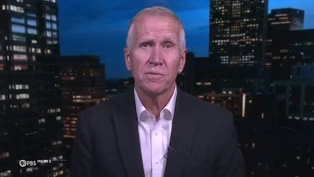
Trump should 'own' election outcome, Sen. Tillis says
Video has Closed Captions
Trump should 'take stock' and 'own' election outcome, Sen. Tillis says (11m 42s)
Providing Support for PBS.org
Learn Moreabout PBS online sponsorship New Episode
- News and Public Affairs

Today's top journalists discuss Washington's current political events and public affairs.

- News and Public Affairs

FRONTLINE is investigative journalism that questions, explains and changes our world.

 New Episode
 New Episode
 New Episode
 New Episode

 New Episode
 New Episode




Support for PBS provided by:
Major corporate funding for the PBS News Hour is provided by BDO, BNSF, Consumer Cellular, American Cruise Lines, and Raymond James. Funding for the PBS NewsHour Weekend is provided by...