
New focus on autism fuels debate over splitting the spectrum
Clip: 4/27/2026 | 9m 33sVideo has Closed Captions
New focus on autism fuels debate over splitting the spectrum
Last year, Health Secretary Kennedy thrust autism into the national spotlight, calling it an epidemic and vowing to investigate what he characterized as its environmental causes. It struck a nerve in the autism community and reignited debates about whether the autism spectrum is too broad. Judy Woodruff and producer Mary Fecteau have the story for our series, Disability Reframed.
Problems playing video? | Closed Captioning Feedback
Problems playing video? | Closed Captioning Feedback
Major corporate funding for the PBS News Hour is provided by BDO, BNSF, Consumer Cellular, American Cruise Lines, and Raymond James. Funding for the PBS NewsHour Weekend is provided by...
New focus on autism fuels debate over splitting the spectrum
Clip: 4/27/2026 | 9m 33sVideo has Closed Captions
Last year, Health Secretary Kennedy thrust autism into the national spotlight, calling it an epidemic and vowing to investigate what he characterized as its environmental causes. It struck a nerve in the autism community and reignited debates about whether the autism spectrum is too broad. Judy Woodruff and producer Mary Fecteau have the story for our series, Disability Reframed.
Problems playing video? | Closed Captioning Feedback
Where to Watch PBS News Hour
PBS News Hour is available to stream on pbs.org and the PBS app.
Providing Support for PBS.org
Learn Moreabout PBS online sponsorshipGEOFF BENNETT: Last year, U.S.
Health Secretary Robert F. Kennedy Jr.
thrust autism into the national spotlight, calling the developmental disability an epidemic and vowing to investigate what he characterized as its environmental causes.
His speech and the reaction to it struck a nerve in the autism community and reignited debate about whether the autism spectrum is too broad and whether those with the highest needs are being left out of the conversation.
Judy Woodruff and producer Mary Fecteau have this story.
It's part of our series Disability Reframed.
COMPUTER VOICE: Pizza.
Car.
ALICIA MESA, Mother: Oh, you want to go pizza, car.
JUDY WOODRUFF: Twenty-four-year-old Pablo Mesa lives with his parents outside of Santa Cruz, California.
ALICIA MESA: We call him either Pabs or Pablito.
He is full of life and energy.
He absolutely loves listening to music.
He is also on the very severe end of the autism spectrum.
He's not able to tell me that something hurts.
JUDY WOODRUFF: His mother, Alicia Mesa, has been his principal caregiver since he was diagnosed at age 2.
ALICIA MESA: He lives with deep frustration from not being able to communicate because he's nonverbal.
His autism presents with severe self-interest behavior, aggression, destructive behavior.
JUDY WOODRUFF: And he has hurt himself over time?
ALICIA MESA: He has.
His aggression most of the time is trying to communicate that something's wrong.
So, instead of saying, oh, my head hurts, he will start hitting his head forcefully.
He has to go around wearing a football helmet in order to protect him from more brain injury.
JUDY WOODRUFF: Pablo is supported by an around-the-clock team of at least three people funded by the state of California who work with him to develop skills to become more independent and intervene if his behavior becomes aggressive.
ALICIA MESA: Systems are not built for individuals like Pabs.
JUDY WOODRUFF: High-needs individuals like Pablo once represented the vast majority of diagnosed autism cases.
CATHERINE LORD, Clinical Psychologist, University of California, Los Angeles: I mean, I remember the first patient I saw as a graduate student, people said, oh, he doesn't have autism because he's talking.
Can you help me make a cake?
Make it flat.
JUDY WOODRUFF: Catherine Lord is a clinical psychologist at the University of California, Los Angeles.
She has spent more than five decades researching and diagnosing what is now known as autism.
CATHERINE LORD: We thought it was a very rare disorder that was defined by this combination of behaviors that we still talk about, but we're definitely better at identifying autism in young kids and also autism in adults.
JUDY WOODRUFF: Once thought to be a form of schizophrenia in young children, autism wasn't even recognized as a distinct condition until 1980.
But, in 2013, people with lower support needs, including those with a condition known as Asperger's syndrome, were all folded into a new diagnosis that Catherine Lord helped create, Autism Spectrum Disorder.
CATHERINE LORD: I think the idea of a spectrum was really more than just one thing.
It was the idea of like a rainbow, where you have different hues and different levels of intensity and different subtle differences, but it's all together.
And I think it may have backfired in some ways because it is now so big and includes so many things.
JUDY WOODRUFF: Driven in part by the broadening of the definition, the number of children with the diagnosis has skyrocketed over the past 25 years.
Today, about one in 30 kids is diagnosed with autism.
But critics of the broad definition say it puts people like Pablo in the same diagnostic category as Elon Musk.
ELON MUSK, Owner, X: I'm actually making history tonight as the first person with Asperger's to host "SNL."
JUDY WOODRUFF: A 2021 "Lancet"-commissioned report on the future of autism research and care introduced the term profound autism for individuals needing 24/7 care, typically with I.Q.s below 50, minimal verbal ability, or both.
COLIN KILLICK, Executive Director, Autistic Self Advocacy Network: If you have a hard line, inevitably some people will get harmed by which side they fall on it.
JUDY WOODRUFF: Colin Killick is the executive director of the Autistic Self-Advocacy Network, a group led entirely by autistic people.
He says splitting the spectrum comes with a new set of issues.
COLIN KILLICK: The people who will be most hurt are the people who are right on either side of the line, the person who, if they get labeled profound, get stereotyped, get stigmatized, get shunted away from things like career services, or, if they don't get labeled profound, lose access to vital supports and services that could keep them in the community.
ROBERT F. KENNEDY JR., U.S.
Health and Human Services Secretary: These are kids who will never pay taxes, they will never hold a job.
JUDY WOODRUFF: But the deep divisions within the autism community were on full display last year after the way U.S.
Health Secretary Robert F. Kennedy Jr.
characterized autistic people during a news conference.
ROBERT F. KENNEDY JR.
: They will never write a poem.
They will never go out on a date.
Many of them will never use a toilet unassisted.
JUDY WOODRUFF: What was your response to that?
COLIN KILLICK: Horror, shock, anger.
I mean, that's incredibly untrue.
JUDY WOODRUFF: Alicia Mesa disagrees.
ALICIA MESA: A lot of people were offended.
However, as a mother of a severely autistic son, I felt relief.
Finally, someone in high office was acknowledging the reality that my son lives through every single day.
To me, that is not stigma.
That's truth.
JUDY WOODRUFF: Alicia says Pablo's high support needs have made it difficult to access services, even those provided by agencies that specialize in therapy for autistic people.
ALICIA MESA: I lost count after 15 agencies that all of them came in here one by one into our home, just to be disappointed a few days later when I got a call from them saying, sorry, but we're not actually able to take your case.
JUDY WOODRUFF: She thinks the autism spectrum diagnosis should be divided and people like Pablo should be classified separately.
ALICIA MESA: Let's go on the sidewalk, Pablo.
Pablito requires moment-to-moment supervision.
Someone on the more mild side of the autism spectrum, they could have a completely independent life, so it's not the same.
So there should be some distinction.
JUDY WOODRUFF: But over 2, 500 miles away near Akron, Ohio, 31-year-old Jordyn Zimmerman worries that those distinctions would have limited her opportunities.
Zimmerman is a non-speaking autistic woman who communicates through a text-to-speech program and, because of that, some of our questions were provided in advance.
JORDYN ZIMMERMAN, Disability Advocate (through computer voice): Before I had access to reliable communication, school was very difficult.
I struggled to regulate my body, which sometimes looked like frustration, like hitting others or banging my head on walls.
But it was really about not being able to express myself academically.
I was often asked to repeat the same tasks over and over, even things I had already learned years earlier.
So I wasn't just disconnected socially.
And, in society, I was also not even recognized for what I was capable of.
JUDY WOODRUFF: Her autism was thought to be too severe for her to learn in a classroom alongside her peers.
That changed when she started using a communication app in an iPad at the age of 18.
What was that like for you personally to experience that ability to communicate for the first time?
JORDYN ZIMMERMAN (through computer voice): It was painful to think about all I had missed and all the ways I had been so misjudged, but also incredible to think about how I could now have a say in my life.
JUDY WOODRUFF: And there's some other plaques, Ohio University.
JORDYN ZIMMERMAN (through computer voice): And Boston College.
JUDY WOODRUFF: Zimmerman earned a master's degree, built a career in inclusive curriculum development, and now shares her story at speaking engagements worldwide.
She questions whether those opportunities would have been possible if she had been labeled profound.
JORDYN ZIMMERMAN (through computer voice): Based on the information I have seen and heard, I would likely be classified as profound due to my need for support and being nonspeaking.
My worry with that for myself and everyone in the community is that the narrative doctors told my family when I was 4 years old, but also when I was 18, is wildly different than who I am.
It will more likely cause more health care disparities, because, once a formal label like profound autism is applied, it becomes easier for people to give up.
JUDY WOODRUFF: Back in California, Alicia Mesa says it's not about giving up.
It's giving her son a voice.
ALICIA MESA: Parents like myself are exhausted.
I can't go and advocate for him, just take a trip to Washington.
So he has the potential to disappear completely from the conversation.
You had a wonderful day today.
JUDY WOODRUFF: For the "PBS News Hour," I'm Judy Woodruff in Freedom, California.

Accused gunman charged with attempted assassination of Trump
Video has Closed Captions
Accused Correspondents' Dinner gunman charged with attempted assassination of Trump (5m 4s)

Ex-agent weighs in on Secret Service security concerns
Video has Closed Captions
Ex-agent weighs in on Secret Service security concerns (7m 55s)

The health concerns as Supreme Court hears Roundup case
Video has Closed Captions
A look at health concerns as Roundup case reaches Supreme Court (6m 33s)

Reporters describe chaos at Correspondents' Dinner shooting
Video has Closed Captions
Liz Landers and Lisa Desjardins describe chaos at Correspondents' Dinner shooting (5m 37s)
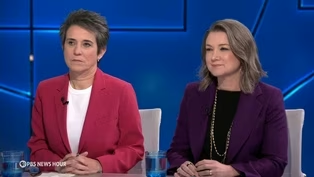
Tamara Keith and Amy Walter on risks of political violence
Video has Closed Captions
Tamara Keith and Amy Walter on the growing risks of political violence (7m 48s)

U.S.-Iran talks at impasse over nuclear program and Hormuz
Video has Closed Captions
U.S.-Iran talks at impasse over nuclear program and Strait of Hormuz (4m 34s)
Providing Support for PBS.org
Learn Moreabout PBS online sponsorship New Episode
- News and Public Affairs

Today's top journalists discuss Washington's current political events and public affairs.
 New Episode
- News and Public Affairs

FRONTLINE is investigative journalism that questions, explains and changes our world.

 New Episode
 New Episode
 New Episode
 New Episode
 New Episode
 New Episode
 New Episode
 New Episode
Support for PBS provided by:
Major corporate funding for the PBS News Hour is provided by BDO, BNSF, Consumer Cellular, American Cruise Lines, and Raymond James. Funding for the PBS NewsHour Weekend is provided by...