Here and Now
Here & Now for February 6, 2026
Season 2400 Episode 2430 | 26m 47sVideo has Closed Captions
Watch the entire episode of Here & Now for February 6.
Watch the entire episode of Here & Now for February 6.
Problems playing video? | Closed Captioning Feedback
Problems playing video? | Closed Captioning Feedback
Here and Now is a local public television program presented by PBS Wisconsin
Here and Now
Here & Now for February 6, 2026
Season 2400 Episode 2430 | 26m 47sVideo has Closed Captions
Watch the entire episode of Here & Now for February 6.
Problems playing video? | Closed Captioning Feedback
How to Watch Here and Now
Here and Now is available to stream on pbs.org and the free PBS App, available on iPhone, Apple TV, Android TV, Android smartphones, Amazon Fire TV, Amazon Fire Tablet, Roku, Samsung Smart TV, and Vizio.
Providing Support for PBS.org
Learn Moreabout PBS online sponsorshipThe following program is a PBS Wisconsin original production.
>> Another government shutdown averted for now after immigration enforcement tactics leave communities reeling and demanding change.
[MUSIC] I'm Frederica Freyberg tonight on "Here& Now".
Congresswoman Gwen Moore on DHS funding and accountability for Ice agents.
[MUSIC] one of the candidates for Wisconsin Supreme Court and a report on how small communities are pushing back against big data centers.
It's "Here& Now" for February 6th.
[MUSIC] >> Funding for "Here& Now" is provided by the Focus Fund for Journalism and Friends of PBS Wisconsin.
>> Democrats could block funding for Homeland Security when it expires next Friday, unless there are, in their words, dramatic changes to how immigration operations are conducted.
This comes in the aftermath of the deaths of two protesters in the midst of the enforcement surge in Minneapolis.
In Wisconsin, all six Republican members of Congress voted this week for the stopgap two week spending plan.
Both Democratic House members in Wisconsin voted against, including U.S.
Representative Gwen Moore of Milwaukee.
She joins us now from Washington.
And thanks very much for being here.
>> Oh, thanks for having me, Fredricka.
Always good to be with you.
>> So why did you vote no.
On the stopgap spending for Homeland Security?
>> Well, Frederica, I was being very consistent.
I voted against the bill when it passed the House and went on to the Senate.
The Senate, then Senate Dems managed to create a negotiation where they split the bills.
Theoretically, five bills to pass as is, and the Homeland security bill to have a two week stopgap.
When it came back to the House, I truly expected it to have an opportunity to vote on separately on the other five bills in Homeland Security.
But I had exactly one vote, and I decided to stick with my initial vote because of the egregious way that these, you know, you know, rogue forces were operating.
And of course, as you mentioned, they killed two people.
And, and and further, they've jailed children, American citizens, destroyed property and just terrorized our communities.
And I just couldn't in good conscience, knowing that I had an opportunity to to to vote and stick a pin in this to, to to not do so.
>> What specifically are you and others seeking around these accountability measures for agents that are part of these enforcement activities?
>> Well, thanks for asking for me.
Really common sense things.
Anything that any American would expect, how they would want to be treated as a citizen or not.
First of all, targeted enforcement have probable cause to stop someone, not stop someone because they are speaking Spanish or because they look like a Somali, or they look brown, or God forbid that they be a protester that's exerting exerting their First Amendment rights, and they get arrested for that, have a probable cause.
We want them to have no masks.
I mean, this is horrifying.
You know, Frederica, would any of us tolerate masked people not in uniform, but just dark clothes and hoodies to come up and and and kidnap us require some identification.
What?
What's wrong with a badge and a badge number?
We want state and local oversight and coordination in these arrests.
Police in Wisconsin have the right to prosecute Ice officers if they are using unreasonable force.
We want body cameras being used to record what's happening, not to track people, but to record what's happening.
And certainly no paramilitary police.
We want people trained as in regular law enforcement duties and standards, and we want them to have a judicial warrant in order to be able to arrest them, not an administrative warrant, not something that, you know, Kim Bondy has drawn up, but a warrant, a warrant signed by a judge.
>> In in terms of judicial warrants instead of administrative warrants.
I've heard some Republicans say that the requirement of having judges sign off would cause gridlock in the system and dramatically slow this process.
What about that?
>> We wouldn't have a snag in the system if, in fact, they were going after the people they said they were going after.
Got God bless every Ice agent that finds a rapists and murderers and folks like that who have have breached our borders.
But to just round people up and to have a quota so that if they see you and I together, they decide to round us up so they can get their quota that day, none of that.
They they are creating the gridlock with these aggressive paramilitary activities.
>> What are your expectations for quick agreement around these measures that you call for?
>> These are not extraordinary things.
I mean, these are common sense things.
I mean, some of the worst criminals in the history of this country have not been confronted by agents with masks on and hoodies.
They have been arrested, given they're told what their rights are and and they're being reassured that they're being arrested by people who have the authority to do it, and they've been arrested because there was probable cause that they, in fact, were the people that they were seeking, not just some.
They were not five year old kids being scooped up in order to manipulate their parents into presenting themselves to be arrested.
This is common.
This is how hard could it be to come to some agreement around common sense, a common sense agenda?
Just regular order.
How about regular policing?
That's what we're asking for.
>> I wanted to get your take on the president calling to federalize elections.
Do you think Wisconsin, and especially Milwaukee could be a target of that?
>> Well, just let me say the Constitution, which the president seems to readily and often infrequently ignore, says that states shall run the elections.
So this is yet another unconstitutional thing that President Trump and his sycophants want to do.
I am so happy that Fulton County, Georgia, is suing the president over the seizure, the FBI seizure of their records.
And I'm sad to think that the Justice Department, that they are appealing to are a bunch of, you know, Trump cronies.
But at some point, I hope that the Supreme Court will uphold the 10th Amendment, the Supremacy Clause, which Republicans have often relied upon for their segregation purposes.
But the 10th Amendment clearly talks about a couple of things, like our right, for example, to have authority, resting powers and authorities in our jurisdictions, as well as securing our voting operations.
>> On another note, you've also been calling for the Wisconsin Supreme Court to act on congressional redistricting.
But resolution isn't at all likely ahead of the midterms, is it?
>> Oh, absolutely.
I would I am calling on the jurists to look at this before our midterm elections with all haste, as we see the president trying to steal the 2026 election.
You know, here we are in a state that's 50, 50 Democrat, Republican.
Everybody knows that this is the this is the purplest of the purple states.
That's why we saw all the candidates congregating here during the election because this was high on this, this this is a prize to either side.
And yet in Congress you got poor men.
Park Pocan holding it down for the Democrats.
And there is a 6 to 2.
Majority for Republicans.
And you know what?
In a 5050 state.
6 to 2, the math just ain't math.
And Frederica.
>> All right, Congresswoman Gwen Moore, we leave it there.
Thanks very much.
>> Thank you.
>> We'll hear from a Republican congressional member on these matters next week on this program.
In the race for a seat on the Wisconsin Supreme Court.
We are two months away from Election Day.
The seat is currently held by Conservative Justice Rebecca Bradley, but she decided not to run again.
Liberals currently hold a 4 to 3 majority, so the winner of this race will not change the balance of the court.
The conservative candidate is appellate Court judge Maria Lazar, and the Liberal candidate is appellate Court Judge Chris Taylor.
Here and now, senior political reporter Zac Schultz sat down with each of the candidates tonight.
We hear from Maria Lazar.
>> Well, Judge Lazar, thanks for coming in today.
>> Thank you for having me.
>> So let's start with your judicial philosophy.
How would you describe it and how does it guide you from the bench?
>> I describe my philosophy as originalism with a slice of textualism, which means for those who are not law nerds like me, which means that I look at the documents and the laws as they're written, and I interpret them from that point of view.
And if you have to go a little bit outside, I do, but I don't go all the way outside to intent of legislators and things like that.
>> So obviously this race is now an open seat because Justice Bradley decided not to run again.
What was what was your first thoughts when she announced she was not going to do that?
>> Well, it was it was a surprise.
My thoughts were that I looked at the last election, and I thought that it was so politicized for the people in the state of Wisconsin that I thought they actually could use a judge or a justice like me, who's someone who is calm, judicial, has the experience and will not legislate from the bench.
>> Has she given you any guidance?
Have you reached out to her about what it's like to run for Supreme Court?
of the past justices.
I've talked to anyone who will talk to me, and actually more people talk to me than you would think.
to be needed to win this race?
>> I'm not positive on that.
I know it will not be anywhere close to last year.
>> So in what way?
How is this different from, I guess, the last two races when control of the court was up for grabs?
>> Well, that's one thing.
I think what I meant by not being anywhere close, I think the numbers were bigger because it would have changed the composition of the court.
This time we're talking about a position that is going to be most likely in the minority, but someone who will stand up to be a strong voice for the common sense people of my home state.
fundraising totals came out, and you raised about 200,000, your opponent close to 2 million.
Some people raised their eyebrows at that.
But you got into this race after her and you're trying to, I guess, fight your way into kind of an oxygen starved environment when it comes to fundraising.
So what's it been like for you?
>> Well, that's true.
So I started on October 1st.
So I think the numbers actually are relatively good for starting that late.
Also since January, which was the cutoff date January 1st, we've had a big groundswell of support from people who've recognized and actually heard about this race and realize there is no primary, and they've looked at it and they've said, this is a race and a candidate they're interested in supporting.
>> So when you look at the last two elections, has that impacted morale for the number of people paying attention to this race, or perhaps for for people getting behind your your campaign and seeing, well, the last two conservative candidates lost in rather large fashion.
>> I don't I don't know if it's impacted morale.
What I will say is this, I think that the state of Running and for what reason?
And when I look at this race.
The reason I am running is because I want to be someone on that court who represents the law for the state of Wisconsin.
I want to be someone who is their voice, bringing diversity of thought and and judicial backgrounds and experience to that court.
I don't look at those past races as anything indicative of what's going to happen.
In fact, I'm kind of hoping that there's going to be a line in the sand drawn now where we can look forward and say, who's the better judicial candidate, who has more experience?
And I think in this race, it's pretty clear that that's my candidacy.
>> When when you compare the records of the two candidates here, you're both circuit court judges.
You've both now in the appellate court.
So how do you explain to the public that the difference in your background.
>> Well, numbers, numbers are the reason.
So I spent 20 years in private practice.
I spent five years at the Department of Justice representing the state of Wisconsin.
But I spent seven years in the circuit court in every branch criminal, civil, juvenile, mental commitments.
My opponent spent two years in criminal.
I've spent four years in the Court of Appeals, published many written opinions.
My opponent has spent two.
I think when you add up the numbers, it's pretty clear who has the judicial and legal experience.
>> Obviously, there's a pretty high profile race for governor also kicking off right now when we talk about that oxygen starvation of people paying attention, how do you cut through to let people know, hey, this race is really important?
>> Well, you're right.
So my race is April, April 7th and all the other races are in November.
I think since I've been on the Circuit court and the Court of Appeals, I have continually gone to my 12 counties and anywhere else, including Milwaukee, to talk to people, to talk to high school kids, college kids about the courts, about why it's so important.
And I do that all the time.
So I think this is just a continuation of telling people why this race is so important.
It's in April because it's nonpartisan and it's in April because that's how Wisconsin legislature has determined it to be.
>> We've seen in the past couple of races, candidates talk more about their own personal values versus issues.
And that's that's a change compared to races in prior decades.
How are you talking about your values versus issues, and what does that mean to the public when they're hear maybe more, more clues to what you actually feel or how you might rule, even though that's obviously not what you're supposed to be talking about.
things that are really important.
So how I might rule is never an issue.
And no judge, no justice, no candidate should ever say that.
But we've looked at the rules and we've looked at the ethical rules, and we've determined that it's possible to tell the state of Wisconsin more information about where I stand, what I stand up for, and what issues I believe are important and how I view the law, how I interpret the law, what my philosophies are.
So on my website, you can go there.
Judge Maria Lazar com, you can go there.
And it has my positions on important issues that are set there, written in Black and white so people can see it, can see what I stand for.
I don't say how I will rule on a case, but I say what I believe is important.
>> Is that frustrating when you when you speak to people that are potentially voters who they want to hear more, they want to hear you talk like a politician because they they think of these races more political as opposed to an independent judicial race.
>> They do.
And in some, some respects, I'll go places where there will be politicians speaking.
And it's always that interesting dichotomy between the calm demeanor of a judge versus the politician who's yelling at the room and screaming at everybody.
But I think that's what people want.
They want their judges not to be someone who's yelling with their hair on fire in the room.
They want someone they think they would like to have adjudicate their cases.
So when I go and talk to people, I explain to them that I can't tell them how I'll rule on case A versus B, but I do tell them, here's how I rule, here's how I respect people in my court, here's what I think of victims rights, those sort of things.
I think that gets across to people.
They recognize that there are certain limits and that we're bound by those limits, or we should be.
precedent, you've mentioned a couple of times that if you win, you would be in the minority.
But that's not a forever thing.
As we've seen, the court can change what is the standard when it comes to overruling precedent.
Well.
>> So people have to understand that its precedent means that you don't.
Just because the court changes composition, you don't necessarily go back and then revisit things you've just done.
Precedent is that you respect, you give stereo decisis.
Its a credit, and it's a benefit to cases that have been done.
And you give them time to maybe air to be to be looked at.
When courts have overturned precedent, the US Supreme Court in general, it's something that's maybe 20, 30 years down the road.
It's not something that they just do willy nilly as as Scalia would say, it's something that you have to have seen that it doesn't work.
You can't just say, I'm now the member of the majority.
So everything that was done, I get to undo.
That's not how courts work.
We need to restore the respect and integrity in those courts and have them move forward and not always be looking back to things that they want to change.
>> And finally, will you seek Donald Trump's endorsement?
We saw Brad Schimel go out and ask for that towards the end of his campaign.
endorsements of anyone who's out of the state of Wisconsin.
If someone looks at my campaign and they agree with my vision, my idea that we need to restore justice and integrity to the Wisconsin State Supreme Court, I would welcome the discussion.
But I'm not seeking anything.
>> All right.
Judge Lazar, thanks for your time.
>> Thank you very much.
It was a pleasure.
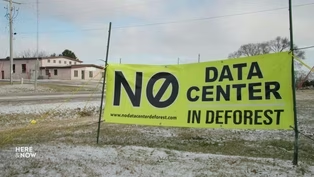
>> A large scale data center in the village of DeForest was rejected this week.
It's an example of the push pull between local communities and tech companies, with their ever increasing demands to store and process huge amounts of data, especially in the age of artificial intelligence.
As Steven Potter reports, opposition from DeForest residents left the village board with a difficult decision to announce.
>> Some of you might feel very victorious tonight.
Others are feeling a great loss.
>> When residents in the DeForest area first heard that a large scale data center was being planned for farmland just outside their village.
They were not happy about it.
>> I picked this spot 40 years ago to live because it was so remote.
I never thought we'd be faced with something like this.
>> Nancy Roth was one of the residents who opposed the sprawling 1600 acre and $12 billion development proposed by technology company data centers.
They worried that the data center may damage natural resources and tear apart the tranquility of their rural landscape.
>> We want to live in a farming community, not next to a concrete walled data center.
>> So Roth and others went to work.
They organized residents printed yard signs, created an online community, and voiced their opposition at numerous town and village board meetings.
And just this week, after months of expressing their outrage.
>> We're at a point where we can finally make a vote.
>> Those opposed to the DeForest Data Center were able to claim victory when the village board voted unanimously against the data center plan.
>> Yes, to reject AQ.
>> With that rejection of the proposal from the village of DeForest has now formally withdrawn from the project.
This kind of conflict, which hinges on the local control of land and resources, has been repeating itself around the state.
Here's what happens.
A large scale data center gets proposed.
Residents get upset and voice their opposition.
And then local officials take notice of the outrage and put an end to the project.
Or the data center company itself decides to pull out.
Other proposed data centers that have been nixed recently include one in Brown County and another in Racine County, and the city councils of both Menominee and Madison have passed restrictions on data centers being built there.
>> The data center industry, especially at this scale, it's new, right?
And any time there's something of this magnitude that's new, it's scary.
>> Tricia Braun is with the Wisconsin Data Center Coalition, which advocates for these developments to boost the state's economy.
She says that our ever growing need for more information, more entertainment and more innovation, including and especially with the use of artificial intelligence, is what's driving demand.
>> Whether you're on your phone, your live streaming TV, your manufacturer that's automating your processes, your regular company that just decides to move its server offline or to the cloud, all of that needs to be stored somewhere.
That's where data centers come in.
>> Some large scale data centers house only one company, which is the case for the Beaver Dam Data Center being built right now by meta and the Microsoft Data Center, under construction in Mount Pleasant.
But Braun says smaller and midsize companies are clients, too.
>> Whether it's insurance companies, financial institutions, just general businesses can be some of these tenants when it comes to something that is changing this fast.
And as you know, we're all doing more with technology every day.
The demand is increasing.
>> According to research from the Brookings Institute, there are more than 5000 data centers operating in the United States.
That's ten times more than any other country.
There are around 50 data centers here in Wisconsin, at least for now.
But if technology companies get their way, there may be several more of them here soon.
And some of them will be the hyperscale sized data centers that span hundreds of acres and cost billions of dollars.
Data center companies find Wisconsin appealing because of available land, energy, and a favorable, particularly cooler climate.
Currently, data centers are being proposed in Rock County, Ozaukee County, Wood County, and Kenosha County, and although Qt's withdrew its bid for DeForest, the company says they may explore other locations in Wisconsin.
>> I think digital infrastructure is critical to our economy and critical to national security, and it has to get built somewhere.
>> State lawmakers are also getting involved in data center regulation.
>> We need to be competitive in this space.
>> Mark Born, a Republican in the state assembly, represents Beaver Dam, where social media company meta is building a $1 billion, 700 zero zero zero square foot data center.
>> This is the future.
And why shouldn't Wisconsin communities benefit from some of the economic development that comes from that?
>> While he is in favor of these developments, Bourne also wants to make sure that data centers don't lead to higher electrical bills for local residents and that the state's water supply is protected.
He's a lead author of legislation that aims to regulate data centers.
>> Ratepayers should be protected.
We should be protecting our natural resources.
>> Democratic State Representative Angela Stroud of Ashland, says the Republican bill doesn't go far enough.
She wants to see more rules around renewable energy fees and labor.
And if data center developers don't meet those requirements.
not be well suited for the state.
And I think we should be willing to admit that and say, fine, then we're not the place for you.
But if we can achieve those things, which we can with smart regulation, we need to get something done.
>> Regulation is a sticky topic for data center proponents.
very careful about what is put into place as far as rules, restrictions, regulations to make sure that those unintended consequences aren't an overall detriment to future development.
>> While the future of data centers in Wisconsin remains a case by case situation, proponents say the need for more and more computing power and data storage is undeniable.
But for now, it remains an exercise in compromise between data center developers, local residents, municipal government and state lawmakers.
Reporting from DeForest.
I'm Steven Potter for "Here& Now".
>> For more on this and other issues facing Wisconsin, visit our website at PBS Wisconsin and then click on the news tab.
That's our program for tonight I'm Frederica Freyberg.
Have a good weekend.
.
>> Funding for "Here& Now" is provided by the Focus Fund for Journalism and Friends of PBS Wisconsin.

Gwen Moore on ICE and Funding Levels for Homeland Security
Video has Closed Captions
Clip: S2400 Ep2430 | 9m 31s | Gwen Moore on debate in Congress over funding the Department of Homeland Security. (9m 31s)
Here & Now opening for February 6, 2026
Video has Closed Captions
Clip: S2400 Ep2430 | 59s | The introduction to the February 6, 2026 episode of Here & Now. (59s)
The Local Battles Over Data Center Developments in Wisconsin
Video has Closed Captions
Clip: S2400 Ep2430 | 6m 27s | Debates grow over energy-intensive data centers that are a backbone for tech business. (6m 27s)

Maria Lazar on the 2026 Wisconsin Supreme Court Race
Video has Closed Captions
Clip: S2400 Ep2430 | 9m 8s | Maria Lazar on her perspectives on the law and the politics of judicial elections. (9m 8s)
Providing Support for PBS.org
Learn Moreabout PBS online sponsorship
- News and Public Affairs

Top journalists deliver compelling original analysis of the hour's headlines.

- News and Public Affairs

FRONTLINE is investigative journalism that questions, explains and changes our world.












Support for PBS provided by:
Here and Now is a local public television program presented by PBS Wisconsin