
January 23, 2026 - PBS News Hour full episode
1/23/2026 | 57m 46sVideo has Closed Captions
January 23, 2026 - PBS News Hour full episode
Friday on the News Hour, a monster winter storm is expected to bring frigid temperatures, heavy snow and dangerous ice to more than 200 million across the country. As images of a 5-year-old boy being detained by ICE in Minnesota trigger outrage, we speak to his school's superintendent. Plus, TikTok's parent company finalizes a deal to avoid a ban that would affect millions of users in the U.S.
Problems playing video? | Closed Captioning Feedback
Problems playing video? | Closed Captioning Feedback
Major corporate funding for the PBS News Hour is provided by BDO, BNSF, Consumer Cellular, American Cruise Lines, and Raymond James. Funding for the PBS NewsHour Weekend is provided by...
January 23, 2026 - PBS News Hour full episode
1/23/2026 | 57m 46sVideo has Closed Captions
Friday on the News Hour, a monster winter storm is expected to bring frigid temperatures, heavy snow and dangerous ice to more than 200 million across the country. As images of a 5-year-old boy being detained by ICE in Minnesota trigger outrage, we speak to his school's superintendent. Plus, TikTok's parent company finalizes a deal to avoid a ban that would affect millions of users in the U.S.
Problems playing video? | Closed Captioning Feedback
How to Watch PBS News Hour
PBS News Hour is available to stream on pbs.org and the free PBS App, available on iPhone, Apple TV, Android TV, Android smartphones, Amazon Fire TV, Amazon Fire Tablet, Roku, Samsung Smart TV, and Vizio.
Providing Support for PBS.org
Learn Moreabout PBS online sponsorshipGEOFF BENNETT: Good evening.
I'm Geoff Bennett.
AMNA NAWAZ: And I'm Amna Nawaz.
On the "News Hour" tonight: A monster winter storm is expected to bring frigid temperatures, heavy snow and dangerous ice to more than 200 million people across the country.
GEOFF BENNETT: Images of a 5-year-old boy being detained by ICE in Minnesota trigger outrage.
We speak to his school superintendent.
ZENA STENVIK, Superintendent, Columbia Heights Public School District: There are very many ice agents right now in our community.
They are driving around our schools, circling our schools.
They are at our bus stops, following our buses.
AMNA NAWAZ: And TikTok's parent company finalizes a deal to avoid a ban that would affect millions of users in the United States.
(BREAK) AMNA NAWAZ: Welcome to the "News Hour."
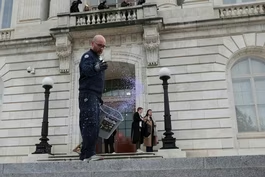
More than half of the nation is bracing for what's expected to be an historic weekend winter storm, one posing dangerous travel conditions, thousands of canceled flights, likely power outages and serious risks of hypothermia.
GEOFF BENNETT: Between now and Monday, the storm will span more than 2,000 miles from Texas to New England, pummeling more than two dozen states along the way with a combination of freezing rain, ice and snow.
Across much of the country, salt trucks are stocking up and snowplows stand at the ready.
Many states are pretreating roads ahead of what's expected to be a massive and menacing winter storm.
At least a dozen states have already declared weather emergencies.
GOV.
KATHY HOCHUL (D-NY): No state will be immune from feeling the effect of Mother Nature's wrath on this weekend.
ZOHRAN MAMDANI (D), Mayor of New York City: What is being predicted right now, whether it's a foot of snow or even a little bit more, would be one of the biggest snowfalls that our city has seen in years.
GEOFF BENNETT: Forming today across the Central Plains, the storm will trudge thousands of miles across the country before arriving in Maine by Sunday.
More than a foot of snow could fall in places in the North.
The south will see freezing rain and sleet.
Almost 180 million Americans are under winter watches and warnings.
JONATHAN PORTER, Chief Meteorologist, AccuWeather: And it will be significant.
GEOFF BENNETT: The chief meteorologist for AccuWeather.
JONATHAN PORTER: There are many communities that are not typically used to dealing with this magnitude of snow and ice that are going to be having to contend with that.
GEOFF BENNETT: Setting the stage, arctic air that is pushing even further south, putting more than 200 million Americans under alerts for extreme cold.
With windchill tonight, it will feel below zero everywhere from the Texas Panhandle to the Midwest and New England.
GOV.
KATHY HOCHUL: You better bundle up.
You will be experiencing minus-40-to-minus-50-degree windchills.
GEOFF BENNETT: Much of the country will stay below freezing well into next week, meaning the snow and ice will not melt.
That could strain electric grids and lead to widespread power outages.
The storm is also expected to paralyze travel.
Nearly 2,000 flights across the country were either delayed or canceled today in advance of the storm.
And officials warned people to avoid driving.
GOV.
ABIGAIL SPANBERGER (D-VA): I am asking all Virginians to stay off the roads as of Saturday night, all day Sunday, through Monday morning.
This will allow not only for the safety and security of our neighbors, but it will allow for faster clearing of roads.
GEOFF BENNETT: Preparing to hunker down, many people have already stocked up on food and supplies, others finding store shelves empty.
JENNIFER GIRARD, Georgia Resident: We may be a little bit early, but we're trying to beat the crowd, yes.
And I used to live in Florida.
And we used to do that all the time for hurricane season.
So it's not so different.
GEOFF BENNETT: Hoping for the best, but preparing for the worst, schools from Chicago to Houston canceled classes today and many school districts across the country are preparing for snow days or remote learning next week.
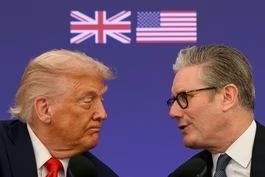
AMNA NAWAZ: In the day's other headlines: British Prime Minister Keir Starmer is calling President Trump's comments about NATO troops serving in Afghanistan insulting and appalling.
During an interview on the sidelines of the Davos World Economic Forum yesterday, Trump said of NATO member nations - - quote -- "They'll say they sent some troops to Afghanistan.
They stayed a little back, a little off the front lines."
Speaking today, Starmer pointed out that more than 150,000 British troops served in Afghanistan in the years after the U.S.-led invasion in 2001 and more than 450 died.
KEIR STARMER, British Prime Minister: If I had misspoken in that way or said those words, I would certainly apologize.
I'm not surprised they caused such hurt to the loved ones of those who were killed or injured.
AMNA NAWAZ: Meantime, in another fallout from Davos, President Trump has withdrawn his invitation to Canada's Prime Minister Mark Carney to join his Board of Peace.
That comes after Carney delivered a stark speech in Switzerland in which he warned about what he called the rupture in the world order.
He called on so-called middle powers like Canada to band together to adapt to the new global reality.
In Abu Dhabi, diplomats from Ukraine, Russia and the U.S.
met today for talks on ending the nearly four-year war in Ukraine.
The gathering was the first time on record that officials from the Trump administration have sat down with both countries at once.
Ukrainian President Volodymyr Zelenskyy says the future of Ukraine's Eastern Donbass region will be key to any success in the talks.
Russian leader Vladimir Putin has called on Kyiv to withdraw its troops from such areas.
The White House described today's talks as productive and said conversations would continue into the weekend.
The FBI says it has arrested Ryan Wedding, a former Olympic snowboarder and alleged drug kingpin.
Officials say the 44-year-old oversaw a multiple national cocaine operation running from Colombia through Mexico and into the U.S.
and Canada.
They say he also orchestrated a number of witness killings to keep it going.
Wedding was one of the FBI's 10 most wanted fugitives, a far cry from his former life as a snowboarder representing his native Canada in the 2002 Winter Olympics.
Today, FBI Director Kash Patel said Wedding was apprehended in Mexico last night, where he'd been hiding for the past decade.
KASH PATEL, FBI Director: He's a modern-day El Chapo.
He is a modern-day Pablo Escobar.
And he thought he could evade justice.
And here we are today bringing him to justice for trafficking hundreds of kilos of cocaine and also for the murder of innocent civilians.
AMNA NAWAZ: Canadian police say Wedding also faces separate drug trafficking charges there that date back to 2015.
Vice President J.D.
Vance rallied anti-abortion activists in Washington, D.C., today as part of the annual March for Life.
J.D.
VANCE, Vice President of the United States: We have made tremendous strides over the last year and we're going to continue to make strides over the next three years to come.
AMNA NAWAZ: Vance cited the expansion of a ban on funding for U.S.
foreign aid groups that support abortion services and he emphasized the importance of boosting the nation's birth rates just days after he and wife Usha announced they're expecting their fourth child.
The event also included a video address from President Trump followed by the march itself.
The mood was largely upbeat, though some activists have called for the administration to do more to crack down on abortion pills like mifepristone.
The city of Philadelphia is suing the Trump administration over the removal of a slavery exhibit at the Independence National Historical Park.
Yesterday, National Park Service crews removed display panels from the President's House, where George Washington once lived, that commemorated people enslaved there by his family.
The Interior Department cited President Trump's executive order aimed at -- quote -- "restoring truth and sanity to American history."
Today, handmade signs covered the space where the panels hung with messages that read "Learn all history" and "History is real."
On Wall Street today, stocks ended mixed after a week dominated by talk of tariffs.
The Dow Jones industrial average lost nearly 300 points on the day.
The Nasdaq managed to gain of about 65 points.
The S&P 500 added just two points, so basically flat.
And Trinity Rodman is now reportedly the highest paid women's soccer player in the world.
The 23-year-old forward signed a three-year deal with the Washington Spirit, where she started her career.
It's valued at an estimated $2 million per year when counting in bonuses.
The deal comes amid a broader legal fight over salary caps in the National Women's Soccer League.
In a statement, Rodman said -- quote -- "We're chasing championships and raising the standard, and I can't wait to keep doing that with my teammates."
Rodman has scored 11 goals in 47 appearances for the national team, more than any other player on the roster.
Still to come on the "News Hour": David Brooks and Jonathan Capehart weigh in on the week's political headlines; a surge of new measles cases raises worrying questions about the drop in vaccination rates; and a new book explores a 1980s New York subway shooting that defined an era.
GEOFF BENNETT: The Trump administration's immigration crackdown and ICE surge in the Twin Cities drew large protests today.
AMNA NAWAZ: It was part of a general strike and walkout backed by labor leaders and faith groups.
Special correspondent Fred de Sam Lazaro begins our coverage with this report from Minneapolis.
PROTESTERS: ICE out!
ICE out!
ICE out!
FRED DE SAM LAZARO: Thousands of people braved bone-chilling temperatures this afternoon for a rally in downtown Minneapolis, protesting what they call a siege of the Twin Cities by federal agents.
For many here and throughout the Twin Cities, Renee Nicole Good has become an icon.
The 37-year-old mother of three was shot by an ICE officer in Minneapolis two weeks ago.
Her image now appears widely throughout the Twin Cities.
Annie Rose co-owns the Lost Fox, a downtown St.
Paul cafe that's a quiet refuge from all the tension outside.
ANNIE ROSE, Co-Owner, Lost Fox: Renee Good is the face of it.
It's a face that people can feel comfortable with.
She's a woman.
She was a mother.
She was white.
And it's something that we can come back to and say, oh, they came from my neighbors and then they came from me.
Well, that is something that we can all like resonate with.
FRED DE SAM LAZARO: Today, she closed the place, even though it's tough to lose a Friday evening's revenue in the slowest month of the year, she says.
ANNIE ROSE: It's already hard out here.
Every January, I take out a no-interest credit card to make sure I can make payroll.
This year, I'm going to probably have to pay interest on that credit card.
FRED DE SAM LAZARO: Across the metro area, hundreds of small businesses, especially restaurants, Heeded a call to observe a general strike, many in sympathy with immigrant-owned shops where business has plummeted sharply amid fears of ICE patrols.
Schools in the area also closed today.
Labor unions led the call for the general strike, but the decision was made easier by today's life-threatening low temperatures.
Still, Annie Rose said she felt compelled to brace them.
ANNIE ROSE: It's all fear-based.
You're afraid to go to rallies, whether it's cold.
You're afraid to go to rallies because you don't want to be shot.
You're afraid to stand up for things because of fear, and how can you live your life if you're constantly in fear?
It's important to show my kids that, no, you can stand up for what you believe in.
FRED DE SAM LAZARO: Protesters marched about a mile through downtown Minneapolis to the indoor basketball arena.
The DHS gave no signs today of easing up on its surge in the Twin Cities in the days ahead.
On Thursday, Border Patrol Chief Greg Bovino was asked if there's a number of arrests agents were targeting.
GREGORY BOVINO, Border Patrol Commander: There is a number, and it's called all of them.
FRED DE SAM LAZARO: DHS Secretary Kristi Noem said 10,000 -- quote -- "criminal illegal aliens" have been arrested here, a sharp spike from the start of the week, when the agency put the figure at 3,000.
But the department has released details of far fewer cases, which it calls the worst of the worst.
All this comes at a time of rising public scrutiny.
ICE officers detained a 5-year-old boy on Tuesday during an immigration enforcement operation.
At a press conference today, Marcos Charles, the head of ICE's deportation branch, said the boy was being cared for.
MARCOS CHARLES, ICE Associate Director: We do everything in our power not to separate families.
So they took him back together to Minneapolis, to the city, to the ICE facility for processing.
And now they are being well cared for at a family residential center.
FRED DE SAM LAZARO: On Thursday, three prominent civic activists were arrested after an anti-ICE protest at a St.
Paul church.
The White House later posted an A.I.-manipulated image of one woman to its social media account.
When asked about the image, Kaelan Dorr, the White House Deputy Communications Director, wrote: "Enforcement of the law will continue.
The memes will continue."
At a separate anti-ICE rally today, roughly 100 people, including members of clergy, were arrested after protesting outside a terminal at the Minneapolis-St.
Paul International Airport.
ANNIE ROSE: I am slowly losing hope, and that is a problem, and that's what keeps me up at night.
But then I go to rallies.
Like, you asked me.
I'm going to go to the rally, and that is to see hope in process.
(SINGING) FRED DE SAM LAZARO: For the PBS "News Hour," this is Fred de Sam Lazaro in Minneapolis.
GEOFF BENNETT: As we've seen, the ICE operations in the Twin Cities are also affecting children who are caught up in the surge of personnel and detentions.
Our Liz Landers joins us now with that part of the story -- Liz.
LIZ LANDERS: Thanks, Geoff.
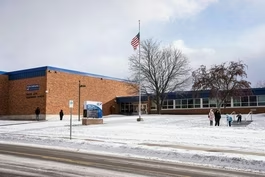
The 5-year-old boy Liam that Fred mentioned in his report was a student in the Columbia Heights School District.
Superintendent Zena Stenvik joins me now.
Zena, thank you so much for joining "News Hour" this evening.
What is your understanding of what happened to Liam when he was detained earlier this week?
ZENA STENVIK, Superintendent, Columbia Heights Public School District: My understanding is that there were bystanders, community members, school officials, and another adult who actually lives in the home asking to keep Liam, that they would take Liam, that they would take care of him and get him safely to family members, and that they -- that didn't happen.
They weren't allowed to do that.
And, instead, he was pretty quickly, within hours, flown to Texas to a detention center.
LIZ LANDERS: The Homeland Security Department is giving a different version of what happened when he was detained.
A spokeswoman claims that Liam was abandoned by his family and his mother refused to take custody of him when agents knocked on the door.
Here's Customs and Border Patrol official Greg Bovino when he was asked about this specific case earlier today.
GREGORY BOVINO, Border Patrol Commander: Some of you have had questions on the 5-year-old yesterday.
That 5-year-old remains with his family.
We say again he remains with his family.
We know that.
That false median narrative that was pushed out yesterday was -- well, it was false.
He remains with his family.
LIZ LANDERS: He's now being held at a federal processing facility in Dilley, Texas, which you mentioned.
And I will add that "News Hour" had a conversation about that facility earlier this week.
There is contaminated food there.
There's limited access to drinking water and inadequate medical care there, according to a lawsuit that's been filed.
What is your response to what the administration is saying?
ZENA STENVIK: He's in a detention center.
A 5-year-old is being held in a detention center.
I have a real problem with that.
I know that his preschool classroom is a beautiful, wonderful environment.
I have been in his home, where it was -- he has a backyard where he can play and build snowmen with his older brother.
And when I was in the home, there were plenty of toys around and just a really nice environment for a child to live in.
It was a far cry from -- I just -- I hate to think about where -- what he's actually experiencing right now, what the conditions could possibly be, given the lawsuit that's out there.
As I mentioned, I was on scene.
I was there shortly after Liam was taken.
I have been in the home.
I have talked to the mother.
The people claiming that she abandoned her child is so far from the truth.
We have to remember that she had another child on the way home from school.
And we also have to remember that there were eight armed and masked agents swarming all around the house and the driveway and the car, so a very intense situation.
She was asked to not open the door by her husband, who was in the driveway in handcuffs, and just all around a tense situation.
We have -- unfortunately, at this point now, for those of us living in the Twin Cities, it's very common knowledge that ICE agents are bursting through doors if you crack open the door a little bit.
They're bursting through into apartments, apprehending people.
They're even breaking down doors and leaving broken doors or no doors now.
So, opening the door with ICE agents looming, it's not as easy or as clean of a statement as one might suggest.
LIZ LANDERS: There are some conflicting reports about whether the family is here legally.
Federal officials say that they are not, but a family attorney says that they are pursuing a legal asylum pathway.
Does that matter for education purposes in your school district?
ZENA STENVIK: No.
I mean, there's federal case law.
We are -- and under the Minnesota Constitution, we educate children regardless of legal status.
So when children enroll in our school district, we're actually not even allowed to ask their legal status.
But I will tell you, as I mentioned, I was in the home and I saw the legal documentation with my own eyes.
LIZ LANDERS: There are a number of students that have been detained by ICE in your school district.
How are you educating children right now in your community?
How are you responding to this?
How are parents responding to this in Minnesota right now?
ZENA STENVIK: I will tell you, there's really nothing normal about our daily lives at this point.
The surge has been going on for a few weeks now, and it has really changed our standard operating procedures.
We have -- staff have been working around the clock and overtime walking children home.
People have been donating different resources for us to get to the families.
We do have an online option that families can select so that the children are learning from home.
But let me stress that that is not the best practice.
That is not what we want.
We want our children in school, in their classrooms, with their teachers and with their classmates, because we know that that's what's best for children.
We all learned that during COVID.
But there's so much fear.
And I'm not just talking about, so -- quote, unquote -- "illegal people."
People who are here with legal documentation are fearful, as I think there have been many reports that ICE agents have taken citizens of the United States.
So there are very many ICE agents right now in our community.
They are driving around our schools, circling our schools.
I have seen it with my own eyes.
They are at our bus stops following our buses, and they have been on my school property multiple times.
LIZ LANDERS: Zena Stenvik, thank you so much for joining the "News Hour."
ZENA STENVIK: Thank you.
Let's get our kids back.
AMNA NAWAZ: TikTok has closed a deal to keep the wildly popular video sharing app used by more than a billion people worldwide available in the U.S.
The agreement caps a six-year legal and geopolitical fight after Congress passed a law requiring TikTok to divest from its Chinese parent company or face a nationwide ban.
GEOFF BENNETT: The Trump administration says the deal protects American users from potential Chinese influence.
But, as Nick Schifrin reports, many national security experts argue it falls short.
NICK SCHIFRIN: Today on TikTok, a presidential victory dance on the beloved video sharing app that the Trump administration has now saved for 200 million Americans.
WOMAN: You know you're getting a legit Labubu, Is not a Lafufu.
NICK SCHIFRIN: TikTok's viral sensations have combined access to music with editing tricks made easy to create a social media monster.
DONALD TRUMP, President of the United States: I have a warm spot in my heart for TikTok.
NICK SCHIFRIN: And from one social media platform to another, President Trump announced the deal on TRUTH Social, that TikTok U.S.
would be owned by -- quote -- "a group of great American patriots and investors."
A TikTok press release says that tech giant Oracle will house Americans' data and secure the TikTok U.S.
app, which will not have to be redownloaded.
TikTok U.S.
will -- quote -- "retrain, test and update the algorithm," although it will still be owned by Chinese parent company ByteDance.
TikTok U.S.
board of directors will be majority American.
And the largest investors are Oracle, the Emirati firm MGX, and the American firm Silver Lake, each of which owns 15 percent.
ByteDance retains 19.9 percent.
But the app's critics argue TikTok is built with an internal sleight of hand.
WOMAN: How are you doing that?
MAN: I got a Nimbus 2000.
NICK SCHIFRIN: And that the app allows Beijing to manipulate content and steal Americans' data, even after today's announcement.
MICHAEL SOBOLIK, Senior Fellow, Hudson Institute: It's unilateral surrender to Beijing.
NICK SCHIFRIN: Michael Sobolik is a senior fellow at the Washington, D.C., think tank the Hudson Institute.
The announcement says that the new U.S.
TikTok will -- quote -- "retrain, test and update the algorithm."
What's wrong with that?
MICHAEL SOBOLIK: The real concern here isn't the data that it's being trained on.
It's what the algorithm is emphasizing or censoring.
And Beijing is going to be the one that retains control over those decisions.
And that is not only a doomsday scenario in the future.
There's a track record of TikTok doing this in recent years.
In 2023, pro-Hamas content was boosted significantly on the app right after the October 7 attacks in Israel by Hamas.
We are allowing ByteDance, it appears, to retain control over this all-important algorithm.
That signals a lack of resolve and weakness on the administration's part that they're not taking national security as seriously as they should.
The president got bad advice on this deal.
I know he loves a good deal, but this is the art of the steal, not the art of the deal.
NICK SCHIFRIN: This deal says that U.S.
users' data will be protected by Oracle.
Oracle has run the cloud for the CIA, for the intelligence community for many years.
So what's wrong with that?
MICHAEL SOBOLIK: Remember that Oracle has already been serving TikTok in this way for the past few years.
There's been numerous investigations from Forbes, from BuzzFeed, and other outlets that have demonstrated that ByteDance, again, a Chinese company, has gone to TikTok and requested us user information data outside of normal channels.
That is deeply concerning, and that happened under Oracle's watch.
NICK SCHIFRIN: But I spoke to some other technology experts today who wouldn't give me an interview on camera, but argued this deal does protect Americans.
They say that there will now be multiple layers of oversight for American users' data, for the algorithm and the TikTok app.
And they argue this deal includes the U.S.
government's most rigorous cybersecurity and data protection standards, which apply to no other social media company.
DONALD TRUMP: It's a great honor to be with a friend of mine really for a long time now.
NICK SCHIFRIN: But critics of the president's China policy who want him to confront Beijing see TikTok as a symbol of the president's prioritizing deals over national security.
MICHAEL SOBOLIK: It says that our national security is for sale at the right price, which is a dangerous message to send to the ruler of the Chinese Communist Party.
NICK SCHIFRIN: U.S.
officials dispute that... DONALD TRUMP: To all of those young people of TikTok, I saved TikTok, so you owe me big.
NICK SCHIFRIN: ... and say national security concerns and the demands of hundreds of millions of users have now been answered.
For the "PBS News Hour," I'm Nick Schifrin.
GEOFF BENNETT: President Trump's remarks in Davos, Switzerland this week forced Western leaders to reevaluate their relationship with the U.S.
That's as tensions escalated here at home over the ongoing immigration enforcement operations in Minnesota.
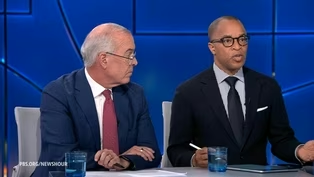
For more, we turn tonight to the analysis of Brooks and Capehart.
That's New York Times columnist David Brooks and Jonathan Capehart of MS NOW.
Good evening, gentlemen.
JONATHAN CAPEHART: Hi, Geoff.
DAVID BROOKS: Good evening.
GEOFF BENNETT: So, David, what did we learn this week from President Trump's climb-down on acquiring Greenland about his instincts, his sense of leverage and the limits of his approach?
DAVID BROOKS: Well, he does have a method that he uses over and over again, which is to overreach, to offend everybody, and then back off.
And he sort of did that.
And that would be the nine explanation of what happened this week.
The serious explanation is that this, I think, was probably the final break in the postwar international order, that we have taken it for granted that we in the West, as we call it, are democracies aligned and friends with each other.
And what really struck me this week was how many European leaders, Mark Carney, from Canada, how much pleasure they took in being bitterly breaking, divorcing with America and that we're never going back to that.
And I asked Europeans, like, is it like that Taylor Swift song, we are never getting back together?
And they said, yes, that's what it's like.
We are never getting back together because they say, you might elect a sane person in 2028, but you're always four years away from another one of these.
And so they're really rethinking the whole global architecture.
And it should be concerning to Americans.
As Robert Kagan wrote in "The Atlantic" this week, we're going to look back on the Cold War with nostalgia.
And we're going to look back on the post-Cold War world as if it was paradise and that we're just entering, as Kagan wrote, the most dangerous time in American foreign policy since World War II.
GEOFF BENNETT: Jonathan, should allies take some reassurance from the outcome, that Trump ultimately backed off his tariffs and territorial demands or concern about the way that it started?
JONATHAN CAPEHART: I think the allies, particularly with Greenland, they understood what was happening.
And I think, to David's point, this was the break.
Going after Greenland, territory of Denmark, NATO ally, the president of the United States was willing to blow up NATO in order to get Greenland.
And I watched that -- the speech he gave at Davos with just my jaw on the ground for how many norm-busting things he said.
And I kept going back to, again, to David's point about the Europeans thinking we're one election away from this happening again, when Vice President Kamala Harris went to the Munich security summit the first year of the Biden/Harris administration, she gave a speech.
She sat down with the outgoing president, who asked, President Biden says America is back, but the question is, for how long?
Europeans have been wary of the United States since the first term of Donald Trump.
And I think the speech by Canadian Prime Minister Mark Carney, to me, was the rhetorical break, because what I heard from him in style and language was all the things we're used to hearing from an American president, setting the table for what it means to be a global collective unit that is as much about security as it is about mutual prosperity.
And it was the Canadian prime minister who stood up for that, only to be threatened the next day by the president of the United States for saying the same -- those exact words.
GEOFF BENNETT: You mentioned Mark Carney, Canada's prime minister.
Here he is in his own words.
MARK CARNEY, Canadian Prime Minister: Let me be direct.
We are in the midst of a rupture, not a transition.
The middle powers must act together because, if we're not at the table, we're on the menu.
We shouldn't allow the rise of hard power to blind us to the fact that the power of legitimacy, integrity, and rules will remain strong if we choose to wield them together.
GEOFF BENNETT: A rupture, he says.
And, David, if governing by strength and spectacle is a defining feature of the Trump era, how sustainable is that approach for allies who are trying to manage this relationship for the next three years?
DAVID BROOKS: Yes, well, it's governing by pure rancor.
And Donald Trump has set out to create a world where gangsters can have free rein and that the people who believe in the use of force above the rule of law, they should be able to run the show.
And what's perverse about it is that he seems to have gone back to some sphere of influence idea from the 19th century, giving Russia that region, giving China that region, as long as we get to control our region.
And this is simply -- it's just an illusion to think you can take this approach and it won't lead to bloodshed.
We have already seen, since 2013, I think I mentioned in this show some weeks before, that the number of people who died in war deaths from 1990 to 2013 was like 15,000 a year.
After 2013, it surges to over 100,000 people a year.
So we're already seeing a massive ramp-up in bloodshed.
And then when you get to where it's gangster versus gangster, we can expect that to continue or to exacerbate.
GEOFF BENNETT: Well, while at Davos, the president launched what he's calling the Board of Peace.
And the board's official mandate was to help oversee the Gaza Strip under an Israel-Hamas cease-fire deal brokered by the Trump administration last year, though the president has hinted at broader ambitions here.
It's not exactly clear how this will all operate.
And, Jonathan, some allies worry that this board could undermine the U.N.
But could the opposite be true?
Could this board -- I mean, could the reason the board exists, could that be because the U.N.
has struggled to adapt to modern conflicts and geopolitical realities?
JONATHAN CAPEHART: I mean, maybe.
Sure, a Board of Peace on paper sounds great, but who's on this board?
And who created it?
And who is going to be the person who can be the president of this Board of Peace long after he's no longer president of the United States?
Donald Trump.
You were just showing a moment ago I believe it was the family photo of the people who were there on the Board of Peace.
There's no France, there's no United Kingdom, there's no Western alliance.
It's all potentates from the Middle East and Viktor Orban and other people who don't exactly care really about small-D democracy and liberal small-D democratic values.
So, forgive me if I am not jumping for joy over the Board of Peace and what they're going to do for Gaza or do to Gaza.
GEOFF BENNETT: How do you see it?
I mean, are you in this moment where you have these sort of ad hoc coalitions replacing permanent institutions like the U.N.?
DAVID BROOKS: It could be.
I'm one who believes that the Trump administration, going back to Abraham Accords in the first term, that was superior in regards to the Middle East than the Biden administration or the Obama administration's policies.
And so I think they have done some good things in the Middle East.
And if they can pour investments into Gaza, God bless them.
I'm a little dubious they can do so with Hamas running Gaza and unwilling to step down.
Who's going to want to invest?
And so it is still a fact that you can call an international confab, but unless you actually prefer democracy and a place that will be stable, I'm very dubious that it's going to work.
GEOFF BENNETT: Let's shift our focus stateside with what's happening in Minneapolis with the ICE enforcement.
As we speak, there are thousands of people in the streets of Minneapolis protesting.
We learned this week about an internal ICE memo that allows agents to enter people's homes without a judicial warrant.
They're using administrative warrants.
At what point does this aggressive enforcement start to undermine constitutional guardrails, Jonathan?
JONATHAN CAPEHART: Start to?
One could argue that it's already happening, that you have ICE busting into people's homes, snatching people off the streets, or, as folks in Minneapolis are saying, people are being kidnapped, cars left in the middle of the road, sometimes still running with the possessions inside because ICE has snatched people off the street.
What is happening in Minneapolis and Minnesota, it breaks my heart because we are seeing these constitutional norms that you're asking about being eroded before our very eyes, being not just challenged but abused.
That's the word I'm looking for, abused.
When you look at a 5-year-old who -- and his father who are in process, the asylum-seeking process, which means they are not undocumented, being used as bait, and then shipped to Texas with his father, or Mr.
Thao, the 57-year-old who earlier in the week was hauled out of his home in boxer shorts and Crocs and a robe in 12-degree temperatures, I mean, what is happening to the people of Minneapolis, to American citizens?
There was just a report today of a U.S.
Army vet who was taken into custody for eight hours there in Minneapolis.
At some point, at some point -- well, I was going to say the administration will have to see the error of its ways, but they will not.
And this gets to the thing where I say my heart's broken, but my heart is full, watching the protests in Minneapolis of people taking to the streets to stand up for their own constitutional rights, but to stand up for their communities and for their fellow folks who live in Minneapolis, because they -- people should not have to live in fear the way that they're living there in Minneapolis right now.
It's not -- just at a moral level, how can anyone look at what's happening in Minneapolis and not stand up and not fight back and not push back?
Because if it's happening in Minneapolis, Minnesota, a state that's 75 percent white, it's coming to you next.
And it's already happening in Maine.
GEOFF BENNETT: David, how does all of this strike you?
DAVID BROOKS: Yes, the domestic analog of the foreign policy.
It's a theory that we should rule by force.
And I think what we have seen is a disillusion of the ideals of what democracy is supposed to be all about.
And one of the things I'm curious about is, how will the American people react?
How are they reacting to the image of the 5-year-old kid Liam?
And I think that we already know from polling that large majorities do not approve of what's going on.
They think ICE is overbearing, cruel and ruthless.
But how much will they react?
Will it cause a break in public opinion of the sort of we haven't seen since the first Trump term?
Maybe.
You have to remember -- I remember, when I first started the conservative movement, there was a strong libertarian presence.
And the single greatest thing they were talking about over and over again was federal troops violating due process rights, First Amendment rights, Bill of Rights.
And this is exactly what's happening under the Republican Party.
So there still is a libertarian element within the Republican Party.
Are they going to say, what the heck?
I did not sign up for this.
And we will see if that happens.
But this is one of those issues, if there's ever going to be a break on the Trump coalition, I would think this would touch a chord.
GEOFF BENNETT: David Brooks and Jonathan Capehart, thanks to you both, as always.
JONATHAN CAPEHART: Thanks, Geoff.
DAVID BROOKS: Thank you.
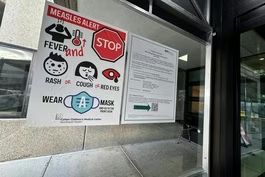
AMNA NAWAZ: Measles, one of the world's most contagious diseases, was declared eliminated in the U.S.
more than 25 years ago.
Today, an outbreak that started last year is continuing, even as the U.S.
officially ends its membership in the World Health Organization.
Stephanie Sy explores the ramifications and the reasons behind the outbreak.
STEPHANIE SY: Measles cases have been skyrocketing since last year.
Take a look at this chart.
In 2023, there were just 63 cases.
That number quadruples by 2024 to more than 280 cases, then, last year, a huge spike, 2,240 cases.
We're only three weeks into this new year, and already 416 cases have been confirmed.
Outbreaks in South Carolina and along the Utah-Arizona border are jacking those numbers up, all this as vaccination rates continue to decline, and that accelerated during the COVID pandemic.
Caitlin Rivers, an epidemiologist at Johns Hopkins University and author of "Crisis Averted: The Hidden Science of Fighting Outbreaks," joins us now with more.
Caitlin, thank you so much for joining the "News Hour."
So, more than 200 measles cases were confirmed in just one week this month.
Are these outbreaks likely to stay relatively local or are we moving toward a point where the U.S.
could see a widespread outbreak?
DR.
CAITLIN RIVERS, Epidemiologist, Johns Hopkins Center for Health Security: We are seeing that some of the larger outbreaks like that currently centered in South Carolina, it is being exported to other states.
And the longer these outbreaks spread, the more opportunities there are for the virus to travel.
That being said, public health officials are working very hard to contain them and stop transmission, but there have been a lot of cases in the last year,and I do expect that to continue in the year ahead.
STEPHANIE SY: Who is most vulnerable in these outbreaks?
DR.
CAITLIN RIVERS: People who are unvaccinated are by far the most vulnerable.
Around 94 percent of cases found last year were in people who were unvaccinated.
And so the strongest protection to prevent infection is that MMR vaccine.
STEPHANIE SY: We have been hearing from parents of babies who are getting measles.
They are those that may not be vaccinated yet or the vaccine may not have taken full effect yet.
And then there's the question of the elderly and whether they should be getting vaccine boosters at this point.
What do you think?
DR.
CAITLIN RIVERS: It's true that, infants, who are too young to be vaccinated, people who are immunocompromised, they're going to be at higher risk.
And that's why it's so important that we as a community take all of the steps that we can to prevent transmission, because stopping transmission overall is the best way to protect those people.
Now, older adults is a little bit of a different story.
A few decades ago it was the policy that people would only get one MMR vaccine.
That provides about 94 percent protection from infection.
That two-dose, that second dose, brings up the level of protection to closer to 97, 98 percent.
So if you are older and you are considering getting a second vaccine or wondering if that's right for you, one thing you can do is ask your doctor to check your titers, check your blood and see whether your immunity to measles is high enough.
If not, they may offer you that second dose.
STEPHANIE SY: You talked about the local and state response to containing these outbreaks, but I want to talk about the federal impact.
The chair of the federal advisory panel on vaccines, himself a pediatric cardiologist, has said in just the last few days that the polio and measles vaccines should be optional, including at schools.
What is your reaction to that?
DR.
CAITLIN RIVERS: That's really not the role of the Advisory Committee on Immunization Practices.
They do not have the power and, in fact, the entire CDC agency does not have the power to require anyone to get vaccinated.
What they're meant to do is provide the best advice to the American people about how to keep themselves and their communities safe from infectious diseases, and I'd like to see them get back to that in 2026.
STEPHANIE SY: Is that the best advice to make these vaccines that have long protected public health optional?
DR.
CAITLIN RIVERS: Absolutely not.
There's no question that the measles vaccine, the polio vaccine and in fact, the entire childhood vaccination schedule does good.
It is good for people and communities, because it prevents preventable infection.
But what's at issue here I think is mandates.
And I want to underscore that the federal government does not make vaccine mandates.
They do not have that authority.
And so when -- I think it's a red herring to pit individual choice against vaccine recommendations, because individual choice is not at issue here.
STEPHANIE SY: We have heard quite often that decreasing vaccination rates can be attributed to vaccine hesitancy.
But, Caitlin, you have pointed out that equal attention should be paid to health care access and affordability.
Expand on that.
DR.
CAITLIN RIVERS: There's no question that there is rising vaccine hesitancy.
And I think we're right to think about that and to worry about that.
But when you look at which demographic groups have lowest vaccine coverage, it is people who are uninsured.
And so I think access and affordability needs to be on the agenda when we talk about ways to increase community vaccine coverage.
STEPHANIE SY: The U.S.
at this point may be on the path toward losing what in your field is called measles elimination status.
How big of a deal is that and what would it mean?
DR.
CAITLIN RIVERS: It's really a sign that something has gone wrong in our public health system.
Measles was eliminated in the United States in the year 2000.
So it's been over 25 years of maintaining that elimination status.
And I think we will likely lose it in the year ahead.
Now, I want to make the point that a vast majority of Americans are vaccinated and support vaccination.
And so it's really this minority of people who are thinking about ways to erode our vaccine confidence and reducing community access.
And, unfortunately, we are seeing the effects of that.
But I also want to contrast that with the point that vaccines are very popular.
STEPHANIE SY: The U.S.
left the World Health Organization officially this week.
I'm curious whether you think that might affect the measles outlook, either domestically or globally.
DR.
CAITLIN RIVERS: Measles is probably not top of the list of places where we will see the impact of our withdrawal from the World Health Organization.
But, regardless, it's clear that that is a move that will reduce the United States is preparedness for epidemics and pandemics.
The WHO is the main way that we receive information about what is happening in the world.
And we provide information and support as well.
And so I think it's really a mistake to sever those ties.
STEPHANIE SY: That is Caitlin Rivers, an epidemiologist and author of "Crisis Averted: The Hidden Science of Fighting Outbreaks," joining us.
Thank you.
DR.
CAITLIN RIVERS: Thank you.
GEOFF BENNETT: In 1984, a shooting on a New York City subway thrust Bernard Goetz into the center of the national spotlight.
After opening fire on four Black teenagers he said were trying to rob him, Goetz was hailed by some as a vigilante hero in a city gripped by fear and rising crime and condemned by others as a symbol of racial violence.
The case unfolded against the backdrop of New York's turbulent 1980s, when public anxiety about safety collided with enduring questions about race, justice and the limits of self-defense.
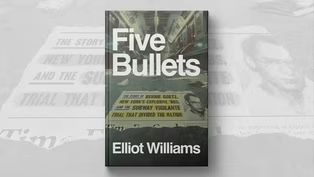
In "Five Bullets," Elliot Williams, a former federal prosecutor and legal analyst, revisits the shooting, the trial that followed and the cultural moment that turned a single act of violence into a referendum on American law and society.
I spoke with him recently about the book.
Elliot Williams, welcome to the "News Hour."
ELLIOT WILLIAMS, Author: Oh, thank you so much for having me here, Geoff.
GEOFF BENNETT: Absolutely.
So this book revisits a case that many Americans remember in broad strokes as the subway vigilante.
ELLIOT WILLIAMS: Right.
GEOFF BENNETT: Forty years later, why did this whole story feel so urgent to return to?
ELLIOT WILLIAMS: Right.
It's lived in my head for quite some time.
I grew up, as you did, in New Jersey and remember this quite well from all over the headlines and the nightly television every night.
I think we are still living with many of the issues that are central to the book "Five Bullets."
That's polarization, media bias, but also race and crime and how much society tolerates or even encourages vigilante behavior.
So there's lots of threads in the world we live in, and it just felt too ripe to pass up.
GEOFF BENNETT: And the notion of fear, how does this entire episode reveal how fear operates in not just law, but public opinion?
ELLIOT WILLIAMS: Sure.
Well, fear is one of the greatest motivators of human behavior.
It's one of the few things that links all of us as human.
Everybody experiences fear in some way.
Now, the fear drives how -- fear drives how laws are written and enforced.
At the center of this case is the question of the legitimacy of Bernard Goetz's fear.
How afraid was he and did that entitle him to use lethal force against these four Black teenagers?
And, in general, fear drives a lot of -- I used the words media bias earlier.
Fear drives clicks on social media and headlines that newspapers put up, which has an effect on how people see the world.
So all of these things fit together and fear often is at the center of it.
GEOFF BENNETT: And you place Goetz in the long tradition of American vigilantism.
Why does this idea of the armed citizen taking matters into his own hands, why does this loom so large in the American imagination?
ELLIOT WILLIAMS: Right.
So, going back to the country's founding, the idea of individual defense or self-defense or public defense has been really part of what makes America, whether folks want to agree with that or not.
It's enshrined in the Constitution.
The country won its independence after a very vicious civil war.
And violence, oddly and perhaps at times tragically, is who we are as Americans.
Now, there's a long tradition of Americans almost making a fantasy or fetish out of vigilantes, from films like "Death Wish," which really Bernard Goetz gets called the Death Wish Vigilante by The New York Post, and that becomes his nickname, to the way that society lifts up men, usually white men, who engage in vigilante behavior.
Kyle Rittenhouse was more of a celebrity than many people at the time on account of engaging in behavior that one could quite confidently call vigilante behavior, stepping out to protect society with violent force.
And so it really is baked into who we are as Americans.
And Bernard Goetz in 1984 was probably one of the earliest modern big television, nightly news, American experience examples of it.
GEOFF BENNETT: Well, say more about that.
How did media coverage at the time amplify that case in a way that distorted the reality, instead of clarifying it?
ELLIOT WILLIAMS: Sure.
I have an entire chapter in "Five Bullets" about Rupert Murdoch's takeover of The New York Post in 1970, I believe it was '6, where he'd had a bunch of tabloid newspapers in other cities and other countries and really wanted a big city tabloid to compete with.
He got The New York Post and really shifted the coverage of The Post to focusing on the most sensational aspects of crime, woman found in bathtub and guns and fear and a night of terror and everybody's screaming.
And those were, in three-inch headlines, the kinds of headlines you would see in The New York Post all the time.
And they sold very, very well.
In New York, The Daily News and Newsday, other tabloids people would read every single day, would sort of follow suit and it became an arms race in the 1980s to have the most sensational, most violent, most shocking headlines.
That's all really largely how people consume their news.
And by the end of it, everybody was scared, everybody was buying more newspapers, then getting more scared.
And it was just a culture of fear that pervaded New York and really a lot of America.
GEOFF BENNETT: You interviewed Bernard Goetz for this book.
ELLIOT WILLIAMS: Yes.
GEOFF BENNETT: What surprised you the most about how he sees himself in that day all these years later?
ELLIOT WILLIAMS: Right.
He regards himself as having committed an act of public service.
And I asked him that question.
And he's almost proud or indignant about how -- the appropriateness of his actions.
So that was something that stunned me.
I would have thought that, even if he did not feel he was guilty of a crime -- and he was acquitted of violent crime charges in 1987 -- even if he didn't feel he was guilty, I would have thought there might have been some self-reflection.
And there was absolutely none, number one.
Number two, I was shocked the extent to which he, speaking to a Black man, was willing to not use ethnic slurs or really go there, but to say things that would not be acceptable in mixed company.
I was just shocked by his comfort and looseness in speaking with him.
And then, I guess, three, he's obsessed with the 1980s.
Mario Cuomo came up more in this conversation than with anybody I have talked about in a long time.
He's just obsessed with liberal leaders, the 1980s and how the fat cats and the politicians and the media are all in cahoots and aligned against us.
GEOFF BENNETT: This book humanizes an event often described and discussed in abstractions.
ELLIOT WILLIAMS: Yes.
GEOFF BENNETT: What do you want readers to carry forward from the story?
ELLIOT WILLIAMS: That I want readers to carry forward that all stories are more complex.
I approached this as a journalist, not an advocate or activist or whatever else.
And I approached it wanting to create a three-dimensional look at this immensely polarizing story.
And so, for instance, Geoff, you mentioned my conversation with Bernard Goetz, which many might have taken issue with the fact that I even sat down with Bernard Goetz.
Now, he does not come across sympathetically in this book at all.
This is -- he's not the hero of this story, but he comes across as three-dimensional.
And I made every effort to make him three-dimensional, while pointing out the big warts I saw with him as an individual and his actions.
Same thing with the young men, who certainly had, at times, horrific or ugly criminal histories, but were human beings with families and lives.
And I wanted that to come through and signify that, even if they had troubled pasts or criminal histories or whatever else, that did not entitle anyone to take violent force against them under nebulous circumstances or confusing circumstances.
So everything is just more complex than we remember it to be when we were young.
GEOFF BENNETT: "Five Bullets: The Story of Bernie Goetz, New York's Explosive '80s, and the Subway Vigilante Trial That Divided the Nation."
Elliot Williams, great to speak with you.
Thanks for being here.
ELLIOT WILLIAMS: Always great to talk to you, Geoff.
Thanks.
As always, there's a lot more online, including the potential effects of President Trump's efforts to ban large investment firms from purchasing single-family homes.
That's on our YouTube page.
AMNA NAWAZ: And be sure to watch "Washington Week With The Atlantic" tonight on PBS.
Moderator Jeffrey Goldberg and his panel assess the war of words between President Trump and Canada's Prime Minister Mark Carney.
GEOFF BENNETT: And on the next "Horizons," hosted by our own William Brangham, a report from a glacier the size of Florida and why the scientists there are going to extreme measures to study it.
And on "Compass Points," Nick Schifrin and his panel discuss the consequences of President Trump's aggressive efforts to acquire Greenland.
You can check your local listings for "Horizons" and "Compass Points" or tune in on YouTube or wherever you get your podcasts.
And that is the "News Hour" for tonight and this week.
I'm Geoff Bennett.
AMNA NAWAZ: And I'm Amna Nawaz.
On behalf of the entire "News Hour" team, thank you for joining us.
Have a good weekend.
Brooks and Capehart on allies reevaluating ties with U.S.
Video has Closed Captions
Clip: 1/23/2026 | 11m 46s | Brooks and Capehart on Trump forcing allies to reevaluate ties with U.S. (11m 46s)
Measles cases surged in 2025 as vaccination rates dropped
Video has Closed Captions
Clip: 1/23/2026 | 6m 55s | Measles cases surged in 2025 as vaccination rates dropped (6m 55s)
More than two dozen states preparing for huge winter storm
Video has Closed Captions
Clip: 1/23/2026 | 2m 59s | More than two dozen states preparing for impacts of massive winter storm (2m 59s)

National security experts argue U.S. TikTok deal falls short
Video has Closed Captions
Clip: 1/23/2026 | 5m 9s | National security experts argue U.S. TikTok deal falls short (5m 9s)
News Wrap: Starmer calls Trump's troops comments 'insulting'
Video has Closed Captions
Clip: 1/23/2026 | 5m 36s | News Wrap: Starmer calls Trump's comments on NATO troops in Afghanistan 'insulting' (5m 36s)
School superintendent responds after ICE detains 5-year-old
Video has Closed Captions
Clip: 1/23/2026 | 6m 31s | 'They are circling our schools,' superintendent says after 5-year-old detained by ICE (6m 31s)

Thousands brave frigid cold in Twin Cities 'ICE Out' protest
Video has Closed Captions
Clip: 1/23/2026 | 4m 19s | Thousands brave frigid cold in Twin Cities 'ICE Out' protest (4m 19s)
Providing Support for PBS.org
Learn Moreabout PBS online sponsorship
- News and Public Affairs

FRONTLINE is investigative journalism that questions, explains and changes our world.

- News and Public Affairs

BREAKING the DEADLOCK sparks bold, civil debate on America’s toughest issues.












Support for PBS provided by:
Major corporate funding for the PBS News Hour is provided by BDO, BNSF, Consumer Cellular, American Cruise Lines, and Raymond James. Funding for the PBS NewsHour Weekend is provided by...