
July 1, 2026 - PBS News Hour full episode
7/1/2026 | 57m 46sVideo has Closed Captions
July 1, 2026 - PBS News Hour full episode
July 1, 2026 - PBS News Hour full episode
Problems playing video? | Closed Captioning Feedback
Problems playing video? | Closed Captioning Feedback
Major corporate funding for the PBS News Hour is provided by BDO, BNSF, Consumer Cellular, American Cruise Lines, and Raymond James. Funding for the PBS NewsHour Weekend is provided by...
July 1, 2026 - PBS News Hour full episode
7/1/2026 | 57m 46sVideo has Closed Captions
July 1, 2026 - PBS News Hour full episode
Problems playing video? | Closed Captioning Feedback
Where to Watch PBS News Hour
PBS News Hour is available to stream on pbs.org and the PBS app.
Providing Support for PBS.org
Learn Moreabout PBS online sponsorshipAMNA NAWAZ: Good evening.
I'm Amna Nawaz.
GEOFF BENNETT: And I'm Geoff Bennett.
On the "News Hour" tonight: Financial disclosures show President Trump making over $2 billion since returning to office, raising major questions about conflicts of interest.
AMNA NAWAZ: Venezuela continues the arduous recovery from two deadly earthquakes, as the hope of finding survivors fades.
GEOFF BENNETT: And one year after the Trump administration closed USAID, we speak with the agency's former administrator about the far-reaching consequences of that decision.
SAMANTHA POWER, Former USAID Administrator: People are dying because they don't have access to medicine, they don't have access to clean water.
(BREAK) GEOFF BENNETT: Welcome to the "News Hour."
President Donald Trump's latest financial disclosure shows his various businesses generated more than $2 billion in income in 2025, his first year back in the White House.
AMNA NAWAZ: That is more than triple his reported income from the year before.
The biggest gains came from the Trump family's cryptocurrency ventures.
The president was asked about his finances this morning before leaving for North Dakota.
DONALD TRUMP, President of the United States: You know, you saw the cash, and you report the different things.
And what they do is, we gave it, I think it's called a blind account, but they basically -- they take it.
And I purposely -- I never speak to any of the people that run the money, but they're at big institutions, and they invest in whatever they invest in.
AMNA NAWAZ: For more on this, we turn now to Eric Lipton.
He's an investigative journalist for The New York Times and has reported on President Trump's business interests for years.
Eric, thanks for joining us.
Before we talk more broadly about his finances, I want to ask specifically about a big chunk of it that's from cryptocurrency specifically.
The president made more than a billion dollars just from crypto businesses in his first year as president.
Break that down for us.
How did he do that?
ERIC LIPTON, The New York Times: The two biggest chunks come from his meme coin, which he launched three days before his inauguration.
It was a kind of a collectible that surged in value initially, and the people who quickly invested made a boatload of money, but then it crashed, and hundreds of thousands of people then lost money.
Trump made hundreds of millions of dollars from that gamble that he asked people to follow on him on.
And many of his followers ended up as losers.
The second big chunk of revenue comes from World Liberty Financial, a company that he and his sons started in October of 2024.
That company is now one of the biggest issuers of what's called stablecoins in the world, and it was bought secretly and -- half of it -- by the United Arab Emirates in January of 2025, just as he was being sworn in to be president.
And the UAE separately has invested $2 billion into its stablecoin, making it one of the biggest stablecoin issuers in the world.
So, I mean, the it is really intensely tied up with a foreign government.
And the president is profiting from that foreign government's investment in his own business at the same time as he is acting as commander in chief and working with that foreign government to negotiate a war in the Middle East.
AMNA NAWAZ: And we should say it's not just crypto that's fueling the president's wealth.
What other businesses and ventures and deals and settlements contributed to his income last year?
ERIC LIPTON: I mean, there are new real estate deals in the Middle East, in Vietnam, in Romania, in the Maldives.
He's struck a bunch of deals that include some deals that are actually with foreign governments, like the government of Saudi Arabia and in Qatar as well.
And then there are, as you mentioned, settlements from lawsuits and that are being paid to him from media companies.
And there's also money in there from Melania, from Jeff Bezos and Amazon for the documentary.
I mean, there's just -- it's quite a crazy array of sources of revenue going to a sitting president.
We just -- there's nothing like this in American history.
AMNA NAWAZ: And more than $80 million in settlements, according to your reporting there, from some various networks and others.
But what about what we just heard from the president there about how his finances are structured?
He says his investments are run by other people, it's in a blind account, that he doesn't talk to the people making those investments.
Is that all true?
ERIC LIPTON: He was referring there specifically to his stock trades.
And his stock trades are handled by professional investors who they assert to my colleague Ben Protess that they are making those individual stock purchases, and there are thousands of them, but they are making them without consulting with President Trump or his family.
So that specific quote that you pulled from, he was referring only to his stock and trades, which there are hundreds of millions of dollars' worth of stock trades.
Again, unheard of that a president is -- at least in his name, is seeing this much buying and selling of stocks while he's president of the United States.
AMNA NAWAZ: You know, in a statement to our White House correspondent, Liz Landers, the White House spokesperson, Anna Kelly, said this in part.
She said: "Neither the president nor his family has ever engaged or will ever engage in conflicts of interest.
All actions by President Trump and his administration are taken in the best interest of the American people."
Eric, I guess the big question here is, if Mr.
Trump was not president, could he or would he have made the same amount of money that he did?
ERIC LIPTON: It's hard to imagine that if he were not president that there would -- that his meme coin or -- it would be as profitable as it has been, or that there would have been the scale of investment in World Liberty Financial and the stablecoin.
It is -- it seems as if his status as president is intimately intertwined with the success of those companies.
And, I mean, the fact that he launched the meme coin as they were gathering in an auditorium in D.C.
three days before his inauguration for what was called the Crypto Ball -- it was a bunch of crypto executives and administration -- soon-to-be administration officials there to celebrate his inauguration.
And that's the night he launched it.
And it was like, follow me as I lead the world.
These things are so intertwined, I think it's hard to imagine he would have made as much money.
He's never made this much money in his entire life as he's made in this one year.
So I think that's part of your answer right there.
AMNA NAWAZ: And in less than a minute or so we have left, how does that compare to how past presidents have handled their finances while in office?
ERIC LIPTON: Again, nothing anything remotely like this from any president in the history of the United States.
Other presidents for the most part have attempted to disassociate themselves from investments that could create conflicts of interest.
Famously, Jimmy Carter put his peanut farm into an independent -- with an independent trustee.
Lady Bird Johnson sold off radio stations -- or -- I'm sorry -- hired an outside lawyer to run radio stations when her husband became president after Kennedy was killed.
I mean, again and again, we see -- George W. Bush sold his stake in the Texas Rangers.
We see presidents who are looking for ways to avoid conflicts, whereas President Trump has embraced all kinds of new businesses that bring conflicts.
AMNA NAWAZ: Eric Lipton, investigative journalist for The New York Times joining us tonight.
Eric, thank you so much.
ERIC LIPTON: Thank you.
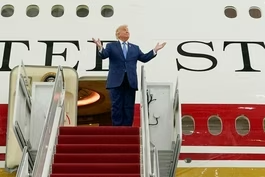
GEOFF BENNETT: In the day's other headlines: President Trump took his maiden voyage today on a new Air Force One, which was donated by Qatar last year, an unprecedented foreign gift.
DONALD TRUMP, President of the United States: You can do two things.
You can low-key it or you can show it.
GEOFF BENNETT: Before taking off for North Dakota this morning, the president told reporters he's proud of the retrofitted Boeing 747, which required hundreds of millions more dollars in defense and security systems.
The jet boasts a new color scheme red, white, navy, and gold.
During the flight, Trump staffers posted photos of the new interior.
The Qatari-gifted jet worth $400 million raised questions among some lawmakers and ethics experts.
Mr.
Trump has called it a necessary upgrade from the previous model, which flew presidents for more than three decades.
After Mr.
Trump leaves office, ownership of the new plane will reportedly transfer to the Donald J. Trump Presidential Library Foundation.
Meantime, in Qatar, negotiators from both the U.S.
and Iran held more indirect technical talks today.
The two sides spoke through regional mediators, and reopening the Strait of Hormuz was still a key sticking point.
Iran insists it controls the waterway.
And state TV broadcast images today of a container ship that ran aground after trying to use a route that Iran did not approve.
Speaking to reporters following a military visit, Vice President J.D.
Vance remained optimistic about the talks and the future of the strait.
J.D.
VANCE, Vice President of the United States: We have got gas prices starting to come down.
We're really just ensuring that we continue to make the progress on that.
And that's what they're focused on.
And then we're going to -- obviously, we're worried about the nuclear issue.
We're going to start talking about that.
So, right now, the talks are going well.
It's still pretty early, but talks are going well.
GEOFF BENNETT: Separately, a U.S.
crew member is missing tonight after a Navy Seahawk helicopter had to make what officials are calling an emergency water landing in the Arabian Sea.
Three others were recovered and are in stable condition aboard the USS George H.W.
Bush.
The Navy says there's no indication the emergency was caused by hostile action.
In New York, a pair of masked climbers are in police custody after scaling the top of the Empire State Building's antenna.
While there, they unfurled a banner that read "When the power of love beats the love of power, the world knows peace."
The duo then descended to a platform where one of the climbers got down on one knee and appeared to propose.
They were later arrested.
It's not clear how they gained access to that part of the famous skyscraper.
A spokesperson for the building simply called their efforts unauthorized.
In Italy, authorities said today they're keeping Mount Etna's alert level at yellow as bursts of gas and magma continue after its latest eruption.
Footage shows lava lighting up the night sky as molten lava flows down the mountainside of the island of Sicily.
At last, scientists say the lava has traveled nearly 1,000 feet since the eruption started on Friday.
Mount Etna is the largest volcano in Europe and, while eruptions are common, they rarely cause any threat to locals there.
In World Cup action -- and fair warning, results are ahead -- England clawed back from an early deficit against the Democratic Republic of the Congo thanks to two second half goals from Harry Kane.
They will move on to the round of 16.
Co-hosts Mexico have also advanced for the first time in 40 years after beating Ecuador 2-0 last night in front of a home crowd.
(CHEERING) GEOFF BENNETT: Hundreds of thousands of fans erupted into cheers at a massive watch party in the heart of Mexico City, but the festivities were touched by tragedy.
Mexican authorities say three people died of suffocation in those packed crowds.
The Trump administration said today it will not renew the U.S.-Mexico-Canada agreement, also known as the USMCA.
Instead, U.S.
Trade Representative Jamieson Greer says the U.S.
will engage with the other two nations to address what he called the agreement's shortcomings.
For now, the terms of the deal stay in place for 10 years with annual reviews, rather than a 16-year extension.
Meantime, on Wall Street today, tech stocks once again weighed down on the broader markets.
The Dow Jones industrial average slipped just 14 points, so almost flat.
The Nasdaq fell more than 170 points, or two-thirds of a percent.
The S&P 500 posted its eighth loss in the last 11 sessions.
And Victor Willis, co-founder and lead singer of The Village People, has died.
Willis also co-wrote many of the group's classic hits, including "YMCA," which was added to the National Recording Registry back in 2020.
He often performed hits like "In the Navy" and "Macho Man" in a police uniform or a Naval officer's outfit.
The group's music remains a staple at proms, weddings, and LGBTQ marches, among others.
More recently, their songs have become a staple at President Trump's rallies.
Willis' wife said he died from a short but aggressive illness.
Victor Willis was 74 years old.
Still to come on the "News Hour": much of Europe and North America endure record temperatures with disruptive patterns driven by climate change; progressive Democrats in Colorado notch primary victories in a potential bellwether for the midterms; and a new PBS News poll finds American pride is strong, as people worry about the direction of the country.
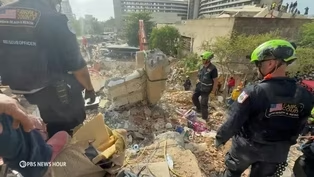
AMNA NAWAZ: The search-and-rescue efforts in Venezuela continued today one week after a double earthquake struck that country.
But fewer and fewer survivors are being found.
A Venezuelan lawmaker today said nearly 2,300 people are now confirmed dead.
Tens of thousands remain missing.
And medical professionals say the biggest danger now is treating survivors wounds and infections.
I'm joined now by Fairfax County Fire and Rescue Department Battalion Chief Daniel Gajewski.
His team has 79 people and six dogs in Venezuela.
Chief Gajewski, welcome to the "News Hour."
Thanks for joining us.
DANIEL GAJEWSKI, Battalion Chief, Fairfax County Fire and Rescue: Absolutely.
Thank you.
AMNA NAWAZ: So give us a sense of what it's like on the ground.
I understand you and your team are in La Guaira, which is one of the hardest-hit areas.
What is it like there and what's your focus?
Is this still search-and-rescue or more recovery at this point?
DANIEL GAJEWSKI: So we're still in the search-and-rescue phase.
We do not determine whether or not we go into the recovery phase.
That's going to be the local government.
So currently we have many recon teams out in the area.
We're looking for survivors all the time, both day and night.
We work 24-hour shifts.
We're always out there looking, and when we identify where survivors are located, we stay there and then we start working that pile until they come out.
At this point, currently, USA-01 has removed five live victims.
We are not stopping there.
So currently we have four rescue teams out identifying and triaging different buildings in the area that have collapsed that have potentially viable victims.
AMNA NAWAZ: And I know yours isn't the only team on the ground from outside doing this kind of work.
How many strong are you and where else are you seeing the other teams coming in from?
DANIEL GAJEWSKI: Teams are coming from all over the world.
I believe we have over 27 countries that are represented in this response and over 53 international teams.
So you head out into some of these affected areas and you see teams from all over helping out and trying to provide their service, their level of expertise to the local governments and the local first responders.
AMNA NAWAZ: You mentioned some of the folks you have been able to save.
And we have seen these incredible moments of rescues, people being pulled from the rubble even days after the earthquakes.
Does any one particular moment like that stand out to you?
DANIEL GAJEWSKI: It does.
I have been on this team since 2011, and this is what we do.
And, for me, and in my position as a task force leader, I kind of sit in the background, but seeing the mother and child being pulled out on our first day here was -- is extremely emotional, not only for the guys and girls that are there doing it, but for everybody back here.
AMNA NAWAZ: You mentioned the many years you have been doing this.
I'm assuming you have been parts of similar missions before.
I'm actually personally thinking back to the scale of the disaster after the 2010 Haiti earthquake, which I was on the ground covering, and what that took.
Can you compare what you're seeing now in terms of the scale of the destruction and the devastation to past missions?
I mean, how bad is it?
DANIEL GAJEWSKI: It's -- yes, it's pretty bad.
I mean, we just -- the most recent mission I can compare this to would be Turkey.
We arrived in country there and then got boots on the ground, and it was just total devastation.
And it's very similar here.
I think Turkey was a little bit larger scale, but still very similar.
Here, we have a lot of buildings that have collapsed, a lot of the multistory buildings that have pancake collapsed, but we have large void spaces.
With large void spaces comes a lot of opportunity for rescues, which is very similar to Turkey.
AMNA NAWAZ: Can I just put to you some of the frustration we have heard from folks on the ground now who are obviously - - devastating, having lost everything?
But there are folks saying heavy machinery in particular is needed in some areas.
Just take a listen to -- one man told us about what they haven't seen in their area days after the earthquake.
ALEXANDER DELGADO, Volunteer (through translator): We are waiting for the state's heavy machinery.
And we haven't actually seen it here at Los Cocos Beach.
We haven't seen the heavy machinery, the machines that can lift tons and move the slabs as easily as a feather.
We're waiting for that as soon as possible, because every minute counts for those people who are down under the rubble waiting to be freed from it.
AMNA NAWAZ: So, Chief, for people who haven't yet seen those resources, what's your message to them?
Is there enough or is it coming?
DANIEL GAJEWSKI: That's always what -- in any large disaster, that's always one of the big needs.
We're not surprised by what we're seeing.
So, case in point, when we see these heavy pieces of concrete and things that generally we wish we could move with heavy machinery, we know that, OK, if we don't have it, we're going to have to go through it.
And we're well versed in that.
We have all the correct tools that we need to do it, and we can do it fast and effectively.
And that's what makes our team so special.
AMNA NAWAZ: We have seen a lot of estimates too that the numbers we're seeing in terms of official death count could rise significantly.
Based on what you have seen, do you agree we could see that?
DANIEL GAJEWSKI: Based on what we have seen, yes, I believe that's a possibility.
AMNA NAWAZ: That is Battalion Chief Daniel Gajewski joining us tonight from La Guaira, Venezuela.
Chief Gajewski, thank you so much for your time.
DANIEL GAJEWSKI: Absolutely.
Thank you.
GEOFF BENNETT: Dangerously high temperatures are set to scorch much of the country this week, as a brutal and long-lasting heat wave bears down on the East Coast and Midwest.
Hundreds of cities could hit record highs by Friday, when more than 175 million Americans will face either major or extreme heat risk, according to the National Weather Service.
For more, we turn now to Jeff Berardelli, meteorologist and climate specialist at WFLA in Tampa Bay.
Jeff, welcome back to the program.
So the National Weather Service, as we said, described this as a prolonged and extremely dangerous heat today.
What should we know as we head into the holiday weekend?
JEFF BERARDELLI, Chief Meteorologist, WFLA-TV: It's going to get worse as we head towards Thursday, Friday, and also into Saturday.
We're going to see the potential for a couple of all-time record highs, or at least very close to those record highs.
Generally, the I-95 Corridor, that's going to be ground zero for the hottest weather.
We could see temperatures max out between 100 and 105.
But when you factor in the humidity, there are going to be feels-like temperatures around 110, some places a little bit higher than that, and, again, the worst Thursday, Friday, Saturday, and it starts to get a little better, little, slowly better as we head to Sunday.
GEOFF BENNETT: So give us a sense of the next few days.
Walk us through it.
JEFF BERARDELLI: Yes, the next couple of days, actual high temperatures, 95 to as much as 105 degrees.
When you factor in the humidity, it feels-like temperatures are going to be about 105 to 110 in some of the hottest cities.
And I think, along the I-95 Corridor, we will likely exceed 110 for that heat index.
So it is going to be oppressive.
GEOFF BENNETT: Yesterday, there was a heat index of 106 in Chicago, 113 in Milwaukee.
We have seen cities like Philly and New York City declare heat emergencies.
Put this in perspective for us.
How hot are these temperatures compared to average?
JEFF BERARDELLI: Right.
So, again, we could see one or two all-time records, but the heat dome or the heat wave is not necessarily unprecedented.
But I'd put it somewhere around the 95 to 100 percentile in terms of how strong it is.
So it's one of the stronger heat domes or heat waves that we have seen, because it's long-lasting, because of all the extra humidity, because of the intensity of it, and because it's affecting such a large part of the country.
Again, the worst of it is the next couple of days, with temperatures getting close to 105 in cities like D.C., maybe even Philadelphia, probably a little less than that in New York.
It's rare we get to numbers like that.
GEOFF BENNETT: What's the impact of El Nino on all of this?
JEFF BERARDELLI: Yes, so there's a lot of heat building in the Tropical Pacific, the Eastern Tropical Pacific.
In fact, we're on pace for a super El Nino.
In fact, we're at record pace already.
This is probably going to be the strongest El Nino we have ever seen.
And we're already seeing it link up with the atmosphere.
And so extra heat is being put into the atmosphere already.
It's early for this to be happening.
So El Nino not only injects extra heat, but it also kind of augments the steering patterns across Earth.
And so we end up oftentimes with events that are somewhat unprecedented, especially during strong El Nino years, and the heat domes tend to be that much more amplified.
It's almost like a weather system on steroids, if you will.
And so we're seeing these heat domes play out all over the world right now.
GEOFF BENNETT: The last 11 years are the hottest on record.
We know the ocean is getting warmer, the Earth's surface temperature is rising, Europe is experiencing unprecedented heat right now.
What's the impact of climate change on all of this?
JEFF BERARDELLI: You know, climate change underlies all this, right?
Air temperatures are about three degrees Fahrenheit warmer than they were just a little over 100 years ago.
So, if you picture it like a building, if your foundation of the building is let's say three feet higher, well, then your building's going to be three feet higher.
So climate change is making all heat domes, every heat wave more intense, longer lasting, and also larger in scope.
And what we're seeing is unprecedented-type heat.
In fact, the heat wave in Europe that played out over the past week or so, there was a study that was done by World Weather Attribution.
They found that the heat dome was likely about six degrees Fahrenheit hotter than it otherwise would have been just 50 years ago.
And 50 years ago, it would have been virtually impossible without climate change.
So that's the impact on the European heat wave.
There's going to be another one shaping up as we head into the weekend and next week.
For the Eastern U.S., again, not an unprecedented heat wave, but climate change is certainly making it hotter than it would have otherwise been.
GEOFF BENNETT: Jeff Berardelli, meteorologist and climate specialist at WFLA there in Tampa Bay, thanks again for being with us.
JEFF BERARDELLI: You're welcome.
AMNA NAWAZ: In Colorado, progressive challengers scored upsets against Democratic establishment names up and down the ballot last night, part of a trend seen in some races across the country.
Lisa Desjardins has more on what that means for the Democratic Party.
LISA DESJARDINS: Democrats in the Centennial State sent their party two messages, move left and time for change.
In the race for governor, the state's Attorney General Phil Weiser beat U.S.
Senator Michael Bennet for the Democratic nomination.
But the biggest surprise of the night may have been in the state's First Congressional District; 29-year-old Democratic socialist Melat Kiros unseated 30-year-old incumbent -- 30-year incumbent Representative Diana DeGette by nearly 10 points.
MELAT KIROS (D), Colorado Congressional Candidate: We are winning from coast to coast, from every level and office.
We are taking back our party and our country!
LISA DESJARDINS: Still, Senator John Hickenlooper successfully staved off a primary challenge from progressive state Senator Julie Gonzales.
But the results are just the latest chapter in a growing storyline this election year, establishment Democrats facing and losing challenges from progressive activists upset about the party's direction.
For more on where the party stands ahead of the midterms, I'm joined now by former DNC Communications Director Mo Elleithee.
He now leads Georgetown's Institute of Politics and Public Service.
Mo, Diana DeGette was the third Democratic incumbent to lose in just the last two weeks, following Dan Goldman and Adriano Espaillat in New York, and there were more downballot in Colorado last night.
Why did they lose?
MO ELLEITHEE, Democratic Strategist: Well, I think you see the energy and the Democratic Party splitting.
In those races and in a number of other races, primarily safe Democratic seats in large urban areas, which tend to skew more progressive and younger, the energy is certainly with the left, but more importantly with the insurgents.
But in the competitive races, the races that will be competitive in the general election, the swing districts, they are far less successful in most of those.
And if you look at the numbers nationwide over the course of this primary season, in those safe blue districts, the insurgent candidate won about 80 percent of the time, but in the more competitive, the swing districts, only about 25 percent of the time.
So it seems like, in blue districts, they're getting bluer.
And in the purple districts, they're not chasing that shiny new object.
They're kind of going with what's tried and true.
But that doesn't mean that there's not a big warning light flashing for the establishment Democrats.
I think there is an anti-establishment energy that's driven by two big desires among primary voters.
One, fight, fight harder.
In that Colorado governors primary, those -- that was not an ideological split.
MO ELLEITHEE: That was not a left versus center.
Those were two establishment Democrats.
But one was seen, the attorney general was seen as the bigger fighter than Senator Bennet.
And the other is be bold.
They're tired of incrementalism.
And right now, the progressive wing of the party sounds bolder.
The moderate wing of the party, the centrist, the establishment wing, seems more incremental.
And in this day and age, people want a fighter and someone who's going to be bold in pursuing change.
LISA DESJARDINS: The left flank is not just progressives now.
It is Democratic socialists.
They have had a fantastic last couple of weeks in general as a group.
My question to you about Democratic socialists, is this a Tea Party sort of faction of the Democratic Party?
Or do you think this is the future of the Democratic Party?
MO ELLEITHEE: It could be.
And it's too soon to tell.
In fact, when the Tea Party first started to emerge, nobody thought that was the future of the Republican Party.
They thought they were a faction.
They ended up hijacking the entire Republican Party and led directly to Donald Trump.
That could happen on the Democratic side if Democratic leadership doesn't learn those lessons that we just talked about.
We have a history in the not-distant past of bold centrists capturing the imagination and attention of the party, Bill Clinton in 1992, Barack Obama in 2008.
They were not incremental candidates.
They put forward a bold vision for the future and defeated more progressive candidates in their primaries.
The 2028 potential Democratic field can learn something from them.
If not, you could see the more progressive wing, Democratic socialists take more seats.
Democratic socialists are not going to help win back the House this time.
They're in districts that are already going to vote blue.
They're safe districts.
LISA DESJARDINS: You're not worried about them in the midterms.
MO ELLEITHEE: But the lessons that this wave teaches us will make or break the future of the Democratic Party.
LISA DESJARDINS: I need to get in a big question for Democrats, which is Israel.
We saw in the Colorado race that winning candidate, Melat Kiros, she ran against Diana DeGette after she was fired for posting a statement about Israel where she accused Israel of committing genocide in Gaza.
That is something that some Democrats find abhorrent.
Other Democrats think it's the right phrasing.
The party is divided.
How does the party move forward?
Can it both support Israel and also so sharply criticize it?
MO ELLEITHEE: Well, I think, number one, the split on Israel-Gaza is similar to the one we just talked about.
Younger voters, urban areas, they tend to be more passionate about -- more critical with using language like genocide, whereas, in more swing districts, it's not as much of a thing.
LISA DESJARDINS: In our last few seconds, though, but how do you get through this?
MO ELLEITHEE: Yes.
Democrats need to figure out -- and some have started to.
Democrats need to figure out how to be anti-Netanyahu and pro-Israel.
And that -- some of them have struggled.
Some have figured it out.
That's where we can be.
We can be for Israel and its role in the region and its relationship with the United States, while denouncing Netanyahu and the way that he waged this war.
LISA DESJARDINS: Mo Elleithee, thank you for an important conversation.
MO ELLEITHEE: Thanks for having me.
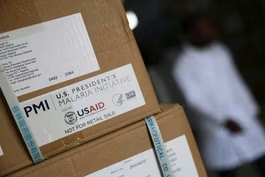
GEOFF BENNETT: Today marks one year since the Trump administration dissolved the United States Agency for International Development, or USAID, as an independent agency, folding what remained of its foreign assistance work into the U.S.
State Department.
For more than six decades, USAID was a central tool of American foreign policy, delivering humanitarian aid, fighting disease, responding to disasters, and advancing U.S.
interests around the world.
The administration called the move a necessary overhaul.
Critics called it the dismantling of one of America's most important instruments of global influence.
For perspective, we are joined now by Samantha Power, the last confirmed administrator of USAID under former President Biden.
She previously served as the U.S.
ambassador to the U.N.
during the Obama presidency.
Ambassador Power, welcome to the "News Hour."
SAMANTHA POWER, Former USAID Administrator: Thank you for having me.
GEOFF BENNETT: You have said the dismantling of USAID amounts to soft power suicide.
A year later, where do you see the clearest consequences, not just in fewer aid programs, but in diminished American leverage and influence?
SAMANTHA POWER: "The Lancet" estimated that 14 million people would die, including 4.5 million kids under 5, by 2030.
It is hard to quantify day by day the deaths that are ensuing, but Boston University ran a tracker and documented 800,000 deaths by February of this year.
So people are dying because they don't have access to medicine, they don't have access to clean water.
The cuts were done not on a glide path, as one would do if one had conducted a reasonable review of programming, but it was a cliff.
And by cutting off resources on a cliff, you do the most human harm possible.
The cost to the 15,000 people who worked at USAID, patriots, public servants, people who volunteered to serve most often in crisis zones, whether war zones, the scenes of natural disasters, really difficult living environments, they did so because they were motivated by just the cause of trying to help vulnerable people and advance U.S.
interests in so doing.
And they were escorted out often by security guards, given 10 minutes, 15 minutes to pack up their offices.
But this just -- it's like taking away one of the great brands that America has ever projected into the world, created by John F. Kennedy, like a Nike, a Coca-Cola, something that really engendered respect and influence all around the world, and destroying that why?
In just almost a fit of absent-mindedness, without any thoughtfulness, without any previous ideological axe to grind.
GEOFF BENNETT: Critics on the right, as you know, say the agency was bloated, that it was slow, that it was captured by contractors who absorbed a large share of every dollar before it ever reached anyone in need.
Looking back, is there a version of reform that you would have supported, or was the agency's scale important in and of itself?
SAMANTHA POWER: Marco Rubio has said that U.S.
assistance needs to move at the speed of relevance, and that is one of the few things in the context of discussions about foreign assistance that I agree with Marco Rubio on.
It absolutely should move at the speed of relevance.
And I also think what the Trump administration is doing, which is moving more money through governments, that is something we also began to push really hard on under President Biden.
What was hard were a set of congressional requirements, compliance requirements that were very well intended, but that added up over the years to ensure that these resources went exactly where Congress and USAID intended them to go.
And what that meant was a ton of red tape, a ton of red tape that actually slowed down USAID's ability to move money from Washington out to the field and actually created distance between some of the incredible public servants who did this work and the communities that they came to USAID to serve.
So I think that could easily be cleaned up, and you could see a kind of risk management approach embraced, rather than a risk-avoidance approach, which is impossible in war zones and places like that.
GEOFF BENNETT: Well, as the U.S.
retreats, who gains?
Do you see a China or a Russia, for instance, trying to convert America's withdrawal from the -- from the world stage into a geopolitical advantage?
SAMANTHA POWER: No question that authoritarian actors benefit.
When you commit soft power suicide, who is going to be the biggest beneficiary?
Of course, your largest geostrategic competitor, and that is China.
So when the United States is pulling the rug out from public health programming, it's not as if China's coming in and saying, here's some malaria bed nets for your people.
Look, we can run this programming too.
That's not their thing.
They are not about giving grants and doing significant humanitarian work in the world, but they are about using their media platforms to amplify the deaths and the harms caused by the United States closing down these programs in such an abrupt and deadly manner.
GEOFF BENNETT: Has this experience changed how you would make the case for foreign aid, less as moral obligation and more as hard-nosed self-interest?
SAMANTHA POWER: Well, I have long made the case in both ways, because -- not to cater to any particular audience, but because I think both things are true.
It's an amazing thing for Americans to know that, for the equivalent of $10 a month for each of them, we are saving, the United States was saving three million lives a year.
It's an incredible thing for them to know that 92 million lives were saved between 2001 and 2021 because of the work USAID did in the world.
And that's not propaganda.
That's a peer-reviewed academic study that shows the good the taxpayer resources did.
At the same time, I think Americans know intuitively that American farmers, who are not having an easy time of it these days for a whole set of reasons, tariffs, climate change, the works, it matters a lot when USAID buys $2 billion worth of American farm commodities, wheat and corn, and uses it to feed really hungry people around the world.
It matters a lot when the United States and the USAID is contributing to growing middle classes in many developing nations, middle classes that will then buy American products and services.
And it matters a huge amount when we think, especially in the wake of COVID, the fact that we had this crack outbreak response infrastructure built that the taxpayers had invested in over so many years, and that we had gotten so good at smothering these outbreaks before they became pandemics, and that we would destroy that, again, it's an own goal of epic proportions.
GEOFF BENNETT: Ambassador Samantha Power, thank you for joining us this evening.
We appreciate it.
SAMANTHA POWER: Thank you so much.
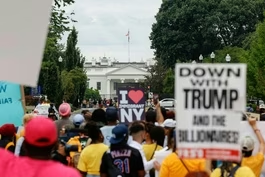
AMNA NAWAZ: With celebrations for the nation's 250th anniversary well under way, the mood of the country and its citizens can best be summed up as complicated.
That's according to a new PBS News/NPR/Marist poll.
Most Americans say the nation has drifted from its founding ideals, and a growing number say the divisions have become so severe that violence may be necessary to set the country back on the right path.
Liz Landers has more insights from the poll and its respondents.
LIZ LANDERS: Flags, fireworks and fanfare.
Beneath the pageantry of the country's 250th birthday, some feel a sense of national pride.
GERALD JAKUBOSKY, Florida Resident: I have been fortunate to travel and work with a lot of people from all around the world.
This is a good place.
I mean, with all its faults, there's not much like it in the world.
LIZ LANDERS: Gerald Jakubosky remembers America's bicentennial 50 years ago, which he says felt like a national party.
He says something is different this year.
GERALD JAKUBOSKY: This time it's, unfortunately, not as joyful as it could have been.
LIZ LANDERS: At this milestone moment, two-thirds of respondents in the latest PBS News/NPR/Marist poll said they are proud to be American.
One-third are not.
Those feelings are largely defined by political alignment, and the partisan gap is enormous; 93 percent of Republicans say they are proud.
Just 45 percent of Democrats and 61 percent of independents say the same.
VERONICA VALDIVIA-VERA, Michigan Resident: I am not proud.
It's embarrassing what is happening in this country.
LIZ LANDERS: Veronica Valdivia-Vera is a naturalized citizen and a political independent.
She says the Trump administration's anti-immigration agenda has her worried.
VERONICA VALDIVIA-VERA: I was born in Mexico, so it fills me with sadness to see what is happening to immigrants, other fellow immigrants, and how we're being targeted because OF the color of skin.
LIZ LANDERS: Nearly half of Americans say the country has moved far away from the principles and ideas on which it was founded.
Just 16 percent say it still represents the nation's founding beliefs.
MARK HOCKING, Indiana Resident: I think it's come a long way from the beginning.
It was nowhere close to perfect at the beginning of this country.
And I think we have come a long way.
LIZ LANDERS: Mark Hocking is a political independent from Indiana.
He's proud, he says, but clear-eyed about how far the country still has to go.
LEE MIRINGOFF, Director, Marist Institute for Public Opinion: There are doubts about where we are and where we're headed.
LIZ LANDERS: Lee Miringoff is the director of the Marist institute for Public Opinion.
LEE MIRINGOFF: I don't think it's really surprising, as much as it can be still considered shocking, that after 250 years of this grand experiment in democracy, folks are having serious doubts and wondering how far we have strayed from our principles.
LIZ LANDERS: Those early founding statements, that all men are created equal, that the pursuit of happiness is a central right, continue to face new tests in the 21st century.
BEVERLY GAGE, Yale University: There are lots of people that are really questioning in this moment whether those things are true anymore.
LIZ LANDERS: Beverly Gage is a historian at Yale University and author of "This Land is Your Land: A Road Trip Through U.S.
History."
BEVERLY GAGE: There have always been in the United States deep concerns about whether the country would hold together, whether we're just this big mishmash of different kinds of people with different experiences and different beliefs, or whether there's something that really unites the country.
I think we're seeing a particularly acute sense of concern over these questions now.
LIZ LANDERS: But what does it mean to be an American?
In the new poll, freedom or liberty was the most common response.
More than a third of respondents said so.
Other common answers included patriotism, constitutional rights and diversity.
MARK HOCKING: To be an American, I think just the opportunity, that we -- anybody can do anything based on ability, but also based on circumstance.
LIZ LANDERS: Despite clear differences in the view of American identity, there was some overwhelming agreement.
More than eight in 10 respondents said that the issues that divide the country pose a serious threat to the future of democracy.
LEE MIRINGOFF: There's very few institutions who have not developed recent scars from just the kinds of sentiment that people are seeing when things are not improving.
LIZ LANDERS: As Americans see stagnation in the direction of the country, there is also an uptick in acceptance of political violence; 37 percent of Americans believe their fellow citizens may need to resort to violence to get the nation back on track.
That's a seven-point increase since October.
BEVERLY GAGE: It's not a great sign for our democracy.
LIZ LANDERS: Gage says the current sentiment is not without historical precedent.
Violence has been a part of the American story from the very beginning.
But she says what distinguishes this moment is what makes it most alarming.
BEVERLY GAGE: The two things that I think are really distinct about our moment are, one, the seeming popularity or resignation to the idea that violence might become necessary, and, secondly, the technology, the weaponry we have today, the widespread nature of gun ownership and the ways that violence can be turned into mass violence much more easily than it could in the past.
LIZ LANDERS: And the poll finds the rising belief is driven most sharply by young Americans.
More than half, 58 percent, of respondents under age 30 say violence may be necessary.
That's a 17-point jump since October.
JACK BORCHERS, Illinois Resident: I think it's something that I can definitely see people doing.
LIZ LANDERS: Twenty-one-year-old college student Jack Borchers is a Democrat.
While he doesn't think he'd take up arms, he understands why other young people might.
JACK BORCHERS: I personally do not want to see violence.
I think that we need to resolve our issues about violence, but I think that it's going towards that path.
It's kind of an unavoidable.
One half of the aisle doesn't seem to want to play by the rules, so it may be time for both sides to kind of agree that the rules need to be broken.
LIZ LANDERS: Despite the grim outlook on creeping political violence, there is room for some optimism.
A majority of Americans, 53 percent, say that America's best days are ahead.
GERALD JAKUBOSKY: Administrations change.
Maybe this one will go down as you know, maybe that wasn't so great.
But there's always another one.
It can be better.
JACK BORCHERS: I hope that those ideals and ideas that they came up with 250 years ago will still exist 50 years from now at the nation's 300th birthday.
LIZ LANDERS: Two hundred and fifty years in, the poll finds a country with a common vocabulary, freedom, opportunity, the promise of something better yet to come.
BEVERLY GAGE: Moments like the 250th, I think also help people step back, take a little perspective on the moment that we're in, and, by the measures of history, maybe come to the conclusion that, while there are certainly deep problems today, maybe all is not so doom and gloom.
LIZ LANDERS: What still divides Americans today is whether they believe those founding ideals and the promises of a new nation are still being kept.
For the "PBS News Hour," I'm Liz Landers.
GEOFF BENNETT: If you have a furry friend, you might have noticed that veterinary care is becoming increasingly expensive.
And as prices rise, attention is turning to a major shift in the industry, private equity firms and large corporations buying up veterinary practices across the country.
Paul Solman has the story.
PAUL SOLMAN: Clyde, a 9-year-old boxer who lived in California with pet parent Kylie.
KYLIE, Dog Owner: I adopted him in April of 2020.
So he's a pandemic baby.
He was in mostly good health for about a year, and then he started vomiting pretty regularly.
PAUL SOLMAN: After a year plus of vet visits, sweet potato Clyde's diagnosis, cancer.
KYLIE: We started him on chemo pretty early on.
PAUL SOLMAN: Costing how much?
KYLIE: In 2026 alone and just for my one dog Clyde, I have spent $3,500.
JENNIFER TIRNAUER, Cat Owner: At what point do you say, enough?
PAUL SOLMAN: Jennifer Tirnauer has spent some 20 grand on her daughter's beloved 14-year-old Balinese cat, Jupiter (ph).
JENNIFER TIRNAUER: If it was $20,000 all at once, I might have said no, but because it was a few thousand, a few thousand, a few thousand, then a few years past, then a few thousand, it's really hard to draw a clear line.
PAUL SOLMAN: Look, we can bombard you with stories like these because veterinary care costs have risen by roughly 60 percent since 2014, far outpacing overall inflation.
The mission of this story, to examine the role of corporate ownership by private equity in particular.
MATT SALOIS, President, Veterinary Management Groups: Rising prices are partly a story of inflation.
They're partly a story of better medicine, partly a story of labor scarcity, and then it's partly a story of ownership and market structure.
PAUL SOLMAN: Economist Matt Salois studies the industry.
MATT SALOIS: And so the private equity component is a piece of that story.
PAUL SOLMAN: Salois says it's hard to precisely quantify private equity's share of these costs, but they are real enough.
And, in fact, Clyde and Juniper (ph) have something in common besides their pathologies.
They were treated by vets owned by the same private equity firm.
Now, as we and others have reported, private equity buys businesses to hike their value, usually with a loan that's loaded onto the acquisition.
The goal?
Increase profits and sell at a higher price.
HELAINE OLEN, Financial Journalist: Private equity has started to move in very aggressively into the veterinary space.
PAUL SOLMAN: Financial journalist Helaine Olen.
HELAINE OLEN: And what often happens is everyone from the customers to the employees get the short end of the stick.
There is a lot of evidence out there now that what they do is, they put a lot of pressure on the veterinary clinics themselves to increase revenue.
They raise prices quickly and often.
PAUL SOLMAN: Salois says, that can happen, but in the vet world, so much depends on how the acquirers operate and how many practices they own.
MATT SALOIS: The entry of private equity into a veterinary practice in and itself is not good or bad.
It's, what kind of operating model?
I think the problem here is one of size.
It's easier for a smaller enterprise to maintain that level of trust between the veterinary team and the pet owner because the distance between decision-maker and decision-implementer is closer.
And that becomes harder as an enterprise grows, as can happen in a corporate veterinary practice.
PAUL SOLMAN: In other words, the practice can wind up putting profits over pets.
A government-backed investigation of vet clinics in the U.K.
estimated that corporate ownership added more than a billion dollars in costs for consumers over a five-year period.
Back here across the pond, corporations owned only 10 percent of vet practices a decade ago.
Today, it's estimated from about 30 to as much as 50 percent and, in specialty care, emergency medicine, oncology, and cardiology, 75 percent.
Why?
Because vet practices can be cash cows, given the emotional bonds between man and beast.
(SINGING) KYLIE: If you're a pet owner that loves your pet, you're going to want to keep that pet alive.
They're my babies.
They're my kids.
JENNIFER TIRNAUER: It's very hard to say no when something might extend their life.
HELAINE OLEN: The status of pets at our society has gone up by a huge degree over the course of our lifetimes.
These private equity places, shops see this and they think this is a guaranteed way to make money, because just keep spending money on their pets.
PAUL SOLMAN: Michele Forbes is a veterinarian who runs an independent vet practice in Ann Arbor, Michigan.
MICHELE FORBES, Owner, Compassionate Care Animal Hospital: When I started 22 years ago, it was you had to be a veterinarian to own your practice.
It was a more locally functioning, connected, sort of we make decisions here in the moment in the hospital.
And now it is -- it's just much more business.
It's a business venture.
PAUL SOLMAN: Vets like Forbes are increasingly getting offers to sell their practices to private equity firms.
Here's a recent bid she got and posted on TikTok.
MICHELE FORBES: Initial corporate offer, $8.5 million.
I, on a daily basis, will get requests from private equity companies to purchase my practice, and the numbers are so hard to walk away from.
PAUL SOLMAN: And she has walked away from every offer.
MICHELE FORBES: That's what we think of selling to corporate.
PAUL SOLMAN: Even so, she says, the rise of corporate-owned practices has made it harder for her to compete.
MICHELE FORBES: There are certain medications that for, every dollar I spend, a corporate hospital spends 30 cents.
So when I charge a client the same amount as a private equity, my profit margin is so slim that it's hard to stay alive.
PAUL SOLMAN: That's because she can't get the same huge volume discounts that come with size.
But when vets like her sell or close up shop, the community may pay the price.
MATT SALOIS: Private equity, consolidation in general has the potential to reduce competition in local markets.
And so, if that happens, that pressure does contribute to higher prices.
Independent practices, they're not just nostalgic.
They are an important competitive force.
PAUL SOLMAN: We contacted some of the largest corporate-owned veterinary groups in the U.S.
Mars, the candy folks, now a conglomerate, which owns three of those groups, and about 2,000 U.S.
practices in all, responded - - quote -- "Diagnostics, treatments, and specialty care that did not exist a generation ago are helping pets live longer, healthier lives.
Those advances, along with industry-wide pressures, such as a national shortage of veterinary professionals and rising costs for medical supplies and equipment, have affected the cost of care.
Our veterinarians have clinical autonomy."
Mars rebrands its vet practices, but that's not usual for private equity owners.
So consumers often assume local ownership.
Francis Wong's dachshund, Pluto, was sideswiped by a car, rushed to a local clinic.
FRANCIS WONG, Dog Owner: And we were just really disappointed in the way he was cared for.
There didn't seem to be any continuity of care.
The vets that he saw were relief vets, so they were coming in and out.
And so they missed the internal bleeding that he had, and that's ultimately what led to his death.
And the other thing that was really torturous for us was just the way in which they were continually asking for additional authorization for payment, including after he had passed.
PAUL SOLMAN: Did you know it was private equity?
FRANCIS WONG: So we didn't, we complained.
We didn't really hear anything back.
And at that point I started researching who owns the practice.
PAUL SOLMAN: The local vet had been acquired by a private equity firm, KKR.
Wong appealed, was offered a refund of his $13,000 bill, but: FRANCIS WONG: That was in return for an NDA.
PAUL SOLMAN: A nondisclosure agreement.
FRANCIS WONG: Meaning that we wouldn't be able to share anything about our experience.
And so, instead, what I decided to do was to try and honor Pluto in some way by setting up this Web site that actually has the goal of bringing transparency to the ownership of veterinary practices across the U.S.
PAUL SOLMAN: His Web site, PrivateEquityVet.org, features a searchable map of corporate-owned practices, something he wishes he had had when he lost Pluto, just a pet, some might say, but, like so many, a priceless member of the family.
For the "PBS News Hour," Paul Solman.
AMNA NAWAZ: And that is the "News Hour" for tonight.
I'm Amna Nawaz.
GEOFF BENNETT: And I'm Geoff Bennett.
For all of us here at the "News Hour," thanks for spending part of your evening with us.
America at 250: Poll finds nation divided over its future
Video has Closed Captions
America at 250: New poll finds nation divided over its identity and future (7m 34s)
Former USAID head says 'people are dying' after dismantling
Video has Closed Captions
Former USAID head says 'people are dying' a year after agency's dismantling (7m 41s)

Millions of Americans face dangerous temperatures
Video has Closed Captions
Millions of Americans face dangerous temperatures as heat wave bears down (4m 38s)

News Wrap: Trump takes first trip on new Air Force One
Video has Closed Captions
News Wrap: Trump takes first trip on Air Force One gifted by Qatar (5m 50s)

Private equity ownership of vet clinics draws scrutiny
Video has Closed Captions
As veterinary costs climb, private equity ownership of clinics draws scrutiny (8m 41s)
Progressive victories potential bellwether for midterms
Video has Closed Captions
Progressives notch more primary victories in potential bellwether for midterms (6m 42s)
Rescue team from U.S. races to find survivors in Venezuela
Video has Closed Captions
'We're not stopping': Virginia rescue team searches for quake survivors in Venezuela (5m 2s)
Trump's $2B financial disclosure raises new ethics questions
Video has Closed Captions
Trump's $2B income in 2025 raises fresh questions about profiting off presidency (6m 31s)
Providing Support for PBS.org
Learn Moreabout PBS online sponsorship New Episode
- News and Public Affairs

Today's top journalists discuss Washington's current political events and public affairs.

- News and Public Affairs

FRONTLINE is investigative journalism that questions, explains and changes our world.

 New Episode
 New Episode
 New Episode
 New Episode
 New Episode
 New Episode

 New Episode
 New Episode
Support for PBS provided by:
Major corporate funding for the PBS News Hour is provided by BDO, BNSF, Consumer Cellular, American Cruise Lines, and Raymond James. Funding for the PBS NewsHour Weekend is provided by...