
Ocean at the front door: Coastal communities battle erosion
Clip: 9/15/2026 | 7m 15sVideo has Closed Captions
Ocean at the front door: East Coast communities race to protect homes from erosion
Rising seas, stronger storms and relentless erosion are reshaping America’s coastlines and forcing communities to make difficult choices. Special correspondent Ben Tracy of Climate Central has the story of two Atlantic coast communities grappling with erosion. It's part of our Tipping Point series.
Problems playing video? | Closed Captioning Feedback
Problems playing video? | Closed Captioning Feedback
Major corporate funding for the PBS News Hour is provided by BDO, BNSF, Consumer Cellular, American Cruise Lines, and Raymond James. Funding for the PBS NewsHour Weekend is provided by...
Ocean at the front door: Coastal communities battle erosion
Clip: 9/15/2026 | 7m 15sVideo has Closed Captions
Rising seas, stronger storms and relentless erosion are reshaping America’s coastlines and forcing communities to make difficult choices. Special correspondent Ben Tracy of Climate Central has the story of two Atlantic coast communities grappling with erosion. It's part of our Tipping Point series.
Problems playing video? | Closed Captioning Feedback
Where to Watch PBS News Hour
PBS News Hour is available to stream on pbs.org and the PBS app.
Providing Support for PBS.org
Learn Moreabout PBS online sponsorshipAMNA NAWAZ: Rising seas, stronger storms, and relentless erosion are reshaping America's coastlines and forcing communities to make difficult choices.
Along much of the Atlantic Coast, homeowners face a tough question, how to protect a place when the shoreline you built your life around starts to disappear.
Special correspondent Ben Tracy of Climate Central has the story of two communities grappling with this, part of our ongoing series Tipping Courts.
LAT WILLIAMS, Outer Banks Homeowner: There were three houses over here, one out here, one right over here.
BEN TRACY: Lat Williams neighborhood in Buxton, North Carolina... LAT WILLIAMS: And then our house was right here.
BEN TRACY: ... has changed a lot in just a year.
LAT WILLIAMS: The house that was on the beachfront was the first one to go.
MAN: No.
BEN TRACY: Twenty-one houses on the Outer Banks have collapsed into the Atlantic in the past year... MAN: There it goes.
BEN TRACY: ... after storms and waves eroded the sand beneath them.
At one point, five homes went down in just 45 minutes.
LAT WILLIAMS: It was devastating to stand there and watch our neighbor's house bump into the corner of our deck.
BEN TRACY: Lat and his wife, Debbie (ph), woke up to find their house was now in the water and barely standing.
They knew it was time to move.
When you say you moved, it wasn't just you, your wife, and your stuff.
LAT WILLIAMS: It was the whole house.
BEN TRACY: Last November, with patio furniture still on the deck, their three-bedroom house was put on wheels and rolled two blocks inland to a new lot they bought 600 feet from the water.
What do you estimate this cost you?
LAT WILLIAMS: North of a quarter-million.
It took a bite out of the retirement fund.
BEN TRACY: Did you ever think of just kind of leaving the house and starting over somewhere else?
LAT WILLIAMS: No, no, never.
BEN TRACY: Many homeowners can't afford that kind of move.
And most flood insurance policies don't pay until the house falls into the water.
DAVE HALLAC, Superintendent, Cape Hatteras National Seashore: And when that occurs, yes, in fact, there typically is a bit of a mess.
BEN TRACY: Dave Hallac is the superintendent of the Cape Hatteras National Seashore, which stretches for 80 miles along the Outer Banks.
This 400-foot-long pile of debris was the mess left after those houses collapsed last year.
DAVE HALLAC: As you can see, there are no front steps that go up to it.
BEN TRACY: We met Hallac in Rodanthe at another abandoned beachfront home.
What's likely to happen here?
DAVE HALLAC: If this house follows the path of the others, it will most likely collapse at some point.
The ocean is just simply catching up to this development.
BEN TRACY: Many of these homes were built in the 1960s and 70s, when they were hundreds of feet from the ocean.
It's now an unwelcome neighbor.
REIDE CORBETT, East Carolina University: The ocean is literally at the front door.
BEN TRACY: Reide Corbett, a coastal scientist at East Carolina University, says while erosion is natural on barrier islands, here, it's uniquely bad.
REIDE CORBETT: You can find areas that have erosion rates of 10 to 15 feet per year.
You're losing hundreds and hundreds of feet of potential beachfront during the time of a single mortgage.
BEN TRACY: And as the planet warms and ICE continues to melt, sea levels are rising, allowing ever stronger storms to push water further inland.
REIDE CORBETT: The sea level has risen by a foot and it continues to erode.
So anything on top of that, high tide, a wave, a storm, you start a foot higher than you were when many of these homes were built.
I do think that we need to be up front about the risk.
BEN TRACY: Corbett says communities like the Outer Banks need to have an honest conversation about what it means to live on the water's edge.
REIDE CORBETT: There have been homes that have fallen in the ocean in the last year where those homes were purchased within the previous 12 months.
And the homeowner didn't have an understanding of the vulnerability of that.
BEN TRACY: And the Outer Banks won't be an outlier.
Climate Central research shows, by 2050, about 2.5 million Americans and 1.4 million homes could be at risk from severe coastal flooding.
REIDE CORBETT: This is an example of what every community at some point in the not-too-distant future is going to be managing.
BEN TRACY: Up the coast in Connecticut, it's moving day for Tim Rath.
TIM RATH, Connecticut Homeowner: I have got to get the hell out of here.
BEN TRACY: How far are you moving today?
TIM RATH: It's about 9.5 feet.
BEN TRACY: With his 60-ton home resting on 10 steel beams, a hydraulic system jacked it up one foot at a time.
In less than a day, the house was nine feet higher.
The lift alone costs $50,000.
Why are you lifting your house?
TIM RATH: I have been here for 42 years.
I have been through, I don't know, four or five major floods, and it gets old after a while.
BEN TRACY: His neighborhood was devastated in 2012... TIM RATH: Sandy was the worst.
BEN TRACY: ... when Superstorm sandy tore up the East Coast, causing nearly $70 billion in damage.
TIM RATH: The waves would come in here and filled this up like an aquarium, right to the roof.
BEN TRACY: Since Sandy, new seawalls have gone up, and nearly half of the homes here are now raised.
TIM RATH: What do you think of all this stuff?
BEN TRACY: For Rath, it's about protecting his legacy.
Did you ever think about just moving somewhere else?
TIM RATH: No.
This is going to be for my grandson, the little 3-year-old you saw in the front yard.
BEN TRACY: Back on the Outer Banks, they're rebuilding the beach in Buxton to protect something else, the economy.
BOBBY OUTTEN, Dare County, North Carolina, Manager: The only reason you're here or I'm here or anybody's here is because we have a beach.
BEN TRACY: Dare County Manager Bobby Outten says the beach also protects Highway 12, the only major road here, from being washed out.
Rebuilding this beach costs about $50 million.
They have done it three times in 10 years.
Critics say it's like shoveling money into the ocean.
BOBBY OUTTEN: Beach nourishment is a great tool as long as you have got enough sand and enough money, because it works.
BEN TRACY: Can you fight this off forever?
BOBBY OUTTEN: We can mitigate it like this for a while.
How long, I can't answer that question.
BEN TRACY: They're also repairing this broken jetty, hoping it will help slow the erosion.
Does it feel weird to be this far from the ocean?
LAT WILLIAMS: Yes, a little bit.
BEN TRACY: Lat Williams knows the future here will look different.
LAT WILLIAMS: We don't deny that there's climate change and that it's affecting things, but you need to adapt to that.
You can't just say, well, abandon everything.
BEN TRACY: He's grateful to still have his home, even if the view has changed.
I noticed your sign on the front of the house.
LAT WILLIAMS: We both agreed that answered prayers was an Appropriate Name.
It still feels like home.
BEN TRACY: For the "PBS News Hour," I'm Ben Tracy with Climate Central.

Analyzing the Supreme Court's mail-in voting decision
Video has Closed Captions
Analyzing the Supreme Court's mail-in voting decision and Trump's reaction (3m 42s)

Election officials get mail-in voting clarity from court
Video has Closed Captions
Election officials get mail-in voting clarity after Supreme Court decision (4m 47s)

NATO shoots down drone as Russia continues to provoke Europe
Video has Closed Captions
NATO jets shoot down drone in Lithuania as Russia continues to provoke Europe (8m 41s)
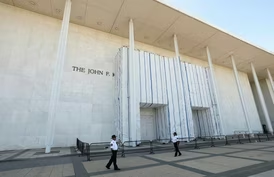
Trump-aligned Kennedy Center board votes to close
Video has Closed Captions
Kennedy Center board votes to close after judge blocks Trump's name from building (4m 32s)

Warner says U.S. can pursue safety without losing AI race
Video has Closed Captions
Sen. Mark Warner says U.S. can strengthen AI safety without losing race to China (9m 7s)

What makes Christian McBride the hardest-working man in jazz
Video has Closed Captions
What makes Christian McBride the hardest-working man in jazz (7m 56s)
Providing Support for PBS.org
Learn Moreabout PBS online sponsorship
- News and Public Affairs

Today's top journalists discuss Washington's current political events and public affairs.
 New Episode
- News and Public Affairs

FRONTLINE is investigative journalism that questions, explains and changes our world.



 New Episode


 New Episode


 New Episode
Support for PBS provided by:
Major corporate funding for the PBS News Hour is provided by BDO, BNSF, Consumer Cellular, American Cruise Lines, and Raymond James. Funding for the PBS NewsHour Weekend is provided by...