
Red Butte Garden & Arboretum, Hour 3
Season 30 Episode 3 | 52m 27sVideo has Closed Captions
See a bounty of Utah treasures from ROADSHOW’s visit to Red Butte Garden & Arboretum!
See a bounty of Utah treasures found during ROADSHOW’s visit to Red Butte Garden & Arboretum including diamond and star sapphire jewelry, a 1952 Al Stohlman tooled leatherwork picture, and Kenner “Star Wars” action figures, ca. 1978!
Problems playing video? | Closed Captioning Feedback
Problems playing video? | Closed Captioning Feedback
Funding for ANTIQUES ROADSHOW is provided by Ancestry and American Cruise Lines. Additional funding is provided by public television viewers.
Support provided by:


Red Butte Garden & Arboretum, Hour 3
Season 30 Episode 3 | 52m 27sVideo has Closed Captions
See a bounty of Utah treasures found during ROADSHOW’s visit to Red Butte Garden & Arboretum including diamond and star sapphire jewelry, a 1952 Al Stohlman tooled leatherwork picture, and Kenner “Star Wars” action figures, ca. 1978!
Problems playing video? | Closed Captioning Feedback
How to Watch Antiques Roadshow
Antiques Roadshow is available to stream on pbs.org and the free PBS App, available on iPhone, Apple TV, Android TV, Android smartphones, Amazon Fire TV, Amazon Fire Tablet, Roku, Samsung Smart TV, and Vizio.
Buy Now

ANTIQUES ROADSHOW's 2026 Production Tour
Enter now for a chance to win a pair of free tickets to one of the three stops on ANTIQUES ROADSHOW's 2026 Tour. Sweepstakes entry deadline is April 6.Providing Support for PBS.org
Learn Moreabout PBS online sponsorship♪ ♪ CORAL PEÑA: "Antiques Roadshow" is cultivating a fascination with old treasures at Red Butte Garden & Arboretum.
It is just a masterpiece.
Yeah.
(chuckling): Wow.
(chuckling): You've got to be kidding me.
(chuckles) That's amazing.
♪ ♪ PEÑA: "Roadshow" has touched down in Salt Lake City; the Crossroads of the West.
With the Wasatch Mountain Range towering in the distance, the views from Red Butte Garden are simply spectacular.
The location has a terraced water conservation garden, a prolific rose garden, and more.
Made by nature or created by human hands, if there are treasures to be found, this is the place.
♪ ♪ GUEST: Back in 1959, my dad was a schoolteacher, and we went back to Natchez, Louisiana, for summer school.
And my mom heard about this lady, Clementine Hunter, so she went over and met her at her shack and bought this painting for eight dollars.
It was originally sold to another lady for a five dollar deposit, but she never came to pick it up.
And my mom loved this painting her whole life.
This club was my grandfather's club, and when we'd go golfing, one of his favorite things he would do-- I'm sure everyone here has seen "Caddyshack," right, with Judge Smails, and he has to bring out his putter, you know-- "Oh, Billy, Billy, Billy."
That's what he would do when he had a really short putt to make.
I was at a estate sale in Washington last November, and I just thought they were really beautiful.
And what did you pay for them?
Five bucks apiece.
And do you know who they're by?
"Dale Nichols" is what it says in the front corner.
It's always hard when they're under glass to determine exactly what the medium is.
But this looks very much as though it's chalk.
These are drawings on black paper.
Okay.
He was born in 1904 in Nebraska.
He lived on a farm, and he was used to farm life, and that followed him all his life.
He was always interested in the Midwest.
He was interested in doing paintings of farms.
Probably the best description of him would be a, a rural regionalist.
But he traveled as well-- in Alaska, Louisiana, and he passed away in 1995 in Arizona.
They're both signed and both dated 1985, so that tells us these are later works.
Yeah.
These are two landscapes, both with a solitary figure, very much "man in nature."
Yes.
We know that his last years were in Arizona; these don't look like Arizona to me.
(chuckling): Right.
It's possible it's Alaska, it's possible this is a glacier.
We don't know-- he may have used his own artistic eye and recreated something from his past travels.
He was not a fan of modernism.
(chuckling): Okay.
So, he-he came from that sort of brand of regionalism.
Yeah.
And, to an extent, he didn't have a problem with being a commercial artist.
Some of his works are quite illustrative, and it's no wonder that they were used occasionally... Yeah.
...in magazines like "Time" or "Life" magazine.
He also did illustrations for "Saturday Evening Post" as well as "Liberty" magazine.
This one, at auction, I think would be $800 to $1,200.
Okay.
And... this one here, $3,000 to $5,000.
Whoa-ho.
That's a good find.
(laughing): Yeah.
Okay.
I'm okay with that.
GUEST: This is an antique Bible that was found on his grandmother's mantle.
Wait a minute, this is not English.
German... I think.
"No sprechen sie deutsch?"
(laughs) Can you speak German?
I do not.
Okay, well, we do have a date down here.
Very bottom of the title page-- 1764.
Inside, it's in immaculate condition.
It's not a significant edition of the Bible.
I would ballpark it in the... $300 to $400 range, at retail.
Well, wonderful.
We'll treasure it.
Maybe we'll learn to speak German so we can read it.
GUEST: This is my mother-in-law's violin.
In 1923, it was made.
It was a-a Roth violin, and they, um, said it had belonged to a college student in Fresno.
And he played in the orchestra, and I guess he decided he don't want it any longer.
My mother-in-law was eight years old, in 1945 is when they went to pick up the violin.
Her mother paid $350 for the violin and the bow.
She had played it a little bit here and there in junior high and high school.
So it has been in storage for... gosh, we'll say 65, 70 years.
It's a beautiful violin.
It's a German violin made by Ernst Heinrich Roth.
And this is an early instrument.
This is from 1923.
He made instruments in different models.
Stradivarius, Amati, Guarneri-- three models he-he used frequently.
This is a Stradivarius model.
On the inside of the violin there's a label.
It says it's Ernst Heinrich Roth.
It was made in Markneukirchen, Germany.
It also gives that it's a Stradivarius model.
It says, "a reproduction of Antonius Stradivarius from 1725."
This one is really a beautiful instrument.
And... from 1923, this almost looks like it's brand-new.
I know.
It looks like it hasn't hardly ever been played.
The top is made out of spruce.
The back and the ribs... Uh-huh.
...and-and the neck and scroll are all maple.
In the violin world, we call it flamed maple.
I love the back, it is gorgeous... This is what we call a one-piece back.
That's just beautiful.
Probably the most desirable ones today are the Guarneri models.
We don't find as many of those, but it's wonderful to see an example like this, of this quality.
A violin like this, in this condition, today would have a retail value of $14,000.
Wow.
(laughs) Ooh!
Wow.
(chuckling): I had no idea.
DERREK HANSON: There's early oral traditions that show that this land was inhabited by at least four tribes: the Ute tribe, the Paiute tribe, the Shoshone tribe, and the Goshute tribe.
The Mormon settlers came in the 1800s, shortly after the U.S.
military put an army base here, and it was called Fort Douglas.
That was in the mid-1800s.
When they decided later on that there was not much more use for the base here is when they started donating land to the university, to the Forest Service, and the federal government in general.
Today, we're now a botanic garden.
We opened in 1985.
It's come a long way, as you can see.
GUEST: I didn't know much about them, but I called my Aunt Carol and she told me a little bit about this ring.
It was handed to her by her father-in-law and gave it to her as a present.
I'm a September baby, so I have a soft spot for sapphires.
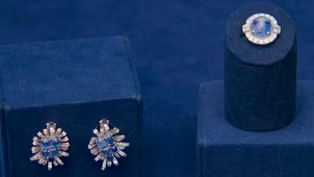
This is a platinum diamond and star sapphire ring, and then you have a pair of platinum diamond and star sapphire earrings.
While they look so, so similar and it's difficult to match these things this well... Mm-hmm, right.
...that beautiful cornflower blue color, the ring actually predates the earrings.
Oh.
So I would date the ring to the late Art Deco period, probably around about 1935 to 1939.
Oh, wow.
Okay.
That central stone there is about 20 carats in a cabochon cut.
And then it's surrounded by old European cut and tapered baguette-cut diamonds, which together equal just under two carats.
Similarly, the earrings are also set with star sapphires, single-cut diamonds, which is an iteration of diamond cutting which is much more typical for the mid-1940s, so sort of the war era.
And I would date the earrings to the Retro period, mid-1940s.
Without a certification, you can't say with 100% certainty, but I would bet that they probably were mined in Ceylon, which is modern day Sri Lanka.
They're not signed, neither piece, unfortunately.
I do think that they're probably American.
Phenomena gems, particularly star sapphires in this case, are actually made by tiny rutile needle inclusions that overlap in a hexagonal pattern inside the stone.
Oh, wow.
And when a light shines on them directly, they make a beautiful star.
You can see the star best when you use a pinpoint light source.
It can be difficult to make out in daylight, but you can see here this strong six-pointed star when I shine this pinpoint light directly on it.
The earrings, conservatively, are in the range of $6,000 to $8,000... Okay, great.
...in an auction situation, fair market value.
Okay.
And the ring, comfortably, is in the range of $10,000 to $15,000.
All right, great.
Thank you.
Good to know.
It's a very pretty star sapphire ring.
Thank you.
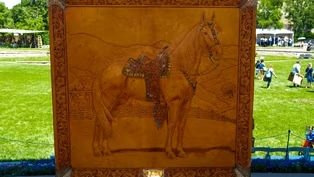
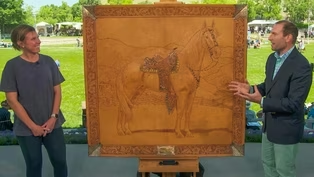
GUEST: So this is a leather picture of a horse that was made, um, by Al Stohlman.
And my great-grandfather started working with leather, and he realized there were no good tools.
So, he created some leather-working tools in partnership with Al Stohlman.
And they kind of went around and toured and taught people how to use the leather tools.
Al Stohlman is considered to be one of the pioneers or the godfather... Mm-hmm.
...of leathercraft tooling.
He's born in California.
As a kid, he-he likes drawing pictures of the Pacific Northwest animals.
Mm-hmm.
World War II is about to happen, he signs up for the Army, and he's sent overseas to the South Pacific... Oh.
Okay.
...and is in New Guinea, and sees locals that are using leather as artistry... Oh... ...and really became interested in it.
Uh-huh.
And he comes back after about 40 months, moves to California... Mm-hmm.
...and ends up living in a chicken coop, taking care of horses.
(chuckles) And as a means to try and generate money, he's taken this newfound skill in tooling leather and takes plain saddles, starts embellishing them and dressing them up with his fine tooling... Okay.
...selling them at auction to make a profit.
Mm-hmm.
It's widely recorded that in 1952, he created a massive leatherwork picture of a palomino horse that caught the eye... (chuckling) ...of the owner of the craft tool company.
Uh-huh, okay.
And the owner, which is your great-grandfather?
Correct, yes.
Was so impressed that he hired Al Stohlman... Uh-huh.
...to work in partnership with him to create leathercrafting tools... Uh-huh.
And to write articles and publications about leathercraft.
Now, I wonder if this is the 1952 picture that's referred to of the palomino horse with the decorative saddle.
(laughing): Sure looks like it.
What he did was he created these fantastic tools.
If I put it up to here, you can see the type of marking it leaves on the leather.
Oh, yeah.
Mm-hmm.
Here's a perfect example of a crescent shape.
And if I take this, and I were to apply pressure to the leaves... Mm-hmm.
...I can create the crescent-shaped veining.
This is a shining example of great craftsmanship.
Mm.
And if this were in a retail setting, we could easily see someone putting $30,000 to $50,000 on it.
Wow.
Wow.
(laughing): That's a lot!
That's... wow.
(laughs) It certainly is.
(catches breath, sighs) I mean, it-it is just a masterpiece.
Yeah.
I mean, that's pretty awesome.
I would feel comfortable putting an insurance value of about $75,000 on it.
Okay, wow.
All right.
GUEST: I come from a family of swap meeters and garage salers, and my mom stopped at every trash dump.
Coming home, I saw a very organized trash dump.
Everything was in Tupperware boxes.
And I found Nintendo games, Nintendo consoles.
PRODUCER: Have you ever played this game at all?
I have not, but my kids have.
I watch from a distance.
(laughs) GUEST: I picked this up from a gallery in Layton.
The original frame actually broke, and I wanted these colors.
I've had it in my music room for-- I play guitar, so I-I-- I have art like this.
I had just got home from the Army, so it was like '97.
It was like $250.
GUEST: I got it from my mom.
I'm guessing I was probably five, six years old.
We were in Thailand, in the northern region.
There was a tribe, and we were staying in huts right along the river.
So that's where she got it.
(chuckles) Really?
Wow.
We used it as a punch bowl.
(chuckling): Oh, really?
We would put a glass, like, regular punch bowl in it, and fill it with punch.
Uh-huh.
And it was a punch bowl.
Beautiful.
So, I don't-- I don't actually know what it's meant for.
(chuckles) Okay.
Well, bowls like this were made in Southeast Asia, in Thailand and Burma.
Oftentimes they were used as offering bowls.
So they were kept in front of temples and people would put offerings inside.
Oh.
Sometimes they were used to display flowers.
Sometimes they were purely for ornamental purposes or to store foodstuffs in.
Okay.
It is made of silver.
It's Northern Thailand.
Okay.
Chiang Mai is where it was most likely made.
Okay.
It's really densely repousséd all around, with scenes of village life.
This kind of real deep repoussé is characteristic of Burmese silver.
I think that the date is around 1950.
You've got oxen... ...drawing carts.
You've got people working... Huts on stilts, water being drawn from a well, someone working a fire.
And again, another oxen cart.
People carrying water or food on yokes on their shoulders.
And just, you know, people enjoying village life.
I believe that the entire bowl is completely handmade.
Wow.
So, even though it looks like these pieces will be potentially pressed against a wooden mold... Yeah.
...I believe that they're all done individually by hand... Oh, wow.
...pushed out, and then they're chased back in.
One really must appreciate the time and the skill that it took to be able to produce it.
People are starting to recognize these and see the real value in them.
Obviously, you've got the silver value; silver is quite high in value right now.
It's at $33 an ounce.
I think that at auction, you'd be looking at an estimate of $1,500 to $2,500.
Okay.
Mm-hmm.
Very cool.
Yeah.
I think I'm gonna keep it as my punch bowl though.
(both laugh) Yeah, it's a great way to use it.
We found him at an antique store in Oregon.
I asked if they would take $100, and they agreed.
When they do come up for auction, they routinely sell, depending upon condition, anywhere between $500 to $1,500.
Okay.
But now I have to-- We have to see the full effect.
For Halloween, we usually sit on... our big porch, and I'm always scared of like, rolling off.
APPRAISER: (laughs) This is a commitment.
Oh, my God, I love it.
You need to get me the cane.
It's not done until you get the cane.
(laughing) It's so funny!
(laughing) I love it.
Oh my God... It's pretty great.
It's so good.
I mean, honestly, like, the hand movements and everything.
Yeah.
If you started tap dancing, I would probably die laughing right now.
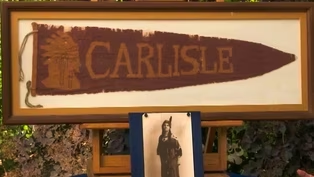
(laughs) GUEST: This is an Indian-beaded pennant from Carlisle Indian School where my grandmother went to get an education.
We know that she had close connections with a football player Who gave her some moccasins, so we're suspecting that he also gave her this as kind of a love gift.
I listened to my mother talk about it.
Mm.
I've also read things that she wrote while she was there and I know how much she enjoyed her experience.
She has scrapbooks full of pictures with friends.
And it was such an eye-opening thing to come from a small community in Oklahoma to the East Coast.
Carlisle Indian School went to Boston to play Harvard for football.
She went on that trip, and, of course, Carlisle won.
She was so proud of her Native American heritage, of being a Cherokee Indian.
And she actually wanted to be able to have herself in a portrait like this.
She did not own a dress like that.
So she went to a photography studio and put on a dress that they owned and she had the picture taken.
So what was her life like on the reservation?
They came across the Trail of Tears and they were there in northeast Oklahoma and received an allotment of land from the government.
So, it's very interesting.
Your grandmother had this tremendous experience, and it sounds like it was a very positive experience for her at Carlisle... Oh!
Oh, yeah.
...because the Carlisle Indian School was actually founded in 1879.
It was part of the U.S.
policy that was actually a forced assimilation of the Native American tribes.
Mm-hmm.
And the students that went to those schools had to change their names, speak English, practice Christianity, and change their clothes.
When I look at this beadwork, I find it fascinating, because here are these students that are going to this school to assimilate them into this culture, but yet we have a very clear piece of Native American artwork here in this beadwork.
This is a circa-1912 hand-beaded pennant.
My colleagues did say this would not have been done by a man.
It was definitely done by a woman.
And this represents such an important time in Carlisle Indian School history, because they were known for their sports.
The team was led by Jim Thorpe, who was their running back, he was their punter, he was their place kicker, he also played defense.
And in 1911, they went to Harvard.
They upset the Crimson 18 to 15, and they finished the year 11 and one.
And later on they were named national champions.
And that put Carlisle Indian School and Jim Thorpe, and the team, and Pop Warner, who was the Hall-of-Fame coach for that team, on the map.
This has been restored.
Correct.
But the beading in this is original.
Correct.
It's the only one that we were able to find.
I would put an auction estimate of $5,000 to $7,000 on this.
You are kidding.
This little thing, out of the bottom of the trunk?
Oh, my goodness.
(voice breaking): How exciting.
How much should I have it insured for?
I would insure it for no less than $15,000.
Oh, my goodness.
Well, okay.
I better get that done pretty soon.
Thank you.
PEÑA: Ethnobotany explores the relationship between humans and plants and how different cultures have used and continue to use plants.
KARA HASTINGS: Utah has a ton of really cool species that we use, uh, today and were used traditionally with our Native tribes.
One of them is the Four Corners potato.
Red Butte has done a lot of work with this particular potato.
It seems to be or have been cultivated about 10,000 years ago.
And it's this really tiny little potato, and it's very starchy.
Traditionally, they would boil it and then kind of grind it up into a paste.
PEÑA: Evidence of Native Americans cultivating the Four Corners potato was found at an archaeological site in southern Utah, near the town of Escalante.
GUEST: It was a gift to my grandfather from the officers of the 9th Cavalry when he was their commanding officer in Fort Houston, Texas, in, I believe 1919.
He was with Teddy Roosevelt, the charge up San Juan Hill.
Uh, he was married to Teddy Roosevelt's cousin.
Later, President Roosevelt wanted him to go to Panama Canal, and he was there for-- I don't know how long; a year, maybe two years.
So he was one of the... Teddy Roosevelt's Rough Riders?
I believe so, yes.
That's what-- that's what the, the family story is.
(laughs) Okay.
There's an inscription on the back.
Yes, there is.
And it was a very loved watch.
I mean, that-- that engraving was deep, and that's really... It's been worn a lot.
It's been worn a lot.
Do you know what it says?
(laughs) Roughly, I believe it's engraved to Captain-- I believe he was the captain at that time-- James E. Shelley, from the offices of the 9th U.S.
cavalry, Fort Sam Houston, Texas, in March of 1919.
It's made by Patek Philippe.
It's dubbed the Officer's Watch.
It's-it's called the model number eight.
It's 18-karat gold.
It's triple signed.
The signature is on the dial, the signature is on the back of the case, and the signature is on the movement.
It has what appears to be the original Dauphine hands that are all coated in radium, along with the markers, all done in radium.
Mm.
It has a porcelain dial.
It's a cushion-shaped, it's a Patek band, but it's a replacement band.
Patek was always one of the finest watches made in the world... Yeah.
...and timekeeping was very important in the military.
Absolutely.
Not that there weren't other good companies that produce watches.
But a Patek was the absolute finest.
On the movement, besides the Patek signature, it's signed E. Hertzberg, San Antonio, Texas.
They would have been the retailer that was probably within 100 and some miles of the army base where it was sold.
On the case... is the case number, Patek Philippe signature, the European hallmarks.
Now, this model came with a porcelain dial, which this has.
It also came with a painted dial.
Unfortunately, because the radium is radioactive, and it would've-- it would have, uh, over years, where-where the hands were sitting, would turn dark, and where the numbers were would start to turn dark all around it.
Uh-huh.
But the porcelain dial is inert, so the dial is literally in mint condition, and most of the radium is still there.
In the marketplace, in the retail level, a watch with a very good Army history... Mm-hmm.
...along with it being Patek, would probably be retailing in around the $22,000 to $25,000 price range.
$22,000 to $25,000?
(deep breath) That-- that's a surprise.
(chuckling): But it's a... it's a pleasant surprise.
It'll stay in the family; it'll go to my son.
If you were insuring it, I could easily see that a-a retail appraisal could be at $30,000 to $35,000.
Okay.
But, if it was gone, then, you're not going, you're not-- there's no, never replacing... (laughs) ...your grandfather's watch.
Right, no, you can't.
GUEST: This was my great-grandfather's.
He played it in the army band in the Spanish-American War.
I'm a singer.
I-I leave the instruments to those that know what to do.
GUEST: This is a bolo tie.
It's almost a boulder of, uh, turquoise.
I was at an estate sale maybe 20 years ago, and there was actually two pieces like this and a buckle.
And I begged my wife to say, "Please, let me get the buckle."
She goes, "No, that's big enough."
And it... and it is.
It's really huge.
My grandfather came from Gallup, New Mexico, and he actually learned from the Navajos and, uh, learned silversmithing.
So I've always had an affinity for bolo ties and silver and turquoise.
GUEST: This is a comic that my grandma received in 1994.
She was in the hospital... Mm-hmm.
...and my grandpa rushed over to go see her... Mm-hmm.
...and on the way there, he had a major stroke.
He collapsed in the chair in her hospital room... Aw.
...and the next day, he passed away, unfortunately.
Aw.
(humorless chuckle) Yeah, very sad.
My grandma was great friends with Amy Schulz, Charles Schulz's daughter.
Okay.
And she would visit her in the hospital.
And a few months later, when my grandma was released, she brought this comic over to her, signed by her father.
Wow, what a gift.
My mom used to have my brother play with her sons.
Oh.
Um, they lived in the same town growing up.
Okay.
So, never met him personally, but my siblings have.
It's just been passed down in our family.
That's great.
Schulz, I think, is like the feel-good king of comics.
Mm-hmm.
And for almost 50 years, "Peanuts," this famous strip, ran in over 2,500 newspapers worldwide.
He drew over 17,000 "Peanuts" comics, and this is one of them.
That's amazing.
We're looking at a great framed original pen and ink drawing, four-panel "Peanuts" cartoon, uh, inscribed and signed to your grandmother up there personally by Schulz.
You've got two of the iconic characters: Linus and Snoopy.
Mm-hmm.
Linus, if you didn't know, was named after one of Schulz's friends, who was also a cartoonist and a puzzle designer.
Some people say Snoopy was modeled on his dog from his childhood.
And, of course, Snoopy is with Charlie Brown.
One of his most famous... Yeah.
...if not his most famous character.
Mm-hmm.
And it ran from what I can tell from that copyright in 1994, 44 years into his career... (chuckles) ...as-as an artist.
Yeah.
The shading you can see in Linus's blanket is something that artists and cartoonists use called Zip tone.
And it's a little sort of sheet and they would cut out the pattern and it has a sticky backing, and they'd put it on top so they wouldn't have to make all those dots by hand.
Do you have any sense, any guess you want to take?
Um... a couple thousand?
(chuckling): I'm honestly not quite sure.
The thousand part is right, but you're a little bit off.
At a well-advertised auction, I would estimate it in the $8,000 to $12,000 range.
That's amazing.
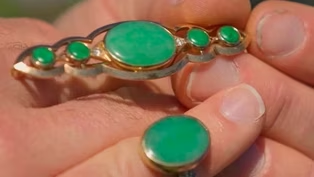
GUEST: The jade was from the last Empress of China.
It was originally set as cufflinks.
It was given to my mother's friend's father.
They lived in China during the 1920s.
When she moved back to the United States, my mother's friend, she had them reset and then they came to my mother after her friend died.
Puyi was the last emperor.
Mm-hmm.
He had several wives and concubines.
They're not jade.
Oh!
They're actually jadeite.
Diamonds, jadeite and gold.
There's no real way to prove that they belonged to Puyi's wife.
If they're not, I think they would likely sell for $3,000 to $5,000 as they are.
If they were, it's really hard to know.
Somewhere between $8,000 and $12,000.
Oh, my goodness.
Well, they're beautiful, aren't they?
They're memorials of my mother's friend and my mother and the Empress of China.
If that's the case.
(chuckles) GUEST: My mother picked it up in-in probably the late '40s at an antique store.
It's called an annular clock and it's French.
And instead of a traditional clock with two hands, a minute hand and an hour hand telling the time, this enameled band spins with the arrow being the indicator in the front.
This is the Three Graces clock.
These are Zeus's daughters and they represent all the positive aspects of life in society.
They're a bronze figure that have been patinated with a chemical that makes them this black color.
It has these three tapered feet that are brass and they're really wonderfully done.
I love all these ormolu open fret bronze castings that are gilded just over the top.
You have this beaded border on this triangular marble base and you have these wonderful garlands.
It just presents itself really well.
You come to the top, you have the spear and then you have these wonderful ormolu mounts and then the putti at the top sitting on a cloud.
When do you think this clock was made?
I think inside it says 1807.
That has a serial number, 1807 on it.
Oh.
(chuckles) It's actually later than that.
It's, uh, it's a clock that was made circa 1890.
This top comes off, but as you know, it was pretty hard to take off.
And inside is a beautiful eight-day French movement.
It's also stamped on the top plate "J. Lefebvre Fils" which is sons, excuse my pronunciation of the French language.
It's the best I can do-- and it was made in Paris.
So this is a clock copied from the original that was produced by François Vion circa 1765-- but this is a later copy.
These were a very popular clock.
A lot of Parisians made the cases and a lot of French clock makers would put their movements inside of these cases.
And you can see the bottom half of the sphere has a little deterioration.
This is the original paint at the bottom.
And this has been highlighted at some time.
And it's also missing a torch, but honestly, really not a big deal at all.
In this as-is condition, in a retail setting, this clock would sell for around $15,000.
Wow.
(chuckles) That's amazing to me.
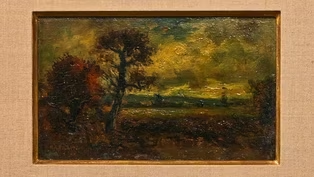
(chuckles) GUEST: We were on our way somewhere and my car blew a tire.
And I happened to be at Goodwill across the street, so I thought, "Oh, I'll go nose around in the Goodwill."
They had just put this out and I saw the frame and I thought, "That's the most beautiful frame I've ever seen."
The picture had fallen out of the frame, so it was dropped down.
I thought, "Well, I'm buying the frame."
It was, I think, $29, $30.
My son was looking at it one day.
My son's name is Blake.
Okay.
And he's like, "Dad, the guy that painted this painting is named Blake."
And I said, "Oh, okay.
How can you see that?"
Because it's very dark.
Uh-huh.
And he goes, "See, it says Blake," and he goes, "I think his last name is Locke."
I typed in "Blake Locke."
It came up, and I guess maybe that's this painter.
Well, the painting is oil on panel by Ralph Albert Blakelock.
It's signed there "R.A.
Blakelock," 1877.
Blakelock was born in New York in 1847.
Uh, his father was a physician and he was intended to follow in his footsteps.
Thankfully for us, he gave up that career in 1866 pretty early on and decided to be an artist.
Blakelock's life is immensely tragic.
He struggles almost from the beginning.
He has moments of success and then things go sideways.
One of his great moments of success was in 1877 when he met and married his wife.
And he had the first of nine children.
So that's when he painted my painting.
In 1877, exactly.
Wow.
In 1891, Blakelock had the first of a series of serious mental breakdowns.
And from 1899 until pretty much his death, he was largely institutionalized.
And he didn't die until 1919.
Today, they would say that he was essentially having bouts of schizophrenia.
What's amazing is that during the very end of his life, he became hugely successful.
While he was in the institution?
But he didn't benefit from it at all because a painting that he had sold for about $500 in 1916 sold for $20,000, which was... Wow.
...the most that any painting by a living American artist had ever sold for.
And so this record was set while he is in a hospital destitute.
Wow.
He didn't get a dime.
This is a small scale work and as we said, 1877 when he got married.
It's also when he's transitioning to a very dark interpretation of the Hudson River School ethos.
And they get much darker than this.
This work is interesting because it's sort of on the cusp of where they're going to end up.
I almost didn't bring it because it's so dark.
(chuckles) It-- and, the later work is even darker; it's incredibly moody.
It's like gothic Hudson River School, almost black and blue, many of them nocturnes.
So this work doesn't have that super signature look to it.
But for Blakelock, it was about mood, not specific location.
At auction right now, we would suggest an estimate on it of about $3,000 to $5,000.
Wow.
It's better than the frame.
(laughs) That's great.
GUEST: I've had it for 35 years, and last night I realized it was Roy Rogers and Dale Evans and Trigger.
After 35 years.
GUEST: I inherited this from my mother.
It's an abstract... Print by Karel Appel.
...pel.
PRODUCER: Do we know what this scene is at all?
What's happening?
No.
(chuckling): No.
How about you?
You know?
(laughs) It's pretty abstract.
She probably got it through the Museum of Fine Arts in Boston.
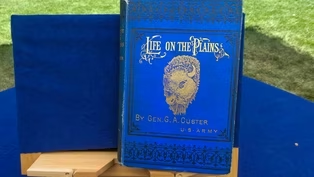
GUEST: The book has been in my family for a number of generations.
I have a great-great-grandfather who was a peer of George Custer.
When Custer later wrote this book, he hand-signed a copy for the son of my great-great-grandfather.
So the book was written by General George Armstrong Custer.
It's titled "Life on the Plains" and published in 1874.
And what was your great-great-grandfather's name?
His name was Francis Amasa Walker.
I think one of the things he's best known for is modernizing the census.
He did the census of 1870.
Wow.
And 1880, 1871.
He was named as the Commissioner on Indian Affairs at the time.
He actually parlayed that work into the 1880 census where he sought to look at the Native American populations of all the different tribes, on the various re-- uh, reservations... Right.
...and incorporate that into the census data.
He inscribed it to your great-great-grandfather's son.
It was Ar-Arthur.
His oldest son, yes.
He was seven or eight years old at the time.
Right.
So with this amazing inscription inside the book, "Master Arthur, if I may suggest to you two maxims "which if adopted will lead to success in life.
"The first would be never cry over spilled milk.
"The second, never cross a bridge until you come to it.
Truly yours, G.
Custer."
May of 1875, so about a year after the publication and about a year before his demise at the Battle of Little Bighorn.
Custer wrote this book after the Civil War about his time during the Indian Wars leading up to the Washita campaign.
He writes a lot about his self-mythologizing to some extent, and being a hero on the plains.
From our perspective, he was very controversial and led to the massacres of thousands of Native Americans and-and obviously led to the destruction of the 7th Cavalry at Little Bighorn a year after this.
Yeah.
So it is a problematic narrative.
As you say, your great-great-grandfather was Secretary of Indian Affairs and also had to deal with questions about the Indian campaign.
And do you know much about that?
It was a difficult time.
From what I've learned of Francis Amasa, uh, he was conflicted in that he was compassionate toward what he saw with the Native Americans being put on reservations of subpar land and unable to sustain their traditional ways of life.
Uh-huh.
Yet the thought of assimilating into, you know, society also seemed to be, you know, he seemed to have biases against that.
Right.
I think today you could've... have to call that racism.
Right-- the book itself is fairly rare.
Inscribed copies of the book are extremely, extremely rare.
There actually is only one other copy that we've seen at auction.
We would suggest a very conservative auction estimate, of $10,000 to $15,000 of the book.
Honestly, that may be low.
(soft chuckle) The other copy that I mentioned had the same estimate and made almost $100,000.
(chuckling): Oh, my God.
Because you never know if... (chuckles) ...the desire of collectors can step up to the plate.
If you were to have it insured, a figure of $30,000 or $40,000 would not be u-untoward or unusual.
Wow.
Wow, I just, I, it's... ...as a child, I loved it just as a child.
But-- and I certainly today recognize the history and the significance, I... (voice breaking): ...no idea.
(soft chuckle) Well, we were so glad you brought it in and were able to share this piece of history with us.
Thank you so much.
Thank you so much, Martin.
That just blows me away.
(soft chuckle) PEÑA: This white petaled flower with a purple and yellow core is native to Utah and has become a symbol of peace and resilience.
Sego lily is awesome.
It's Utah's state flower, "Calochortus nuttallii."
And it was designated our state flower in 1911.
And the Native American tribes kind of taught the settlers how to process this bulb and eat it.
When they had a grasshopper infestation, they were able to use and eat the sego lilies to kind of survive that season.
So it was designated as our state flower.
GUEST: My father's brother was a private secretary to Rita Hayworth and Burt Lancaster.
Between movies, there was a lot of spare time and so Rita Hayworth took up oil painting.
Self-taught, of course.
This was one, uh, that she gave to my uncle.
It was done in 1933.
It's a oil on canvas.
Mm-hmm.
It's a lovely still life with fruit.
And she kind of signed it just with her initials... Initials.
... uh, lower right and dated it 1953.
The date you thought might be 1933.
Someone said that because the five and the three look a lot-- that she was just a very good... (chuckles) signer.
Right, good point, good point.
In 1933, Rita Hayworth would have been 15 years old.
And she wasn't even on contract with the studio yet.
Mm.
It's unlikely that that was the case.
Yeah.
'53 makes more sense because she was right in between, uh, movies and doing a lot at the time.
It would have been a perfect time for her to be relaxing and painting.
And that would be the same time with Burt Lancaster.
Because they were the three of them.
Correct, Burt Lancaster, Rita Hayworth, at that time, the '53 would have been the sweet spot for, for their film careers.
Mm-hmm.
Yes.
And this person, if-if I hadn't known anything about it, I would say, fairly talented, probably an amateur weekend painter.
Mm-hmm.
Mm-hmm.
But the fact that we know it's Rita Hayworth is pretty cool.
(chuckles) Yeah.
Yeah.
So Rita Hayworth is actually one of my favorite, uh, actresses from the Golden Age of Hollywood.
Mm.
She was really started off as a dancer and then had contracts with some different studios in the early '30s.
Had a memorable pinup photo taken of her by "Life" magazine in 1941, which was probably on 90% of the G.I.
's, uh, footlockers back in the day.
Yeah.
(chuckles) Right.
And then a very memorable movie that did really well was "Gilda."
She had some difficulty with the studio later... late... in the late '40s.
Took a bit of a break and then came back kind of in the early '50s and had a long and wonderful career.
Because she was so memorable and because she has this Golden Age presence is why folks would be interested in this.
Just like Frank Sinatra, Red Skelton, Winston Churchill, even George Bush, who-who took on painting.
This kind of stress relief during their career or after their career.
Honestly, she didn't do a lot of these.
And she probably gave most of them to friends and family.
She did.
Because I couldn't find any really on the market.
But clearly this wasn't a one-off.
Conservatively at auction, it's something like $2,000 to $4,000.
I see.
Wow, well, that's more than we thought.
(both laugh) You know, it's the power of celebrity.
Yeah.
More than I knew about it.
I assumed she was probably a better actress than a painter.
But that was... (laughs) Um, I think that's safe to say.
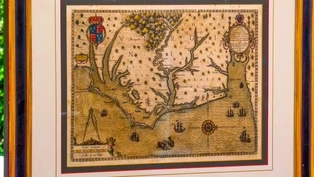
(laughs) GUEST: I brought a map that I inherited from my grandfather.
He is a map collector.
So I... we inherited his collection of maps.
He's just been traveling around the world, um, as part of his job.
He lived in Belgium and all across the United States.
So he's just been collecting maps that way.
Interesting you mentioned Belgium because the mapmaker is Theodor de Bry, who was actually born in Belgium.
Oh.
He's referred to as Flemish, but he was born in the town of Liège, which is now Belgium.
It's a hand-colored engraving printed in Frankfurt 1590.
It's the lower Chesapeake, Virginia and some of what is now North Carolina.
It's the first map to show the Chesapeake Village, which is what the Chesapeake Bay is named for.
North is here.
It's based on a manuscript map by John White.
This map features the Roanoke island, which is the first settlement in this area.
It was published in an atlas.
These atlases were made for wealthy people, uh, to a degree, explorers and, uh, people who were going to colonize the East Coast.
It's hand-colored at the time.
Sometimes these maps are colored later.
The maps of this area were based on this map for like the next hundred years.
Wow.
(laughs) So, so it's-it's a sort of a, sort of a key map.
Yeah.
It's the kind of map that someone who collects East Coast or maps of this area.
This is the-the crowning jewel for the collection kind of thing.
Wow, okay.
Do you want to guess a value or...?
$4,000?
I found multiple dealer prices and the range would be somewhere between $15,000 and-and $20,000.
Well, my grandfather knew what he was doing.
(laughs) Indeed he did.
Wow.
Yeah.
I just wish he was here to see it today.
For insurance purposes, I would probably insure it for $25,000.
GUEST: My mother-in-law got it signed, she was a bartender at the Buckskin Tavern in Fredonia, Arizona.
When the movie company came and came to film, they went down there every night and drank with her.
So they gave her this plaque when-when they left.
GUEST: So this is our vintage blue Snaggletooth Star Wars figure.
Me and my husband were thrift shopping one day.
We stumbled upon this figure in the back of a bin in boxes.
I think we got it for about ten dollars.
We knew it was worth way more.
Because we do love vintage Star Wars so much.
And so we're so excited, uh, to see what the price is on this.
GUEST: I brought, uh, an original Star Wars action figure collection.
They were owned by my parents.
They had a toy store in Las Vegas, Nevada in the late '70s, yeah.
(chuckles) Really!
So you're the child of toy store owners?
Yes, yes, yeah, me and my three sisters.
After the toy store closed, they were stored in their basement.
When did the store close?
Um, 1981.
It actually caught fire and, uh, they closed after that and didn't reopen.
So you're correct, they are original Kenner Star Wars figures.
Okay.
Right.
The first figures that hit the store shelves were in 1978.
Okay.
The film came out in '77, but Kenner was not ready to get product on the shelves for '77.
Okay.
So your first toys hit in 1978.
Your earliest piece here... Mm-hmm.
...is what we have, the Han Solo.
And the reason why we know that is a 1978 Han Solo is two things.
It's what we call a 12 back, as we see the 12 original figures... Oh, wow.
...that were first issued when Star Wars toys were released in 1978.
The other indicator that we know is in the upper left hand corner, you'll notice it's the only figure here that has the little white price sticker box.
Okay.
That's because for 12 backs and early 20 backs... Mm-hmm.
...Kenner had put a box, as you see, "price."
After the 20 back, Kenner decided to drop... Okay.
...the price box on their card backs here.
Mm-hmm.
Everything is from "Empire Strikes Back..." Right.
...except for our Han Solo here.
Okay.
And your earliest in terms of "Empire Strikes Backs" cards is what we call a 31 back.
The majority of the figures here all show 31 different figures... Okay.
...on the style.
Wow.
When it comes to Star Wars figures, condition is crucial because you can imagine... Okay.
...these were meant to be on a store peg, right?
Mm-hmm.
Right.
That's why seeing so many unpunched... Oh... Okay.
...is like an unbelievable sight.
Uh-huh.
When you were laying these out at the table, like bam, bam, bam.
Oh, wow.
I was like... (laughs) Usually you see two, three... Uh-huh.
...factory-sealed Star Wars figures.
Right.
To get an array of 18 like this was mind blowing.
Wow.
It's awesome.
For the figures laid out in the fan, we have some more common figures.
In their condition with yellowed bubble here, yellowed bubble, some creasing here.
Right.
Mm-hmm.
They're gonna be in that $250, $350, $400 range.
Not the biggest deal.
My favorites of the fan on the bottom are that you have two Yodas.
Okay.
Both with clear bubbles, unpunched, no price sticker.
Mm-hmm.
I would say, conservatively $700 to $1,000 each.
Wow.
Oh, my gosh.
But to bring it back a little to your Han Solo.
Okay.
He is known as a small head variant.
The earliest issues have the smaller head.
Okay.
Then Kenner had decided it looked a little strange.
Uh-huh.
And so there's a large head version of Han.
Condition is a little rough.
Some creasing along the top.
Mm-hmm.
And there's a crack along the bottom here.
Oh, okay.
It's a great entry level piece that would be in the... Yeah.
...$700 to $1,000 range.
Oh, my gosh, wow!
(laughs) That's great.
We get to 1980, "Empire Strikes Back."
This is the first time you're seeing Luke, Leia and Han in new attire.
Oh... okay.
New outfits compared to the traditional release.
Right All three figures... Mm-hmm.
...clear bubble, no damage, really.
And another important factor here, especially when you look at Leia, her pistol, her little gun accessory's... Uh-huh.
...still behind the factory tape... Wow.
...within the bubble.
Right.
These are beautiful figures.
For the three of them each... Mm-hmm.
...they would be in the $1,000 to $1,500 mark.
Wow.
Then we get to my man on the end, IG-88.
Mm-hmm.
In the lore of Star Wars, everybody loves bounty hunters.
Original "Empire Strikes Back," you see IG-88 in a weird little background seat.
You don't see much of him... Uh-huh.
...but he's just wicked cool.
He's the baddest droid in the galaxy.
Exactly.
Yeah.
IG-88, the best figure here, would be $1,200 to $1,800 at auction.
Oh, my gosh.
Wow!
(laughs) For the group of 18 figures, easily $8,000 to 12,000 at auction today.
Oh, my goodness, wow!
Who would have known?
(laughs) Not bad when you think they were $2.47 apiece.
Exactly, yeah, with the original price tags, yeah.
(laughs) Thank you, Mom and Dad!
That's awesome.
Thank you.
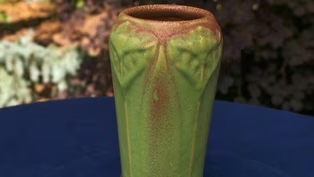
GUEST: I brought up a piece of Van Briggle pottery that I bought at an estate sale.
APPRAISER: What drew you to purchasing this particular piece, if you remember?
The-the metal base and the-the, uh, two-color glaze.
It was done in 1904, which is the year that Artus Van Briggle passed away.
He had moved to Colorado Springs just before 1900 to get better from tuberculosis.
His doctor wanted him to get to a better climate, something better than Cincinnati would have been for him.
He used to be with the Rookwood Pottery.
So he moved here and opened up his own pottery, and started developing his matte glazes and worked very much in the Art Nouveau style.
In 1904, Van Briggle showed at the St.
Louis Fair.
Any art pottery that was showing there was really bringing their very best.
It's either bronze or it is patinated copper to make it look like bronze.
Okay, so this piece was done by artist himself, you think?
Yes.
Wow.
He had help from one of perhaps three or four Japanese artisans that would have worked with him at the Rookwood Pottery.
Whenever you see metalwork on Van Briggle, it comes from one of these gentlemen.
What you don't see are these embedded stones.
You have opals here and you have amber.
There are probably a maximum known of three or four other vases... Oh, my God.
...that have stones embedded in the bronze.
We've done a lot of Van Briggles here on "Antiques Roadshow."
We've never done anything really like this.
(chuckling): Really?
Wow.
I have goosebumps.
(chuckling): I do, too.
Um... ...do you remember what you paid when you bought this?
I paid $275 for it.
Was that a lot?
It was quite a bit, but I love the piece.
If we were to put this at auction today, a very reasonable estimate would probably be $50,000 to $75,000.
(chuckling): Oh, my God!
You've got to be kidding me.
That's amazing.
(softly): Wow.
And, it wouldn't be... unlikely that we would reach $100,000.
Oh, my heavens, and I'm carrying it around in a bag.
(chuckles) Oh, my goodness.
This is one of the great pieces to have ever walked into "Antiques Roadshow."
Oh, my gosh.
Thank you so much.
It's beyond my wildest thought of what it was worth.
PEÑA: You're watching "Antiques Roadshow" PEÑA: And now it's time for the "Roadshow" Feedback Booth.
Overall, for me, it was really fun just to see, uh, it filming in all different places, (chuckling): seeing everybody tote around their-their heavy, uh, carts and stuff and just a really great day.
Thank you.
We've always been grandmas, so we're excited to come somewhere that embraces that.
(chuckles) Yes.
I learned that my Levi's poster from my father's, uh, men's clothing store sort of is the real deal, but laminating it isn't.
So, um, that's my advice.
And when he said he tried to get appraised, but they wouldn't give him five cents, so.
(both laughing) My grandfather was in an affair with a married woman and his... um, and, sorry-- and the husband, uh, burned down his house.
And, uh, my grandfather saved this from the house fire.
It's his parents' marriage certificate, um, from 1894.
This is a hymnal from my husband's fifth great-grandfather and his name was Caleb Bush.
And this Caleb is named after him.
And his hymnal is from 1848.
It has his name, um, and he was from Montrose, Pennsylvania.
BOTH: ♪ When you go to "Antiques Roadshow" ♪ ♪ Bring the best thing you can find ♪ ♪ Might be worth a million, probably just a dime ♪ ♪ "Antiques Roadshow" on PBS.
♪ Support your local PBS station!
PEÑA: Thanks for watching.
See you next time on" Antiques Roadshow."
Appraisal: 1590 Theodor de Bry Map of Virginia
Video has Closed Captions
Clip: S30 Ep3 | 1m 51s | Appraisal: 1590 Theodor de Bry Map of Virginia (1m 51s)
Appraisal: 1875 General Custer-inscribed Book
Video has Closed Captions
Clip: S30 Ep3 | 3m 38s | Appraisal: 1875 General Custer-inscribed Book (3m 38s)
Appraisal: 1877 Ralph Albert Blakelock Landscape Oil
Video has Closed Captions
Clip: S30 Ep3 | 3m 18s | Appraisal: 1877 Ralph Albert Blakelock Landscape Oil (3m 18s)
Appraisal: 1904 Van Briggle Vase with Opal & Amber
Video has Closed Captions
Clip: S30 Ep3 | 2m 54s | Appraisal: 1904 Van Briggle Vase with Opal & Amber (2m 54s)
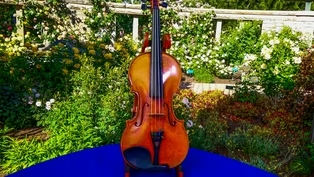
Appraisal: 1923 Ernst Heinrich Roth Violin
Video has Closed Captions
Clip: S30 Ep3 | 2m 11s | Appraisal: 1923 Enst Heinrich Roth Violin (2m 11s)
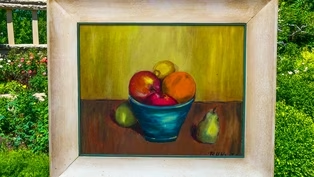
Appraisal: 1953 Rita Hayworth Still Life Oil Painting
Video has Closed Captions
Clip: S30 Ep3 | 2m 38s | Appraisal: 1953 Rita Hayworth Still Life Oil Painting (2m 38s)
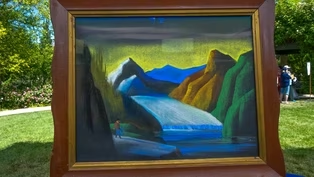
Appraisal: 1985 Dale Nichols Artworks
Video has Closed Captions
Clip: S30 Ep3 | 2m 5s | Appraisal: 1985 Dale Nichols Artworks (2m 5s)
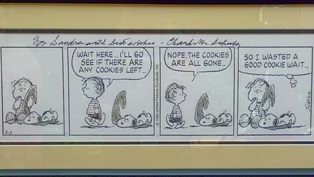
Appraisal: 1994 Charles Schulz-signed "Peanuts" Comic Strip
Video has Closed Captions
Clip: S30 Ep3 | 2m 20s | Appraisal: 1994 Charles Schulz-signed "Peanuts" Comic Strip (2m 20s)
Appraisal: Al Stohlman Tooled Leatherwork Picture
Video has Closed Captions
Clip: S30 Ep3 | 2m 52s | Appraisal: Al Stohlman Tooled Leatherwork Picture (2m 52s)
Appraisal: Carlisle Indian School Pennant, ca 1912
Video has Closed Captions
Clip: S30 Ep3 | 4m 11s | Appraisal: Carlisle Indian School Pennant, ca 1912 (4m 11s)
Appraisal: Chinese Jadeite & Diamond Brooch, ca. 1950
Video has Closed Captions
Clip: S30 Ep3 | 1m 9s | Appraisal: Chinese Jadeite & Diamond Brooch, ca. 1950 (1m 9s)
Appraisal: Diamond & Star Sapphire Jewelry, ca. 1940
Video has Closed Captions
Clip: S30 Ep3 | 2m 29s | Appraisal: Diamond & Star Sapphire Jewelry, ca. 1940 (2m 29s)
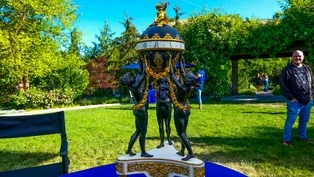
Appraisal: French Three Graces Clock, ca. 1890
Video has Closed Captions
Clip: S30 Ep3 | 2m 21s | Appraisal: French Three Graces Clock, ca. 1890 (2m 21s)
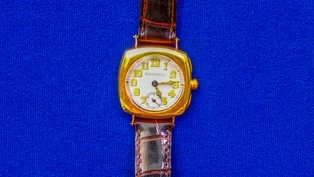
Appraisal: Patek Philippe Officer's Watch, ca. 1919
Video has Closed Captions
Clip: S30 Ep3 | 3m 11s | Appraisal: Patek Philippe Officer's Watch, ca. 1919 (3m 11s)
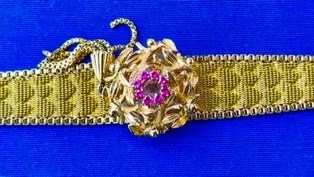
Appraisal: Swiss Gold & Pink Sapphire Bracelet Watch, ca. 1960
Video has Closed Captions
Clip: S30 Ep3 | 1m 4s | Appraisal: Swiss Gold & Pink Sapphire Bracelet Watch, ca. 1960 (1m 4s)
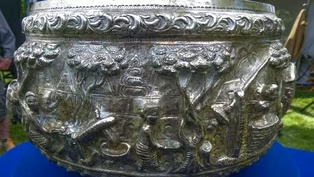
Appraisal: Thai Silver Repoussé Bowl, ca. 1950
Video has Closed Captions
Clip: S30 Ep3 | 2m 26s | Appraisal: Thai Silver Repousse Bowl, ca. 1950 (2m 26s)
Preview: Red Butte Garden & Arboretum, Hour 3
Video has Closed Captions
Preview: S30 Ep3 | 30s | Preview: Red Butte Garden & Arboretum, Hour 3 (30s)
Providing Support for PBS.org
Learn Moreabout PBS online sponsorship
- Home and How To

Hit the road in a classic car for a tour through Great Britain with two antiques experts.













Support for PBS provided by:
Funding for ANTIQUES ROADSHOW is provided by Ancestry and American Cruise Lines. Additional funding is provided by public television viewers.