
The ripple effects of extremism on a small American town
Clip: 6/2/2026 | 4m 32sVideo has Closed Captions
Journalist discusses the ripple effects of extremism on a small American town
Journalist Michael Edison Hayden has spent years tracking extremism in America. His new book, “Strange People on the Hill,” follows what happened when a far-right group moved its headquarters to a small town in rural West Virginia. Amna Nawaz spoke with Hayden about his book and the sharp divisions in American politics right now for our “Settle In” podcast.
Problems playing video? | Closed Captioning Feedback
Problems playing video? | Closed Captioning Feedback
Major corporate funding for the PBS News Hour is provided by BDO, BNSF, Consumer Cellular, American Cruise Lines, and Raymond James. Funding for the PBS NewsHour Weekend is provided by...
The ripple effects of extremism on a small American town
Clip: 6/2/2026 | 4m 32sVideo has Closed Captions
Journalist Michael Edison Hayden has spent years tracking extremism in America. His new book, “Strange People on the Hill,” follows what happened when a far-right group moved its headquarters to a small town in rural West Virginia. Amna Nawaz spoke with Hayden about his book and the sharp divisions in American politics right now for our “Settle In” podcast.
Problems playing video? | Closed Captioning Feedback
Where to Watch PBS News Hour
PBS News Hour is available to stream on pbs.org and the PBS app.
Providing Support for PBS.org
Learn Moreabout PBS online sponsorshipGEOFF BENNETT: Journalist Michael Edison Hayden has spent years tracking extremism in America.
His new book, "Strange People on the Hill," tracks what happened when a far right group moved its headquarters to a small town in rural West Virginia.
Amna Nawaz talked with Hayden for our PBS News podcast "Settle In."
And they spoke about his book and the sharp divisions in American politics right now.
Here's an excerpt of that conversation.
MICHAEL EDISON HAYDEN, Author: I mean, this is real life, as you mentioned.
And there is a story and there's a reason why we choose it.
And I think that the most important thing is like as a -- I mean, do we really -- do we really want to live like this?
I think it... AMNA NAWAZ: It's hard for you to talk about.
MICHAEL EDISON HAYDEN: Yes.
Unexpected.
Yes, it's like, do you really want to live like this?
I don't know.
My friend -- my friend growing up, he's a Republican.
And, like, he's my Mets-Jets type friend and stuff like that.
I spent an entire year not talking to him, because he was -- he supported Trump in the first election.
And I was going through all those threats.
And I was like: "I can't even talk to you, man.
I don't even want to talk to you."
And he said it was -- sorry.
AMNA NAWAZ: That's OK.
Take a minute.
MICHAEL EDISON HAYDEN: All right.
He said it was like the toughest year of his life.
AMNA NAWAZ: That you weren't talking.
MICHAEL EDISON HAYDEN: Yes, that I wouldn't talk to him.
And he also said another thing to me which I thought was really interesting, because he's really like -- I mean, he's just a -- he got into Republican -- he's a business guy.
You know what I mean?
He's not like -- he's not thinking about this stuff like that.
So I forced him to think about it in a totally different way.
And he's like, when I was a kid -- when we were kids basically, we used to play little league together some places.
Like, the president was just a guy on TV.
And that was true.
We didn't care.
We didn't have to care.
I didn't -- I just -- I knew there were two parties, and that was it.
And I was just like -- sort of questions, like, do we really want to live like this?
Do we want to have every day like we wake up and there's like a new thing that we have to go to war over?
I just feel like what has happened to our country since extremism became the dominant strain of politics has been so painful and is taking years off of people's lives.
And I just -- I can't imagine that people really want to live like this.
AMNA NAWAZ: What you share about your friend, though, is I think something a lot of people can relate to.
More and more Americans in particular will have folks in their lives who they disagreed with over politics.
Twenty years ago, it might have meant you just don't talk politics anymore.
And now it means broken friendships, broken families in some cases.
Are you and your friend reconnected again?
MICHAEL EDISON HAYDEN: Oh, yes, we're cool.
(LAUGHTER) MICHAEL EDISON HAYDEN: Really cool.
He actually -- like, he subscribes to a podcast I co-host.
(LAUGHTER) MICHAEL EDISON HAYDEN: We're reconnected.
But I do have people in my own family where it's -- where it's difficult, where there's certain things that we can't talk about.
Or they can't show the same -- like, if everybody in my family shares some article that I wrote and stuff like that, they can't chime in on it, because they're worried that it's going to -- this might go against President Trump and that -- so while I have got -- I'm on this team and so forth.
AMNA NAWAZ: I think the central question you asked there is, do we really want to live like this... MICHAEL EDISON HAYDEN: Yes.
AMNA NAWAZ: ... is something you address so well in the book too.
And the other part of it in our conversation and in the book is this idea that all politics, as we all talk about it, all politics is personal, right?
MICHAEL EDISON HAYDEN: Yes.
AMNA NAWAZ: It shows up in our personal lives.
MICHAEL EDISON HAYDEN: Yes.
And I think, how much of this is really about improving the material conditions of the people who support it and how much of this is really about stigmatizing or destroying imagined enemies, or maybe people think real enemies, but I would say imagined, that we have gone very far off track from what this political system is technically supposed to be?
We're supposed to be trying to figure out how to improve our material conditions.
How are you going to get people health care?
How are they going to get fed?
How are their kids going to get educated?
How are they going to get jobs when they get out of school?
So much of it is talking about sticking it to somebody else.
GEOFF BENNETT: You can watch that full episode of "Settle In" on our PBS News YouTube channel or wherever you get your podcasts.
DOJ scraps Trump’s ‘anti-weaponization fund’ after pushback
Video has Closed Captions
Justice Department scraps Trump’s ‘anti-weaponization fund’ after pushback from Congress (4m 58s)
News Wrap: Rubio tells Congress that Iran talks continue
Video has Closed Captions
News Wrap: Rubio tries to assure Congress that talks with Iran are continuing (4m 51s)
The toll of Trump’s deportation campaign on college students
Video has Closed Captions
Trump’s mass deportation campaign takes a toll on college students (8m 22s)

Ukraine seeks edge against Russian invasion with innovation
Video has Closed Captions
As Russia pounds Ukrainian cities, Kyiv tries to turn the tide with battlefront innovation (7m 33s)
Who is Bill Pulte, Trump’s pick for acting spy chief?
Video has Closed Captions
What to know about Trump’s controversial pick of Bill Pulte for acting spy chief (4m 31s)
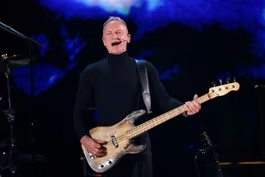
Why Sting continues to push his artistry into new forms
Video has Closed Captions
Why Sting challenges himself to push his artistry into new forms (9m 47s)
Providing Support for PBS.org
Learn Moreabout PBS online sponsorship New Episode
- News and Public Affairs

Today's top journalists discuss Washington's current political events and public affairs.

- News and Public Affairs

FRONTLINE is investigative journalism that questions, explains and changes our world.

 New Episode
 New Episode
 New Episode
 New Episode
 New Episode
 New Episode

 New Episode
 New Episode
Support for PBS provided by:
Major corporate funding for the PBS News Hour is provided by BDO, BNSF, Consumer Cellular, American Cruise Lines, and Raymond James. Funding for the PBS NewsHour Weekend is provided by...