
Campus Conversation
Special | 59m 49sVideo has Closed Captions
The film directors and guests discuss the Revolutionary War’s significance for young people today.
At the event held on November 19, 2025, filmmakers Ken Burns and Sarah Botstein joined experts Maggie Blackhawk and Christopher Brown in conversation with NYU professor and moderator Patrick Egan to discuss the significance of the American Revolution for young people and students today.
From
Problems playing video? | Closed Captioning Feedback
Problems playing video? | Closed Captioning Feedback
Episodes presented in 4K UHD on supported devices. Corporate funding for THE AMERICAN REVOLUTION was provided by Bank of America. Major funding was provided by The Better Angels Society and...
Campus Conversation
Special | 59m 49sVideo has Closed Captions
At the event held on November 19, 2025, filmmakers Ken Burns and Sarah Botstein joined experts Maggie Blackhawk and Christopher Brown in conversation with NYU professor and moderator Patrick Egan to discuss the significance of the American Revolution for young people and students today.
From
Problems playing video? | Closed Captioning Feedback
How to Watch The American Revolution
The American Revolution is available to stream on pbs.org and the free PBS App, available on iPhone, Apple TV, Android TV, Android smartphones, Amazon Fire TV, Amazon Fire Tablet, Roku, Samsung Smart TV, and Vizio.
Buy Now
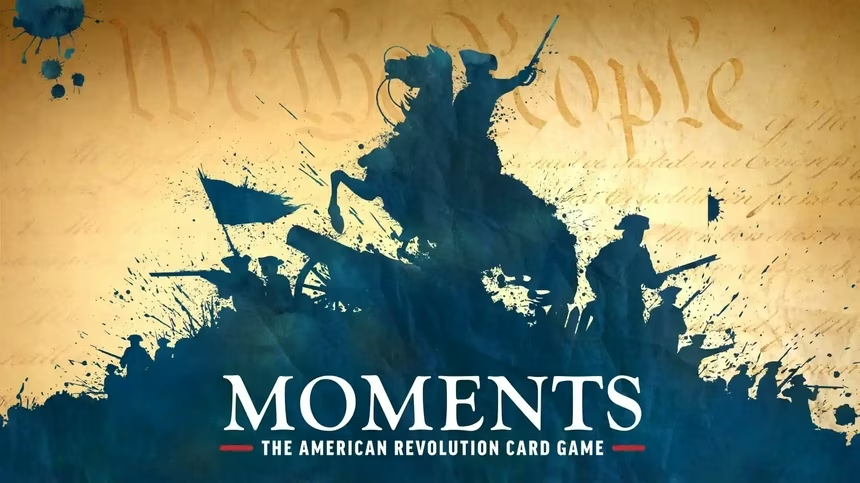
MOMENTS: The Revolutionary War Card Game
Use your knowledge of Revolutionary-era moments to build a timeline of real historical events.Providing Support for PBS.org
Learn Moreabout PBS online sponsorship(calming music) - [Narrator] From a small spark kindled in America, a flame has arisen.
Not to be extinguished.
(calming music) - We think about independence movements of the 20th century.
You don't always recognize the fact that the United States actually started that.
- The American Revolutionary Movement served as a model for freedom from oppression.
- America is predicated on an idea that tells us who we are, where we came from, and what our forbearers were willing to die for.
- Colonists said no taxation without representation.
The fear was, if we give into this precedent, what will they do in the future?
- Crisis changes people.
It gave different people different ideas about what they should be doing.
- It gave them a space to make this democracy real.
- The founders thought we can start over again.
We can begin the world anew.
The British objective is to suppress the rebellion, force them to acknowledge the authority of the king.
- Washington understands the war he's fighting.
He doesn't have to win.
He only has not to lose.
- He becomes quite eloquent in trying to persuade people.
We're all Americans.
- We see regiments flip individuals who are not carrying arms, doing essential labor, including women.
They are at the forefront of this movement.
- One of the most remarkable aspects is that you had such different places come together as one nation.
It mushrooms into a global campaign that touches Europe and all parts of the world.
- [Narrator] It so excites us that we are the product of a revolutionary moment where the world turned upside down.
- [Narrator] To believe in America is to believe in possibility.
(calming music) - Welcome, everyone.
(audience applauding) I wanna thank everyone who have joined us in person and our nearly 1200 people that have joined us virtually for what will promise to be a truly special evening.
My name is Kristie Patten and I serve as Counselor to President Linda Mills here at NYU, and I'm a faculty member at NYU Steinhardt.
We are thrilled to partner with PBS to bring The American Revolution Campus Conversation to you as part of our NYU in Dialogue Series.
This university-wide initiative is designed to strengthen our capacity to listen deeply, value diverse perspectives, and flourish together.
The American Revolution Series reminds us of the ideals that connect us even in challenging times.
Now more than ever, we must seek opportunities to engage across differences, to build bridges when disconnection feels easier, and to remember the values we share.
It is my pleasure to introduce our moderator for the evening, Dr.
Patrick Egan, NYU Professor of Politics and Public Policy, and the Inaugural Director of the newly announced as of yesterday, Berkeley Institute for Civil Discourse and Civic Solutions, which will be engaging students, scholars, and leaders with divergent perspectives to tackle the most pressing civic challenges of our time.
I'll turn it over to Patrick to introduce our esteemed panelists.
(audience applauding) - Thank you, Kristie.
It is so nice to be here with a great audience and our great panelists, and a great film to be discussing tonight.
Again, I'm Pat Egan, and it is my honor to be your moderator tonight.
And let me very briefly, all too briefly introduce each of our panelists.
First and foremost, we have Ken Burns, who's been making landmark documentary films for nearly 50 years.
From "The Civil War" and "Baseball", to "The War" and "Country Music", his films have helped shape our understanding of American history.
Welcome, Ken.
(audience applauding) To my immediate left is Sarah Botstein, who has been a producer with Florentine Films for more than two decades, with acclaimed titles such as "The Vietnam War" and "Hemingway".
Before "The American Revolution", she co-directed "The U.S.
and the Holocaust".
Welcome, Sarah.
(audience applauding) It's a pleasure to introduce my colleague, Maggie Blackhawk, here from NYU, a Professor of Law at the NYU School of Law.
She is both a scholar and teacher of federal Indian law, constitutional law, and legislation.
Welcome, Maggie.
(audience applauding) And last but not least, Christopher Brown is a Professor of History up at that other school uptown, Columbia University, with a principal focus on Britain and the British Empire in the 17th and 18th centuries, quite relevant to the topic tonight.
Welcome, Chris.
(audience applauding) So in addition to the great clip we saw a minute ago, let's begin our conversation with another clip that opens episode six, the final episode, which will be broadcast on PBS this Friday evening.
(calming music) (crows cawing) - I think to believe in America rooted in the American Revolution is to believe in possibility.
That, to me, is the extraordinary thing about the patriot side of the fight.
I think everybody on every side, including people who were denied (guns firing) even the ownership of themselves, had the sense of possibility worth fighting for.
- The American Revolution changed the world.
It's not just about the birth of the United States, it has ramifications across the globe.
So studying the American Revolution, understanding it, and putting it in a global context, I think is vitally important for us to understand why we are where we are now.
- So we've just watched two terrific clips really from the film.
And in these clips, we hear many compelling reasons for why the American Revolution is a signature event in world history, not just American history, but world history, and why understanding these ideas, the ideas that inspired the Revolution, remains key to comprehending our present moment worldwide.
Ken, you've made films about so many aspects of American history, including the Civil War, jazz, prohibition, and as we said earlier, baseball.
So in addition to the fact that 2025 marks a total of 250 years since the start of the Revolution, which if I pronounce this word correctly, is the semi-quincentennial.
Thank you.
What drove you to devote so many years to the making of this film and why did you make it now?
- There's no now.
We started nearly 10 years ago in December of 2015.
Barack Obama still had 13 months to go in his presidency.
Nobody was talking 250.
Nobody thought about 250 as anything.
It's only been in the last year and a half as we've been moving to finish this film, has it begun to sort of have a contemporary sort of resonance that people have us saying, "Boy, your timing is perfect."
We were interested in understanding our origin story in all its complexity and felt that it has been sort of encrusted with the barnacles of sentimentality and nostalgia, and that we have excluded more than we have included in it.
Oh, that's a message from- - From above.
- From above.
From above, we'll just say from above.
And so it was our intention over that course of time to find the images, to find the people.
So we feel that we've removed some of the opacity from the boldface names, but more importantly, introduced you to dozens, scores of characters that are new to me, and I think new to just about everybody who are part of the story of the American Revolution.
And as to its importance in world history, this is, Maggie and I were talking about this before.
This is the fourth or the fifth global war over the prize of North America.
That prize is, of course, the land.
That land is, of course, already occupied by people, and that's a dynamic that is never incorporated.
So you get an, A, usually in eighth grade, if you say taxes and representation, but you really wanna lead that off by saying Indian land, because it was so many factors in that, that we've needed to center that, center half the population, women, the 500,000 out of 3 million who are enslaved are free, African Americans in the 13 colonies, and understand not just those Native peoples that are coexisting, that have been assimilated, but those nations, individual nations to the West that are as distinct, as say, France is from Britain.
And to make those distinctions is to try to tell a different kind of story of the American Revolution.
The punchline is still the same.
Before the Revolution, people, most people were subjects under authoritarian rule.
After the Revolution, there were a few people, white men in the Eastern Seaboard who were citizens, and it was a big deal.
And as Chris heard, and that first clip is not from the film, that is an edited by PBS sort of teaser for the film.
What you just saw is the opening of our last episode.
But as you heard, you know, we started this anti-colonial business, and it's sometimes hard in the position that we find ourselves in.
We're also an empire from the very beginning.
Americans like to pride themselves on not being engaged in empire until maybe the Spanish-American war, and then only tentatively, but we didn't call it the Eastern Seaboard Congress, or we didn't make George Washington the head of the Eastern Seaboard Army.
We called it the Continental Congress and the Continental Army.
We knew where we were going, and that is a huge part of the dynamics of this story.
- Yeah, I'm really struck by your, you know, insistence on avoiding, or at least minimizing the nostalgia and sentimentality.
I think that's something that a lot of people, especially a lot of young people kind of are a little repulsed at when they think about American history in that way.
And actually, that leads me to a question for you, Sarah, which is, you know, in this day and age, we are really exposed to the word revolution so much, including in ads for cars and sneakers, and I even saw one for razor blades the other day.
So, you know, Americans, and especially young people might be forgiven for being kind of numb to the importance of this event that we refer to as the American Revolution, even though it unfolded over eight years, it claimed as many as 100,000 lives on all sides, and gave birth to what would ultimately be called the United States of America.
So, you know, generations of people, from abolitionists to suffragists and beyond have seen in the American Revolution, the foundation for social change.
Is that still relevant today with all of its ambiguities, and, you know our hesitations?
And what lessons especially can young people find in this founding story?
- What a great question.
I think Maggie is probably more equipped to answer this than me, but I think part of what you're getting at, at least for me, is one of the things I take from the American Revolution and spent the last many years thinking about this time period is, it's really a great underdog story.
It was unlikely that we were gonna win.
It's almost kind of absurd that we end up winning, and we don't do it alone.
We do it in some really interesting ways that we will talk about today as well, that it ends up being a global war.
We really needed our French allies.
It turns into a global conflict, which Chris can talk about.
And yes, it is a revolution that in its moment, is speaking to a small segment of people that Ken was just talking about, but it says the word all in our declaration, which I think is a important thing for us to understand how people, me, Maggie, Chris, all kinds of people have, over the last 250 years, use that as an inspirational document to do something important when it comes to a people's republic and a working democracy.
And the ways that we have done well and not well are bruises and our scars.
I think for young people to go back and really understand that, and not just do the mythology is helpful, and I think inspiring and makes the history way more interesting and relevant.
- If I could just add.
- Please.
- Something to what Sarah said, and perhaps the end of the Second World War is ancient, ancient history to many people, but on September 2nd, in 1945, the Japanese surrendered on the USS Missouri and Tokyo Bay unconditionally.
At that same day in Hanoi, and this is a film that Sarah and I worked on for 10 and a half years on "The Vietnam War", that same day, September 2nd, Ho Chi Minh declared Vietnamese independence, taking advantage of the chaos of that moment.
He was, he quoted Thomas Jefferson, "We hold these truths to be self-evident "that all men are created equal."
Standing next to him were two OSS men.
This is the military's version of what will become the CIA.
Unfortunately, within a few weeks, the State Department has reeled them in and said, "No, no, no, this guy's our enemy."
But he was then, our friend, we'd already saved his life, those same OSS men had parachuted into Northern Vietnam and saved his life, he was dying.
And that document, for all the vagueness, the vagueness has actually been an aid to people.
And I think that's an important part of your question to Sarah.
It is as fresh, I mean, you know, besides "I love you", which is the number one sentence in the English language, this is number two.
- Well, yeah, all the ambiguities, the ambivalences I think are so important to acknowledge and understand, and still not discard the whole thing because there's a lot to be grasped and has been grasped by peoples ever since then.
So let's turn to another clip that's gonna from episode three that actually aired on Sunday night.
- [Narrator] General Gage was given a new title, Governor of Massachusetts, in addition to Commander-in-Chief, and a new mission to enforce the new acts and Boston's resistance, and demonstrate to all the colonies the folly of defying their king and parliament.
Gage and four fresh regiments set sail for Boston in mid-April, 1774.
- The British government sees this as a police action, that if they could punish Boston and shut down Massachusetts, contain the rebellion, that the other colonies would get the message, and that order could be restored with some grumbling.
I think the British government is genuinely surprised to see the ways that the other 12 colonies rally to Massachusetts's cause.
- You are not gonna have an American Revolution unless you have Virginia on board, and the leaders of Massachusetts understood this.
It was not going to be easy.
There were deep prejudices between the two regions because of the differences in their ethnic mix and in the nature of their cultures.
And they hadn't previously had any kind of trust for one another.
- [Narrator] But in Virginia, the House of Burgesses declared a day of fasting, humiliation, and prayer in solidarity with the people of Massachusetts.
And when the royal governor, Lord Dunmore, declared the very idea and insult to the king and dissolved the assembly, its members reconvened in Williamsburg's Raleigh Tavern.
The Virginians warned that an attack made on one of our sister colonies is an attack made on all British America, and called for a continental Congress to meet in Philadelphia in September to see how the colonies might resist together.
All the 13 colonies except Georgia, where people were afraid to lose British protection in the event of an Indian war, agreed to take part.
The Prime Minister's effort to intimidate the other colonies by punishing Massachusetts had instead begun to unite them.
- [Narrator] Lebanon, Connecticut.
Yesterday, the bells of the town early began to toll a solemn peal, and continued the whole day.
The shops in town were all shut and silent.
Our brethren in Boston are suffering for their noble exertions in the cause of liberty, the common cause of all America, and we are heartily willing to unite our little powers for the just rights and privileges of our country.
- Just a correction, that's from the first episode, which aired on Sunday night.
So, you know, after watching this clip, you kind of think, you get these blue states and these red states, and they sort of come together in a surprising way.
And one reaction is that the American Revolution was sparked in part by a great miscalculation on behalf of the British about the patriots' unity.
So in this clip, you also hear something that doesn't immediately come to mind when many students learn about the British colonies in America, their ethnic and cultural diversity.
Professor Brown, to what extent do you think that in 1775, the British just fundamentally understood, misunderstood the world, consisting of colonists, indigenous people, and enslaved people that had emerged in the 150 years or so since the establishment of the first colonies?
- It's a good question.
The British government did not understand a lot about North America, but one thing they did understand was the variety of people that were there.
And this was part of the reason why they were so surprised by the way that those colonies came together.
You know, there are commentaries in parliament immediately after Bunker Hill where there are politicians saying, "Okay, there are English, and Scots, and Irish there, "but there was also French, and Dutch, and German, "and, you know, countless Germans, "and Indians, and Africans."
This doesn't seem like a place that's gonna cohere as a nation.
So one reason why they actually underestimated the 13 colonies coming together, because they thought all of those differences, those ethnic differences, religious differences would stand in the way of forming a nation.
And for good reason, because there weren't any nations in Europe that had that kind of broad mixture of people, and political units, to a large degree, were based on history, they're based on religion.
They were based on, you know, ethnicity, nationality.
So the idea that you'd have a nation that's forged out of all these different people was not something the British government fully prepared for.
There's also the bit also that they were not used to working together.
There had never been a continental association in any kind of meaningful way, so that part they didn't get.
- Yeah, it seems sort of an unexpected turn, and one where the British just didn't see all of this coming, and, you know, this unexpected unity that emerges in the wake of these acts.
- Yeah, no, I mean, that's right.
And they continue to, well, so they also recognize that there's divisions within each of the individual colonies, right?
And they're focused on the loyalists, the king's subjects who are not in rebellion.
And one way they understand the need to send soldiers and to begin to crack down on the rebellion is to protect his majesty's subjects in North America who are not in rebellion, right?
So it's also a bringing a show of force is also understood as a way of restoring law and order.
And we don't think about it that way.
We think about the patriots as patriots rather than as rebels.
But from the standpoint of the British government, these are lawbreakers, right?
These are the folks who threw the tea in the harbor.
These are the folks who are harassing their neighbors, right, who are not allowing them to serve as majesty's government.
- It's interesting too, I think maybe I've heard Ken say this elsewhere.
You know, some ways we should think about this as the first Civil War as much as the American Revolution.
- That's a big problem, is that it is a civil war.
It's actually a revolution, and the first one that was about ideas.
And it's a bloody, bloody civil war, as just as Chris has described, and it's this global conflict, and they're all superimposed on one another, and that's what's really, and it's the enlightenment.
So you have these ideas, and there's a wonderful moment in the film when Chris says, "These aren't just arguments between British people anymore.
"These are about transcendent liberties "that we're talking about."
And it's actually the combination of the bigness of the ideas and the escalating rhetoric that adds to the tinderbox that Chris has described so well, which is, you know, it happens today.
Everybody's exactly the same.
They have buckles on their shoes, and hoes and waistcoats.
- I agree with that.
There are no photographs of them, but the degrees of venality and virtue are exactly the same as today.
And what you have is the Brits saying, "You are becoming more rebellious, "and we are saying you are becoming more tyrannical."
And the Brits become more tyrannical, and we become more, you know, rebellious, and we destabilize the whole situation.
Rhetoric becomes action, and then action, and finally, as people say, the genie's out of the bottle, we can't stop it.
- That's really, it's a whole different way of thinking about that time, at least for somebody like me.
So the rhetoric is kind of key to what we're gonna talk about next, because what is perceived by the American colonists as an overreach of power by the British sets in motion this movement that leads to the signing of the Declaration of Independence two years later on July 4th, 1776.
And as we all know, the Declaration was written and signed only by men of European descent, about a third of whom were slave owners.
Nevertheless, as this next clip shows, its ideas were immediately taken up by those excluded from its promise.
(calming music) - [Narrator] The Declaration of Independence was formally ratified on July 4th, 1776.
Just 1,337 words that ended with the phrase, "We mutually pledged to each other our lives, our fortunes, "and our sacred honor."
When Rhode Island delegate, Stephen Hopkins, who had palsy, signed the document, he is said to have remarked, "My hand trembles, but my heart does not."
It was first read aloud to a cheering crowd in the State House yard at Philadelphia on July 8th.
It was soon published in 29 newspapers and greeted by parades and celebratory volleys of gunfire throughout the newly United States.
(guns firing) - [Narrator] Boston, Massachusetts.
When Colonel Crafts read the proclamation, great attention was given to every word, and every face appeared joyful.
The King's arms were taken down from the State House, and every vestige of him from every place in which it appeared and burned in King Street.
Thus ends royal authority in this state, and all the people shall say, "Amen."
Abigail Adams.
- [Narrator] On July 9th in New York, General Washington ordered the Declaration read to his troops.
Hearing the list of George III's alleged crimes so angered the men, that a number of them raced down Broadway to Bowling Green, tied ropes to the statue of the King, and pulled it to the ground.
Pieces of the shattered statue were dispatched by wagon to Litchfield, Connecticut, where patriots melted the gilded lead into bullets, 42,088 of them.
Far to the north at Fort Ticonderoga, the battered survivors of the failed invasion of Canada were assembled so that the Declaration could be read to them.
When it was over, an eyewitness said, "The language of every man's countenance was, "now we are a people.
"We have a name among the states of the world."
Among those who heard the Declaration read at Ticonderoga was Private Lemuel Haynes, a free African American from Granville, Massachusetts.
He understood right away what it might mean for people like him, and wrote an essay entitled "Liberty Further Extended".
(dramatic music) - [Narrator] Liberty is a jewel which was handed down to man from the cabinet of heaven.
It had pleased God to make of one blood all nations of men for to dwell upon the face of the earth.
And as all are of one species, therefore we may reasonably conclude that liberty is equally as precious to a Black man as it is to a white one, and binded equally as intolerable to the one as it is to the other.
- The Declaration of Independence was deeply significant to people at the margins.
It gave them a space of moral argument.
It gave them a space of legal argument that could be leveraged to reshape United States democracy and become a part of it.
And we are going to push every lever we had to be able to make this democracy real, and to make these visions, these values real rather than hypocritical.
(audience applauding) - So that's "Liberty Further Extended".
That's the title chosen by Lemuel Haynes for his essay, invoking the Declaration of Independence to call for the end of slavery.
And, you know, in some sense, Haynes was doing what happens a lot on, say, social media today, which is calling out those in power for their hypocrisy and urging them to live up to their professed ideals.
So Professor Blackhawk, in this clip, you say, and inspiring us all, that the Declaration is a tool leveraged by people at the margins over and over again to reshape US democracy, and really world history.
Can you tell us more about how the words written by the few have become sources of inspiration and power, really, for the many?
- No, it's a wonderful question.
We've talked a bit about the language of the Declaration being ambiguous, archaic, moralistic, even racist in its 27th grievance that includes a claim about merciless Indian savages.
But the document beyond rhetoric was itself a legal argument.
It was a claim by the colonists that because of the tyranny of the king, because of those grievances, and because the government that they promised, one of equality of all men, that they would uphold the laws of nature and of nature's God.
And because of that, they had a claim to an independent sovereignty.
Because they were going to hold those values dear, they had the right on the international stage within the law of nations to have other nations recognize them as sovereign.
And they were terrified.
It was an experiment.
They were arguing vigorously to gain the recognition of these other nations to have all the powers that they wanted to claim as an independent state from Britain.
So that legal argument and legal document was seized very quickly by those on the margins, including free Black Americans, enslaved Black Americans, Native Americans, to start to reshape and ensure that the legal claim that was made for that government to be equal, to be free, especially of tyranny, would be true.
And so even just six months after the Declaration of Independence, Prince Hall, whom political scientist, Danielle Allen, refers to as the forgotten founder, files a petition to abolish human enslavement based on the principles of the Declaration into the Massachusetts legislature.
And again, and again, and again, you have free Black Americans, Native Americans drawing upon those legal principles, those arguments that the Americans are now claiming they hold dear, to ensure that the government that they build will at least aspire to those principles, if not actually adhere to them.
- It's also this amazing thing where because of the diversity that we talked about a minute ago, these founders could not explicitly anyway, base the founding on some notion of ethnicity, you know, like compared to, say, France, or, you know, something like that.
And so I just sort of wonder if that's also part of the ambiguity of the document that gives way open to marginalized people to use it to their behalf.
- You know, it's interesting.
So racialization is actually a complex historical phenomenon.
It started with religion.
Those were non-Christians were savages who were excluded.
And the racialization, of course, came and codified when those savage people began to convert.
And so instead, we wanted a biological basis for hierarchy after that, very conveniently.
But before that, we had religion, and it was non-Christian faiths.
And so savage peoples would not be able to have recognition in the same powers within the law of nations.
But interestingly, so again, the Declaration was a legal argument, but it was also a seizure of law from the King.
So rather than having the law of the world handed down from God or from the King, it was one of the, I think one of the most profound early moments of natural law being declared by humans.
We say what the law is.
We say what justice is.
We don't wait for God or the King to tell us what that is.
And so from that, those people who were, who had been declared savages under God's law or the King's law began to argue for civilization, for recognition as civilized, to say that that classification of us as non-civilized, as non-Christian, as unavailing of those principles of equality that you hold so dear is wrong.
It is an inaccurate portrayal of the law.
And because you have seized those reigns and said, "From here on, we get to have a law "that's declared by people "that's through argument, and reason and discussion, "evidence and expression rather than through power."
Then they had a moment to be able to try and reframe those categories, not around race, but around civilization and around principles.
- The American patriots were in a bind in terms of their political language, because it wasn't immediately obvious that they would turn to the argument from natural rights.
And they were clear, they were aware that they were opening a door, the men who, Thomas Jefferson and the men who wrote the Declaration of Independence and the ones who signed it, they were aware that by saying we hold these truths, that they were providing an instrument for those that they did not intend to be part of the polity, be part of the full have political rights.
They were aware of the fact that they were opening that door.
They needed to do it though because they weren't getting anywhere by insisting on their rights as English subjects.
From the Stamp Act crisis, right down into the, really right up into the Boston Tea Party, a lot of the argument is taken, is made on the grounds of what are the rights of English subjects?
And the position of the Crown is, well, the right of the English subjects is to be subject to parliament.
And so there's a kind of a shift where you say, "Okay, let's stop with the English subjects part, "and let's just talk about natural rights, "things that are prior to the British government, "prior to monarchy, "on which government is grounded in natural rights, right?"
So they go to that place in part because the other arguments were starting to seem inadequate, also because they weren't all English.
And so talking about British rights and British was also had that problem to it.
- This is a huge part of it, and I'll add one little short story to this.
When the Declaration is first read aloud at the Pennsylvania State House there, just a few days after the Declaration was signed, it is heard by a nine-year-old free Black kid named James Forten, and he does not for a second believe that these self-evident truths don't apply to him.
He knows they apply to him.
So the vagueness of the language, the moral arguments, the stretching out from British laws into, as you said, universal laws, this is a big deal for him.
He joins the Revolution, he fights, he's captured, he's given a chance to have a cushy kind of, go back to England with the son of the ship captain, and the captain, he says, no.
He's still, he's a young boy still.
He's sent to one of the worst, if not the worst prison ship that's floating in the East River.
Doesn't die, gets home, works in the merchant marine, makes a fortune, and funds William Lloyd Garrison, the liberator.
His granddaughter, Charlotte, at the beginning of the Civil War, comes down to the sea islands in Georgia, and works with, you can't say emancipation, but recently freed Africans in Georgia to help them adjust to a new life.
So you begin to see that the vagueness of the words, and as Sarah said, the word, "all", is just like "Gideon's Trumpet".
It may take a while, but people on the margins, as Maggie said, are gonna drive a truck through the asterisk.
- It's great.
I mean, one of the kinds of ideas, they sound so normal and natural to us now sitting here in 2025, the idea that we're not subject to a king, that we get to decide things for ourselves, all those things.
But the fact that that's revolutionary a time is important to note, and it's become part of our bread and butter.
Let's go to one last clip.
We're gonna return to the gap between ideals and reality.
This is gonna be broadcast, I think, this evening on PBS, and it's about the recruits who made up the Continental Army in the final hardest fought years of the war, and the promises that were made to them in return for joining the force.
(dramatic music) - [Narrator] The next will be a trying campaign, and as all that is dear and valuable may depend upon the issue of it.
Let us have a respectable army, such as will be competent to every exigency.
George Washington.
- [Narrator] Spring was coming.
Armies would soon be, again, on the move, and Washington wanted to be ready for whatever the British were planning next.
Congress had come back to Philadelphia, but while they were in exile in Baltimore, it had become clear that expecting delegates to make instant decisions about the battlefield was impractical.
They had voted to grant General Washington total control over his army for a period of six months, and authorized him to imprison without trial suspected loyalists or anyone who refused to supply his army.
Some delegates had feared that affording Washington such powers would make him a dictator, betraying the principles for which they were supposed to be fighting.
General Nathanael Greene sought to reassure them.
- [Narrator] I can see no evil nor danger to the states in delegating such powers to the General.
There was never a man who might seem more safely trusted, or a time when there was a louder call.
(calming music) - [Narrator] Most of Washington's new recruits signed on for three years and a $10 bonus.
But those who signed up for the duration of the war were promised a $20 bonus, and 100 free acres of Indian land when the war was over.
- When we think about what was offered to the continental soldier, Indian land at the end of it all.
That land hasn't been taken, ceded, bought.
That land is still Indian land, right?
It tells you that the entire Revolution is premised on the future possibility.
- [Narrator] These soldiers were different from the men who had rallied after Lexington and Concord.
Most of them had been farmers and artisans, propertied men with taxes to pay, creditors to appease, crops to sow and harvest.
From now on, the Continental Army would be made up predominantly of the poorest of the poor, jobless laborers and landless tenants, second and third sons without hope of an inheritance, debtors and British deserters, indentured servants and apprentices, felons hoping to win pardons for their service, immigrants from Ireland, and immigrants from Germany, or their descendants who had never learned English.
John Adams had worried that only the meanest, idlest, most intemperate and worthless men in America could ever be persuaded to serve more than a year.
But victory would be impossible without them.
When patriotic speeches and free rum failed to attract enough recruits, some states instituted drafts.
Names were drawn from a hat.
Married men were exempted.
Property draftees wanting to avoid service could hire substitutes at fees to be negotiated with their replacements.
Some towns managed to avoid sending any men to war by paying men from neighboring villages to go.
South Carolina advertised for vagrants and idle disorderly persons.
Thousands of African Americans, enslaved and free, served alongside whites in units from New England all the way south to Georgia.
Some volunteered, some were drafted, many stood in for their gun-shy enslavers.
Connecticut and Rhode Island would later promise enslaved recruits their freedom when the war ended.
From 1777 onward, the American Revolution begun in part to defend the interests of property owners, would be fought mostly by men who owned little or no property at all.
- Well, I wanna turn this back to Ken and Sarah.
You know, to me, and I'm sure to a lot of people, the audience watching that clip, it's sobering.
Aristocrat John Adams looks down on these working class guys being relied upon to make the Revolution victorious, and promises to these recruits of native land and emancipation from slavery, are really stark reminders of the government condone violence and coercion and domination by the state, that in some sense, performed the dirty work required to achieve the Revolution's lofty goals.
So Ken and Sarah, clearly you did and wrestle with these contradictions in the film.
It seems like a really difficult task.
How did you do that and do you think you were successful?
- Hmm, well, that sort of gets at the heart of why we make these films and what we do, and we really rely on the wonderful and brilliant minds like Maggie and Chris.
I mean, when we started the film in our early discussions with the scholars, some of these principles that are in, or these ideas in that scene were made clear to us.
If you're gonna tell the story of the American Revolution, you have to deal with the question of land, you have to deal with the question of how long the war takes and who fights it?
And I mean, I remember when we first understood that land was part of how people would be paid to serve in the war.
I mean, really, we had to fact check that ourselves several times.
I think, I will say that for me, I grew up in upstate New York, I went to good schools, I feel like I'm a pretty educated person.
The fact that I did not understand the piece of this story is I'm embarrassed about that, and I hope that the film will change our country's conversation about what was really at stake and what are the animating principles behind why the war was fought, and good, bad, and ugly.
So I do think that we as a nation have, I think, a much better kind of general understanding about race and slavery than we do about Native American history, and the piece of this history, which is land.
So I don't know, it's not for me to say whether we've succeeded.
I think we are really interested in complicated history, and good history, and you know, taking history and making a piece of art out of it.
So those are really serious questions.
They're the principles of our editing room.
They're what get us up in the morning, and it's really, really complicated.
- The thing to appreciate is contingency, and the question itself forms into kind of binaries that don't exist, didn't exist then, kind of don't exist now.
They're simple, argumentative kind of containers that don't let us appreciate the fact that no one is completely monolithic.
You're absolutely right, John Adams is an aristocrat of a certain kind, of a new American version of it, and doesn't see he's terrified of the frustration, as he says, of all ranks of people if women should, God forbid, though his wife has been yelling in his ear about it, want rights, or that, you know, various people who don't have a farthing don't want it.
But I think the most important thing is the way that we, because we are where we are, and we know how it turns out, none of them knew how it turned out.
As Rick Atkinson says to us many times, quoting the late historian, David McCullough, there's no foreseeable future in the history.
Nobody knows.
George Washington doesn't know he's George Washington, other than that's his name.
He doesn't know there'll be a dollar bill, and a quarter, and a big pointy thing, and a national capital name for him in a state on the other side of the continent that is named for him, and in every other state, a county or a town, right?
He does not know that.
So in all cases, there is this sense of making it up as you go along, and just the sheer seeming chaos of human events.
So we like to speak about our democracy, or at least the aspirations for democracy, but this is not in any way an intention of the Revolution, it's a consequence of it.
And so we can look at it in a purely binary class way, that scene, or you can look at it as all of a sudden, there are other people breaking through, and they're going to need something at the end of this.
And so Pennsylvania, first of all, says, "Okay, not men of property."
It's just anybody who's white, and male, and 21 years old, you can vote, right?
This is a big deal in Massachusetts, as Maggie is suggesting, there is a woman, an enslaved woman who is beaten by her owner, and she leaves, and she says that the Massachusetts Constitution says that all people, all men are created equal.
I am a human being, I am now free.
And the Massachusetts Supreme Court says, "Yes, you are."
And so all of a sudden, there's just a little bit of a chink in the armor.
And this is the story of human behavior.
Like George Washington and Thomas Jefferson knew that slavery was wrong, right?
And there's a wonderful scene that precedes the scene we saw with our friend and their colleague, Annette Gordon-Reed, you know, where, you know, she says, "How could you keep doing it "if you know it's wrong?"
And then she goes, "Well, that's the human question for all of us."
She's not taking Thomas Jefferson off the hook.
She's putting the rest of us on the hook for our own inconsistencies, our own hypocrisies.
And that's where returning this to simple binaries is a kind of fool's errand, because you forget the human dynamics of it that are always going to be, as Sarah says, complicated.
- I'll just add to that.
You know, what's so striking about that particular clip to me is the men who are mobilized, you get a different idea of why they're fighting.
And perhaps ideals have something to do with that, but also future opportunity has something to do with that.
Lack of opportunity in the here and now has something to do, in their present day, right?
Hay has something to do with it.
And sometimes, you know, my brother's going, my cousin's going, I'm going too.
Neighborhood has something to do with it, which does not mean that ideals aren't part of it too, but in any collection of, say, take a battalion of a couple hundred people, right, there are men there for a variety of different reasons.
So I think it's really important when we're looking back and trying to make sense of why did people fight, right?
To think about what we know from our own lives, which is that motives are very complicated.
The choices are very complicated.
And even what we say, the reasons that we state for why we're doing something may not be the only reason why we're doing it.
- Class is a piece of the story of the American Revolution too.
- Well, we are close to time.
I wanna close with a question that I hope will speak to many of the folks who are with us tonight and those watching around the country who are in college.
Welcome to you, beaming in from around the country, around the world.
So young people in this generation are on the forefront of movements, and that are both progressive or conservative, both from the right and the left, who continue to reinterpret and reinvigorate what America means for all of us.
But my sense is that for many young people, the events and ideas of the Revolution feel kind of distant and hard to access, and you all have done an amazing service in making these things more accessible, more relevant for all of us.
Are there things that any of you, any of the four of you would say to young people who are skeptical about the Revolution- sorry, the relevance of the American Revolution in their lives, their concerns and their hopes in the present day.
Anything that you wanna say about the relevance of this?
- I think we're in a really difficult, I guess this is a euphemism, a difficult political moment, a difficult moment to celebrate national history.
And in essence, we've come to a space in our discourse where we either want a celebratory past or no past at all.
We don't know what to do with the complexity.
We don't know what to do with the nuance.
And so when you look at and call out one of the central causes of the Revolution, one of those motivations being the fact that Britain was keeping the colonists from invading over the 1763 Proclamation Line into what was Indian Country, an area governed by, not just Indian land, but governed by Native peoples, with a wholly different view of the Constitution, and government, and law, and that they wanted to vanquish that.
They wanted to end that because they wanted something more.
They wanted their views to dominate.
And I think looking at that is difficult when you end up on the winning side of that national quest.
But I think that there are two big lessons there.
One is that our past is full of failure, and those failures are there not to make us suffer, not to make us feel guilty, but to teach us how to be better, all of us, not just one group of people, but all of us, because that is what humanity looks like when it fails.
That's what humanity looks like when it does things that are unjust.
But the second lesson is one that I think has hope in it.
It's that those individuals who fought a Revolution to take, and dispossess, and undermine the governments of other people, to essentially dispossess a continent, those people aren't us.
The democracy that they built isn't theirs, it's ours.
It's all of the people that filled those lands, all of the people who resisted that expansion, who made that democracy more real and more connected to those values than the colonists who wrote them down.
And so the aspiration isn't one where we get to see ourselves or find our ancestors in the signatories of that document, but to find our ancestors and the people who upheld the vision of the document, the values of the document, the law of that document, and are still struggling and fighting to uphold those values today.
(audience applauding) - All I can say is amen.
Thank you.
Other thoughts about what we'd like young people to know or take away from the film?
- I mean, I'll just build on what Maggie just said in that our image of the founders is often in their dotage, right?
When they're old men and old women.
And it can be easy to forget the youthful energy, which was so fundamental to the Revolution.
And not only fundamental to Revolution, and this is really true, regardless of who you're talking about in this period.
They're focused on the future.
They're thinking 20 years, 30 years, 40 years ahead.
They're living in the present, but they're also thinking about opportunity for their families, right?
They're eyeing Western lands, right?
So I do think that sometimes it can feel that history either is what happens to you, or it just kind of evolves and has a direction.
And I think one thing to take from this period is what happens next is up to you, right?
I mean, the contingency part of this, right, you don't know if, you know, signing this Declaration, I mean, they could have all just been captured and hung as traitors.
They don't know what's gonna happen next.
They don't know that the war is gonna win.
They don't know that France is gonna join them, right?
There's all kinds of things that they don't know, but they have a vision of where they want to go.
And, you know, I just, you know, for those who are watching this who are in college, you know, it's 2025.
What do you want the country to look like in 2045?
What do you want it to look like in 2055, right?
That seems to me the question, and that's how the revolutionary generation was thinking.
- Thank you.
We've just got a few more seconds.
I don't know, Ken, if you've got anything more to say to folks watching tonight.
- I'll give two seconds and toss it to him.
I mean, I think we've been saying this a lot in the last couple of weeks, that at the heart of the end of the film is this question of citizenship and responsibility, and that's making good understanding, using history as a warning and as a teacher, and to propel the country forward.
- So Harry Truman said, "The only thing that's really new "is the history you don't know."
Our film follows many teenagers, including James Forten, who I spoke about, a South Carolinian named James Collins, a 14-year-old fifer from Boston who fights, who joins when he's 14.
The epitome of a grunt that you've met in every war film you've ever seen named Joseph Plumb Martin, who's 15 years old from Connecticut when he signs up in 1776, a few years after.
We follow everybody, Irish soldiers and British soldiers, loyalists and whatever.
At one point, a loyalist kills his best friend growing up at the Battle of Bennington, and another moment, two brothers on either side of the war in a lull during the Battle of Saratoga come together and embrace in the middle of a river.
There's a, this kind of intensity of human emotion that transcends whether you have a photograph or not.
We also follow a German soldier from the beginning of the film to the end named Johann Ewald.
He is openly contemptuous of the rebels.
As Chris was saying, the name was for those people who like to call themselves patriots.
And he is though one of the members of Cornwallis' army that surrenders in October of 1781 at Yorktown.
And he says, "Who would've thought 100 years ago, "out of this multitude of rabble "could arise of people who could defy kings?"
Even that's archatechism.
- And with that, I wanna thank our panelists who've been with us at NYU for such a special event.
(audience applauding) I wanna thank everyone who contributed, and a lot of folks who contributed to the planning and production of tonight's event, including at NYU, PBS, DKC, and Florentine Films.
Special thanks to the Atlantic Magazine for providing copies of their issue featuring "The American Revolution" as their cover story for our live audience here in the studio.
And don't forget to tune in to watch the rest of "The American Revolution" on your local PBS channel, or livestream the entire series at pbs.org or the PBS app.
PBS would love to hear from you, complete the survey by scanning the QR code that I understand is on your screen.
And finally, thank you so much to our live and virtual audiences for being with us for this hour.
Have a great evening and take good care.
(audience applauding)








Support for PBS provided by:
Episodes presented in 4K UHD on supported devices. Corporate funding for THE AMERICAN REVOLUTION was provided by Bank of America. Major funding was provided by The Better Angels Society and...